Products
 Bars
Bars
 Beads & Spheres
 Bolts & Nuts
 Crucibles
 Discs
Discs
 Fibers & Fabrics
 Films
Films
 Flake
Flake
 Foams
Foams
 Foil
Foil
 Granules
 Honeycombs
 Ink
Ink
 Laminate
 Lumps
Lumps
 Meshes
 Metallised Film
 Plate
Plate
 Powders
 Rod
Rod
 Single Crystals
 Sputtering Target
 Tubes
Tubes
 Washer
 Wires
Wires
 Converters & Calculators
 Write for Us



Ni-Ti Shape Memory Alloys and Their Constituents

A Preface To Shape Memory Alloys
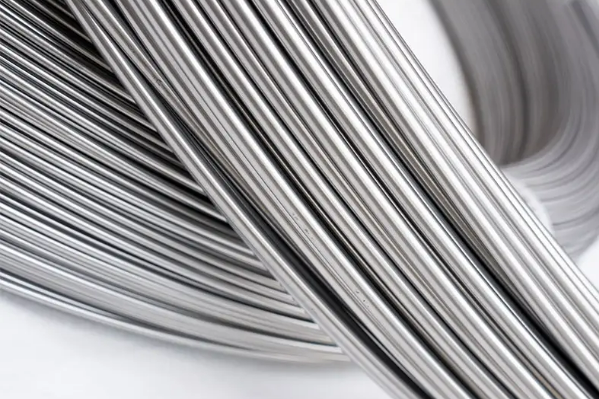
Shape memory alloys or SMAs are those types of alloys that always tend to ‘remember’ their original shape. This means that they remember their cold forged shapes and return to their pre-deformed or original shapes when they are heated. Some other names by which shape memory alloys are known are memory alloys, memory metal, smart metal smart alloys, etc. SMAs are generally lightweight and are used in a number of applications. The following are some uses and applications of shape memory alloys.
Related reading: Nitinol – Amazing Shape Memory Alloy
1. Main Applications of SMAs
Shape memory alloys are used in several industries such as aerospace industries to make aircraft, and engines, to reduce aircraft noise, etc.
• These smart alloys are also used in piping, for example, water pipes, oil line pipes, etc.
• Another use of shape memory alloys is in the automotive industry.
• These alloys are also used in robotics, telecommunication, optometry, dentistry, and medicine.
• Many engines are made using memory alloys and orthopedic surgery is another field where the can be applied.
2. Ni-Ti shape memory alloys
Ni-Ti shape memory alloys are those types of memory alloys that are made using nickel-titanium., in roughly equal amounts. Apart from these two elements, others that can be used to make shape memory alloys are copper, zinc, gold, and iron but Ni-Ti is the most common memory alloy. There are many reasons for using these two elements for making smart alloys, the major ones of which are given below:
• Ni-Ti shape memory alloys are preferable because they are stable, and practical and showcase superior thermo-mechanic performance as compared to other metals.
• The yield strength of Ni-Ti-based SMAs is less than that of steel but it is known that certain compositions can give a better yield than plastic and even aluminum. In fact, the yield stress of Ni-Ti can go to 500 MPa.
• Using Ni-Ti-based alloys can result in a high level of recoverable plastic strain induced.
3. Production of Ni-Ti SMAs
Ni-Ti, or nitinol, is very difficult to create or make. This is due to the exceptionally tight compositional control that is needed and due to the exceptionally high reactivity of titanium metal. The two main melting methods used today to obtain nitinol are:
• Vacuum Arc Remelting - this is a method in which an electrical arc is struck between the raw material and the water-cooled copper strike plate. This melting procedure is done in a high vacuum. The mold used in this procedure is water-cooled copper and no carbon is introduced during the melting process.
• Vacuum induction melting - this is a method of obtaining nitinol which is performed by using alternative magnetic fields so as to heat the raw materials in a crucible. This process too is performed by high vacuum but with the only difference that carbon is introduced into the process.
There is no evidence to prove which of these methods is better than the other and both have advantages of their own.
 Chin Trento