
 Products
 Bars
Bars
 Beads & Spheres
 Bolts & Nuts
 Crucibles
 Discs
Discs
 Fibers & Fabrics
 Films
Films
 Flake
Flake
 Foams
Foams
 Foil
Foil
 Granules
 Honeycombs
 Ink
Ink
 Laminate
 Lumps
Lumps
 Meshes
 Metallised Film
 Plate
Plate
 Powders
 Rod
Rod
 Single Crystals
 Sputtering Target
 Tubes
Tubes
 Washer
 Wires
Wires
 Converters & Calculators
 Write for Us



What is the Tungsten-alloy Mobile Phone Shielding Part?

The tungsten-alloy mobile phone shielding part is mainly used to shield a large number of high-energy electromagnetic radiation produced by mobile phones. The tungsten-alloy mobile phone shielding part has a small volume but a large specific gravity and can shield electromagnetic radiation effectively, which can be widely used in mobile phones to protect users from electromagnetic radiation.
Electromagnetic Radiation From Mobile Phones
The electromagnetic radiation from the mobile phone is a kind of electromagnetic energy, which is transmitted by radio waves or particles. The electromagnetic radiation of mobile phones is generated naturally by mobile phones and exists around us, and our lives are exposed to radiation from the earth, space, and our own bodies. Scientists think that a small number of electromagnetic radiations from mobile phones have no harm to the body, and we already know that radiation in the medical field has a very wide range of applications, which are mainly used for the treatment and diagnosis of some diseases.
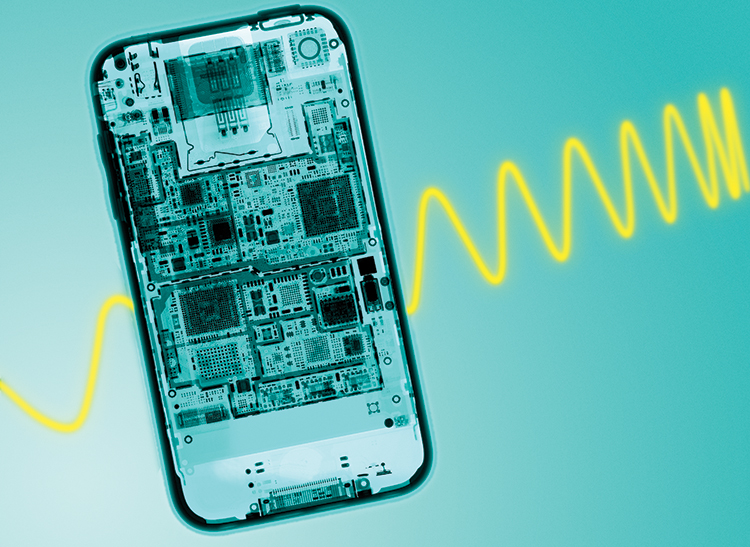
Nowadays, mobile phones are more and more popular, and the electromagnetic radiation produced by mobile phones is a problem that cannot be ignored. Mobile phones produce electromagnetic radiation because they rely on radio waves to send and receive signals. Although the amount of radiation from mobile phones is small and the radiation level is low, it still needs to be shielded. Scientists are now developing cellphone shielding, and the tungsten-alloy mobile phone shielding part is the best option in the field.
Tungsten-alloy Mobile Phone Shielding Parts
Due to its high density and small size, tungsten alloys are widely made into tungsten-alloy shielding parts to protect people from radiation. Besides that, tungsten alloy is a non-toxic and pollution-free material, the frame of the tungsten-alloy mobile phone shielding part is made of wear-resistant tungsten alloy materials, the abrasion resistance of which can ensure that the shield of mobile phones can keep good shielding even after many years. The tungsten-alloy phone shielding part is easy to install, and it can be securely attached to the phone.
Compared with traditional shielding materials such as lead and boron carbide, the smaller tungsten-alloy shielding parts with the same weight have a higher density. Compared with the lead shielding parts of the same weight, the tungsten-alloy shielding part is only 1/3 the volume of lead, but its high density makes it able to absorb as much radiation as the lead. Due to the high density of tungsten alloy, the thickness of the anti-radiation vessel of tungsten alloy is thinner, but the radiation absorption capacity is higher, and this is why tungsten alloy is the best raw material for tungsten-alloy mobile phone shielding parts.
Conclusion
Thank you for reading our article and we hope it can help you to have a better understanding of the tungsten-alloy mobile phone shielding part. If you want to learn more about W products, we would like to advise you to visit Stanford Advanced Materials (SAM) for more information.
Stanford Advanced Materials (SAM) is a worldwide supplier of tungsten metal and has over two decades of experience in the manufacture and sale of tungsten products, providing high-quality products to meet our customers' R&D and production needs. As such, we are confident that SAM will be your favorite tungsten supplier and business partner.
 Chin Trento