Products
 Bars
Bars
 Beads & Spheres
 Bolts & Nuts
 Crucibles
 Discs
Discs
 Fibers & Fabrics
 Films
Films
 Flake
Flake
 Foams
Foams
 Foil
Foil
 Granules
 Honeycombs
 Ink
Ink
 Laminate
 Lumps
Lumps
 Meshes
 Metallised Film
 Plate
Plate
 Powders
 Rod
Rod
 Single Crystals
 Sputtering Target
 Tubes
Tubes
 Washer
 Wires
Wires
 Converters & Calculators
 Write for Us



Characteristics and Applications of Silicon Carbide Ceramic Foam

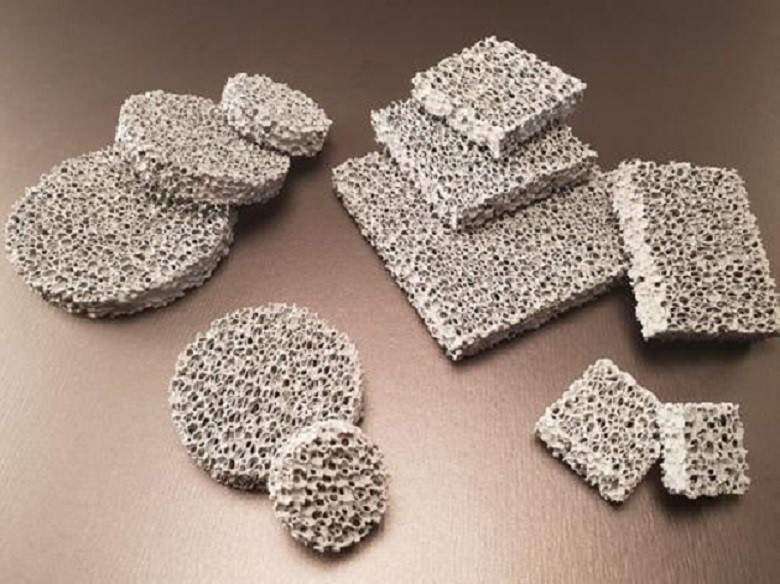
Ceramic foam is a porous ceramic that looks like foam. Currently, the materials for preparing ceramic foam mainly include ZrO2, Si3N4, Al2O3, SiC, etc. The most common is silicon carbide ceramic foam, which is currently the most promising inorganic high-temperature material. So, in this article, let's take a look at the characteristics and applications of silicon carbide ceramic foam.
Characteristics of Silicon Carbide Ceramic Foam
The development of silicon carbide ceramic foam began in the 1970s. As a new inorganic non-metallic filter material with many pores in its internal structure, it has the advantages of a lightweight, high strength, high-temperature resistance, corrosion resistance, simple regeneration, long service life, and good filter adsorption.
- Silicon carbide ceramic foam can be sintered and compacted under atmospheric pressure and can be compacted without high pressure and inert atmosphere, which reduces the production cost of enterprises.
- Generally, adding suitable sintering aids reduces the sintering temperature of the silicon carbide ceramic foam. During normal pressure sintering, it can reduce the oxidation of SiC on the surface of the ceramic foam and improve the overall performance of the ceramic foam.
- Silicon carbide ceramic foam is not easy to be corroded by acid and alkali when filtering liquid, and will not pollute the filtered metal liquid. In addition, after use, it can be reused without reducing filtration efficiency, which greatly reduces enterprise costs.
- Its molding processing performance is also good. Diamond tools can easily cut it off, and diamond wheels can be used when grinding is needed. The silicon carbide ceramic foam can be easily processed into the required shape by changing the processing conditions.
Applications of Silicon Carbide Ceramic Foam
Catalyst Carrier
Silicon carbide ceramic foam has the advantages of higher porosity, thermal conductivity, mechanical strength, oxidation resistance, and corrosion resistance. Its surface is uneven and has many micropores. This special network structure greatly increases the contact area of the two phases.
All these characteristics make silicon carbide ceramic foam become a new generation of catalyst carriers to replace traditional silica, alumina ceramics, and activated carbon.
Filters
Silicon carbide ceramic foam has the characteristics of low-pressure loss, heat resistance, thermal shock resistance, and high oil fume collection efficiency, making it very promising as a filter for diesel engine oil fume collectors.
Applications in Biology
Silicon carbide ceramic foam material has good biocompatibility and controllable pore size, which can be used for the repair of complex shapes and long load-bearing bone defects.
Sound-Absorption Material
Silicon carbide foam ceramics can be used for sound absorption and noise reduction due to its unique network structure.
Applications in the Chemical Industry
Silicon carbide ceramic foam can be used as a foam structure packing, and also as a foam tray. It can also be used in steam generators, high-pressure adiabatic burners, radiation burners, etc. in the chemical industry, which greatly improves the heat transfer coefficient and strengthens the combustion process.
Other Applications
Silicon carbide ceramic foam can also be used in fields such as materials for the heat treatment of electronic components, fluidized bed bottom plates, humidifiers, water boilers, and microbial carriers.
Conclusion
Thank you for reading our article and we hope it can help you to have a better understanding of the characteristics and applications of silicon carbide ceramic foam. If you want to learn more about silicon carbide ceramic foam, we would like to advise you to visit Stanford Advanced Materials (SAM) for more information.
As a leading supplier of silicon carbide ceramic foam across the world, SAM enjoys over two decades of experience in the manufacture and sale of silicon carbide ceramic foam, offering customers high-quality silicon carbide ceramic foam filters to meet their R&D and production needs. As such, we are confident that SAM will be your favorite silicon carbide ceramic foam supplier and business partner.
 Chin Trento