Products
 Bars
Bars
 Beads & Spheres
 Bolts & Nuts
 Crucibles
 Discs
Discs
 Fibers & Fabrics
 Films
Films
 Flake
Flake
 Foams
Foams
 Foil
Foil
 Granules
 Honeycombs
 Ink
Ink
 Laminate
 Lumps
Lumps
 Meshes
 Metallised Film
 Plate
Plate
 Powders
 Rod
Rod
 Single Crystals
 Sputtering Target
 Tubes
Tubes
 Washer
 Wires
Wires
 Converters & Calculators
 Write for Us



Critical Materials for Vacuum Ultraviolet (VUV) Filter

Vacuum ultraviolet (VUV) optics occupy a small but fast-expanding niche in modern-day photonics. We will discuss the critical materials that find application in VUV filters, including thin-film coatings and bulk window substrates. Hope that you can have a better understanding of how the selection of material has a direct impact on filter performance and long-term reliability.
The Challenge of VUV Transparency
Before going into materials, mention should be made of why VUV optics are so specifically difficult. For the majority of material in this wavelength range, electronic transitions are so near to the photon energy of VUV radiation that there is heavy absorption. It is only in some crystalline fluorides and some coatings that one can realistically transmit as high as 120 nm or lower. At the same time, these materials need to be resistant to high-energy radiation, potential exposure to reactive conditions, and thermal cycling in high-power optical systems. The field thus becomes a limited set of candidates.
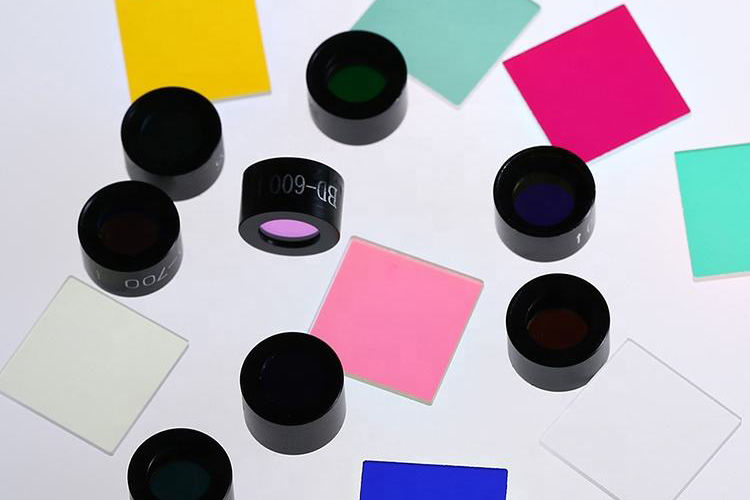
Fluoride Crystals as Window Substrates
Of bulk window materials, the alkaline-earth and alkali halide fluorides are dominant. They have wide bandgaps that allow them to transmit well into the VUV, but offer comparatively stable physical and mechanical properties.
--Magnesium Fluoride (MgF₂):
MgF₂ is one of the most widely used VUV window materials. It is transmitted down to about 115 nm and can be utilized in a majority of spectroscopy and lithography systems. MgF₂ has adequate mechanical strength and resistance to moisture, making it more robust compared to other fluoride crystals. Its relatively moderate refractive index also simplifies anti-reflective coating design.
--Lithium Fluoride (LiF):
LiF extends transmission down to as low as nearly 105 nm and is optimally suited to extreme VUV application. However, it is hygroscopic, readily absorbs water, and deteriorates at humid temperatures. LiF is softer and more fragile than MgF₂ and is not ideally suited for harsh environments or permanent installations except when well shielded.
--Calcium Fluoride (CaF₂):
CaF₂ is better known for deep ultraviolet (DUV) rather than true VUV application, passing up to ~125 nm. It is extremely prevalent, relatively cheap, and less moisture-sensitive than LiF. It doesn't penetrate as far into the VUV as LiF or MgF₂, but it's still used in cost, durability, and transparency-balanced systems.
Other substances such as barium fluoride (BaF₂) and strontium fluoride (SrF₂) also occur in certain uses, though they are not as desirable with increased solubility and reactivity towards the surroundings.
Further reading: Common Fluoride Materials in Industrial Applications
Thin-Film Materials for VUV Filters
While substrates define the transparent substrate, thin-film coatings define the spectral selectivity of VUV filters. Constructing effective multilayer stacks in this part of the spectrum is notoriously difficult because very few materials possess low absorption combined with high refractive index contrast.
- Fluoride Coatings:
MgF₂, LiF, and CaF₂ thin films are generally used as low-index layers. They transfer the extended transmission character of their bulk counterparts to thin-film stacks to help create bandpass or edge filters.
- Aluminum (Al):
Aluminum is frequently utilized as a reflective coating for VUV mirrors but can also be part of filter design. Under an overcoat, Al is effective in reflecting in the VUV, allowing for mirror-based bandpass filters.
- Silicon Dioxide (SiO₂):
For the VUV, SiO₂ is limited since its absorption edge is around 160 nm. Still, it can be included in hybrid filter structures in cases where there are no performance requirements into the deepest wavelengths.
The greatest challenge is achieving equilibrium between film quality and control of layer thickness. Any slight thickness variations or microstructural defects will introduce substantial changes in filter transmission curves, given the small wavelengths involved. Fabricators must thus use ultra-high vacuum deposition equipment and advanced monitoring techniques in an attempt to make it reproducible.
Applications Determining Material Choice
The choice of whether to use MgF₂, LiF, CaF₂, or thin-film stacks depends heavily on application.
- Spectroscopy: The deepest cut-off windows are required by VUV absorption spectroscopy. LiF is widely used, with control of humidity being the only requirement.
- Semiconductor Lithography: Nanometer feature sizes demand the use of extreme ultraviolet (EUV) and VUV optics. MgF₂ and CaF₂ windows with fluoride thin films provide hard, low-defect filters for this demanding market.
- Astronomy: VUV spectrometers and space telescopes utilize MgF₂-coated optics, where deep transmission is matched with vacuum stability over the long term.
- Plasma Diagnostics: The ability of VUV filters to isolate emission lines when studying plasma is made possible through the use of MgF₂ and heavy multilayer coatings.
Conclusion
The technology of VUV filters is directly linked to material science. Few substances—essentially fluoride crystals and thin films—are resistant to the harsh conditions of this region of the spectrum.
Magnesium fluoride provides hardness and long-term usability, lithium fluoride allows for maximum transparency, and calcium fluoride offers a realistically optimal mix of cost and performance. For more information, please check Stanford Advanced Materials (SAM).
 Chin Trento