
 Products
 Bars
Bars
 Beads & Spheres
 Bolts & Nuts
 Crucibles
 Discs
Discs
 Fibers & Fabrics
 Films
Films
 Flake
Flake
 Foams
Foams
 Foil
Foil
 Granules
 Honeycombs
 Ink
Ink
 Laminate
 Lumps
Lumps
 Meshes
 Metallised Film
 Plate
Plate
 Powders
 Rod
Rod
 Single Crystals
 Sputtering Target
 Tubes
Tubes
 Washer
 Wires
Wires
 Converters & Calculators
 Write for Us



Gas Diffusion Layers: Why Fiber Felts Are the Preferred Choice

Gas diffusion layers (GDLs) are critical elements in fuel cells and electrolyzers. They enable efficient transport of gases, electrons, and liquids between the flow channels and the catalyst. Fiber felts are the preferred option because they represent the ideal combination of conductivity, porosity, and flexibility.
What Are Gas Diffusion Layers?
Gas diffusion layers are porous materials placed between the catalyst layer and the flow field in electrochemical devices. Their primary function is to enable uniform delivery of reactant gases to the catalyst surface while enabling efficient evacuation of product gases. In fuel cells, GDLs manage hydrogen and oxygen transport to maximize electrochemical reactions and minimize concentration losses. In electrolyzers, they assist in effectively evacuating hydrogen and oxygen gases generated at the electrodes.
Besides gas transport, GDLs also provide mechanical support for the catalyst layer and are involved in water management. Uniform distribution of water avoids flooding or drying of the catalyst, both of which can severely reduce performance. Electrical conductivity is also a significant function, whereby GDLs conduct electrons between the catalyst and external circuits. With such demands, the material choice of GDLs is essential to device efficiency and longevity in the long term.
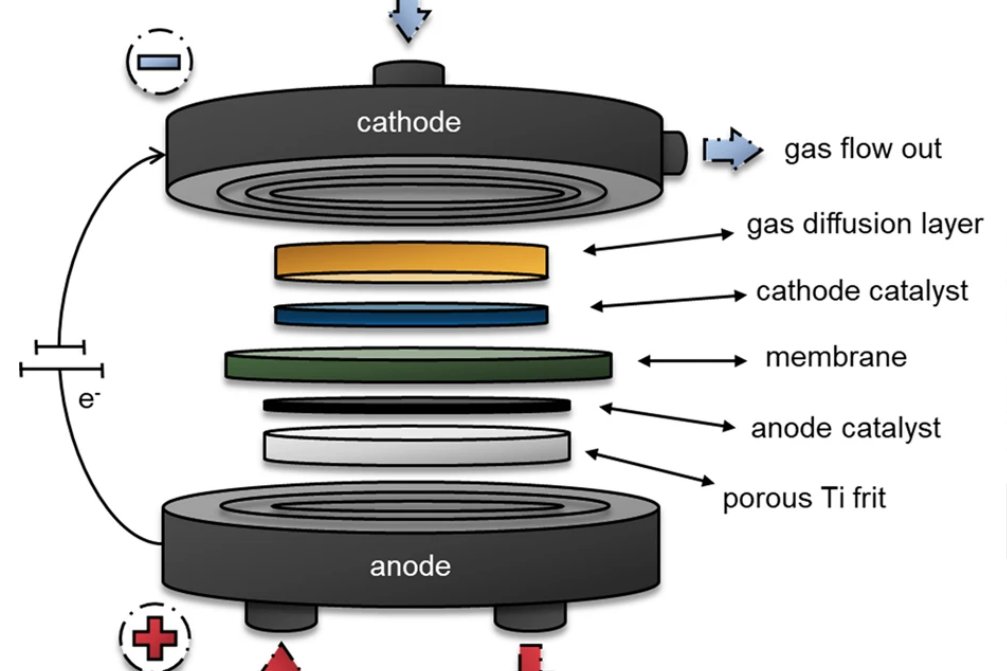
Fig. 1 Schematic illustration of the zero-gap electrolyzer cell [1]
What Are Fiber Felts?
Fiber felts are nonwoven mats that are formed by entangling fibers into a highly porous network. They are typically made of carbon, which are characterized by their electrical conductivity and chemical stability. Fibers within a felt are randomly oriented, forming a three-dimensional structure that offers interconnected paths to gases and liquids. The structure differs from that of woven fabrics or carbon papers and imparts higher porosity and flexibility with maintained mechanical strength.
The production process of fiber felts binds the fibers through heating, pressure, or resin treatments to create mats with engineered thickness, density, and permeability. Carbon felts are exceptionally suited for electrochemical environments due to the fact that they are inert, high-temperature-resistant, and corrosion-resistant.
Why Are Fiber Felts Ideal for Gas Diffusion Layers?
Fiber felts offer a balance of properties that makes them extremely appropriate for use as GDLs. One of the most important properties is that they have high gas permeability and porosity, which allows reactant gases to be distributed evenly to the catalyst layer while product gases can be expelled effectively. This allows concentration polarization to be minimized and electrochemical efficiency to be high.
One other key advantage is excellent electrical conductivity. Carbon fiber felts provide low resistance paths for electrons, facilitating efficient current collection and distribution across the catalyst surface. Chemical stability is also significant; fiber felts are resistant to corrosion and degradation in aggressive acidic or alkaline environments, which are common in fuel cells and electrolyzers.
Mechanical flexibility is also an important factor. Felts composed of fibers can be compressed for close contact with the catalyst and flow field without cracking or degradation of structural integrity. Compressibility provides for thermal expansion and mechanical stresses during operation for long-term performance.
In fuel cells, they manage water. They spread water evenly, prevent flooding, and provide optimum catalyst hydration. In electrolyzers, they provide the rapid release of hydrogen and oxygen bubbles with a minimal accumulation of bubbles, making high efficiency possible at high current densities.
Where to Use Fiber Felts for Gas Diffusion Layers?
Fiber felts have the biggest use in fuel cells and water electrolyzers, where water management and gas transport are crucial. In PEM fuel cells, fiber felts are employed as GDLs for uniform delivery of hydrogen and oxygen to the catalyst layer and for the free exit of water. In alkaline or PEM electrolyzers, fiber felts are employed for effective release of hydrogen and oxygen bubbles from the surfaces of electrodes in order to facilitate high current density operation. Besides these, the fiber felts are applied in unitized regenerative fuel cells, redox flow batteries, and other electrochemical reactors where uniform gas and liquid distribution, chemical and mechanical stability, are essential for high performance.
List of Fiber Felt Materials
Titanium, nickel, and stainless steel fiber felts each offer distinct advantages for gas diffusion layers. Titanium felt is prized in PEM electrolyzers and fuel cells for its high porosity, strength, and excellent resistance to acidic environments. With customizable size and porosity, it ensures stable performance and efficient gas release even at high current densities. Nickel felt, known for its conductivity and resistance to alkaline corrosion, is widely used on the cathode side of alkaline electrolyzers and in some fuel cells to promote hydrogen generation. Stainless steel felt, though less corrosion resistant, combines durability, wear resistance, and lower cost, making it a practical choice for large electrolyzers and flow batteries where mechanical strength is critical.
|
Feature / Material |
Titanium (Ti) |
Nickel (Ni) |
Stainless Steel (SS) |
|
Properties |
High porosity, strong acid resistance |
High conductivity, alkali resistant |
Strong, wear-resistant, lower cost |
|
Applications |
PEM electrolyzers (anode), fuel cells |
Alkaline electrolyzers (cathode), some fuel cells |
Large electrolyzers, flow batteries |
|
Advantages |
Stable at high current, corrosion proof |
Efficient hydrogen release |
Durable, economical alternative |
Conclusion
Gas diffusion layers contribute significantly to the performance and lifespan of fuel cells and electrolyzers. Among the prospective materials, fiber felts stand out for their high porosity, electrical conductivity, chemical stability, and mechanical flexibility. For more advanced materials, please check Stanford Advanced Materials (SAM).
Reference:
[1] Samu AA, Szenti I, Kukovecz Á, Endrődi B, Janáky C. Systematic screening of gas diffusion layers for high performance CO2 electrolysis. Commun Chem. 2023 Feb 24;6(1):41. doi: 10.1038/s42004-023-00836-2. PMID: 36828885; PMCID: PMC9958001.
 Chin Trento