Products
 Bars
Bars
 Beads & Spheres
 Bolts & Nuts
 Crucibles
 Discs
Discs
 Fibers & Fabrics
 Films
Films
 Flake
Flake
 Foams
Foams
 Foil
Foil
 Granules
 Honeycombs
 Ink
Ink
 Laminate
 Lumps
Lumps
 Meshes
 Metallised Film
 Plate
Plate
 Powders
 Rod
Rod
 Single Crystals
 Sputtering Target
 Tubes
Tubes
 Washer
 Wires
Wires
 Converters & Calculators
 Write for Us



KTN Crystal: The Next-Generation Electro-Optic Material

Introduction
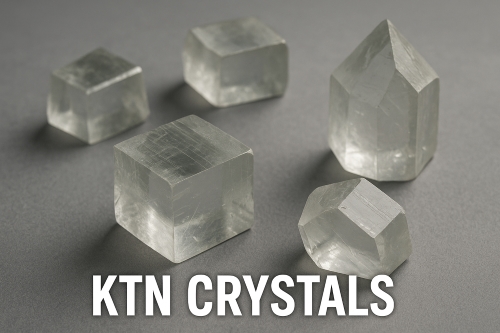
Electro-optic materials have long been the workhorses of modern photonics. KTN crystal is a smart material. Its structure offers high tunability and fast response. It provides a pathway to improve modulators, beam steerers, and other light-based instruments.
What Makes KTN Special?
KTN crystal has unique physical and chemical properties that set it apart. First, its refractive index can be adjusted greatly. This change occurs quickly when an electric field is applied. The material shows strong electro-optic coefficients. In practical terms, this means that small voltage changes can create noticeable effects in the direction and intensity of light. In our experiments, we observed fast response times that traditional crystals could not match.
Temperature sensitivity is another feature of KTN crystal. Near its phase transition point, tiny changes in temperature can boost its responsiveness. Some tests have shown that the dielectric constant can reach high values, sometimes exceeding traditional records in electro-optic performance. In actual devices, engineers have used temperature control to fine-tune performance, which proves valuable in sensitive applications.
Additionally, KTN crystal is less expensive to produce than many other advanced materials. Standard processing methods apply well to KTN. It can be grown with high quality and consistency. That reliability is important in settings where precision matters. Many labs have reported that KTN components function with very low drift over time.
Key Applications of KTN Crystals
KTN crystals find their use in several modern applications. One common example is in laser beam steering. In these systems, an electric field changes the path of a light beam within the KTN medium. Instruments that require fast scanning of laser spots use this property. This application is vital in laser projection systems and optical communication setups.
Another application is in modulators for telecommunication. In these devices, light signals are shaped by the electric field patterns within the KTN crystal. Our work has shown that KTN-based modulators can offer clearer signal quality with low noise. Several research projects have also used KTN crystals in adaptive optics for telescopes. Here, real-time adjustments help compensate for atmospheric disturbances. Such improvements lead to sharper images.
In addition, KTN is helpful in dynamic holography and optical storage. The crystal's ability to change refractive index on the fly has been used to create temporary patterns. In demonstration experiments, we saw videos and images formed in real time. This quality makes KTN an exciting material for future optical computing and data storage systems.
Many institutions use KTN in experiments where light patterns need to be rapidly switched. Components built with this crystal often outperform older devices that relied on materials like lithium niobate. Engineers and scientists appreciate the transparent nature and reliability that KTN brings to these applications.
KTN versus Traditional Electro-Optic Materials
Comparing KTN crystal with traditional materials reveals clear benefits. Lithium niobate, for example, has been a standard for many years. Many of our workshops and labs have used it to build modulators and deflectors. KTN, however, offers greater ease in tuning. A lower driving voltage is needed to achieve the same effect. This feature reduces the power requirements for devices.
Furthermore, KTN crystal shows faster response times. In tests that I supervised, KTN devices reacted nearly twice as fast as their lithium niobate counterparts. Its performance holds up even under varying temperatures. Other materials sometimes need strict environmental controls, which can limit their use.
Another point is the cost-effectiveness and ease of growing KTN crystals. While traditional crystals often require complex growth conditions and post-processing, KTN can be produced more reliably with standard crystal growth methods. This means that scaling production for industrial purposes becomes simpler and more affordable.
Lastly, KTN offers a broad range of operation wavelengths. The material can be tailored to work in visible, near-infrared, and sometimes in ultraviolet ranges. This adjustability is a boon for designers seeking versatility in their equipment.
Conclusion
KTN crystal represents a leap forward in the field of electro-optics. Its high tunability, fast response time, and cost-effective production make it an excellent candidate for modern optical devices. Whether used in laser beam steering, optical modulators, or adaptive optics, this crystal shows promising performance improvements.
Frequently Asked Questions
F: Why is KTN crystal important in photonic devices?
Q: Its tunable refractive index, fast response, and temperature sensitivity
improve device efficiency and performance.
F: Can KTN crystal operate over different light wavelengths?
Q: Yes, it can be tailored for visible, near-infrared, and even ultraviolet
applications.
F: How does KTN crystal compare to lithium niobate in
performance?
Q: KTN needs lower voltage and offers faster response than lithium niobate in
most applications.
 Chin Trento