Products
 Bars
Bars
 Beads & Spheres
 Bolts & Nuts
 Crucibles
 Discs
Discs
 Fibers & Fabrics
 Films
Films
 Flake
Flake
 Foams
Foams
 Foil
Foil
 Granules
 Honeycombs
 Ink
Ink
 Laminate
 Lumps
Lumps
 Meshes
 Metallised Film
 Plate
Plate
 Powders
 Rod
Rod
 Single Crystals
 Sputtering Target
 Tubes
Tubes
 Washer
 Wires
Wires
 Converters & Calculators
 Write for Us



Advantages of Honeycomb Ceramic Filters

Honeycomb ceramic filter is widely used in the filtration of molten metal in the metallurgy and foundry industries. The honeycomb ceramic filter is made of mullite ceramic material with high-quality and high-density straight-hole mesh, which makes it have high thermal shock resistance and high sintering temperature resistance. Its straight hole design ensures the balance between flow and strength, effectively removes impurities and slag particles, etc., greatly improving the mechanical properties, surface quality, and product qualification rate of the casting. In this article, we'll take a closer look at the advantages of honeycomb ceramic filters.
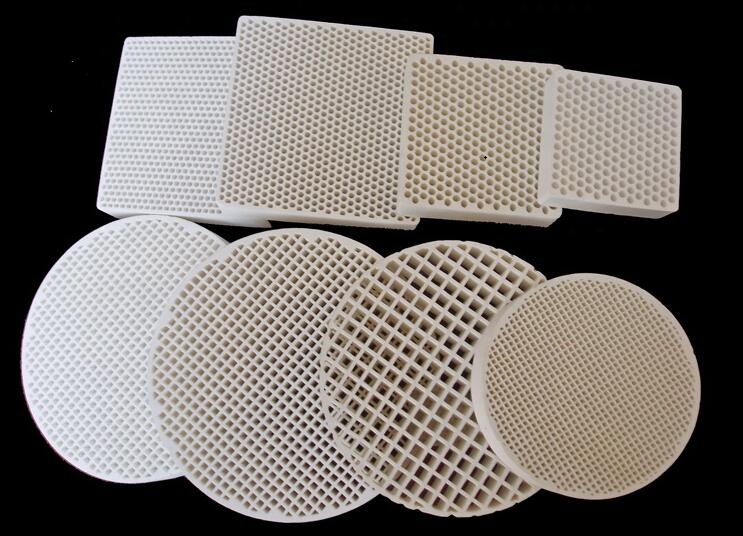
Advantages of Honeycomb Ceramic Filters
- Honeycomb ceramic filter has very high temperature working strength, thermal shock resistance, and resistance to metal flow impact. It does not have any slag drop or cracking phenomenon during work, which ensures the filtering quality of molten metal.
- Honeycomb ceramic filter has extremely high room temperature strength and resistance to mechanical shock. There is no crack or damage during use and transportation, which greatly facilitates the use and operation of the filter.
- Honeycomb ceramic filter has a very significant filtering effect. The performance of the ceramic filter is obviously better than that of the fiber filter. The fiber filter is not as good as the ceramic filter in terms of filtering effect, reducing the turbulent flow of molten metal, and high-temperature strength. The ceramic filter is the best type of filter chosen by foundry manufacturers from the aspects of practicability, reliability, quality, and price to eliminate defects in castings.
- Honeycomb ceramic filter can effectively reduce the turbulence of molten metal caused by pouring, smooth the filling, and avoid surface defects of the casting.
- Honeycomb ceramic filter has a large metal flow rate, and the flow rate is stable, unlike the foam ceramic filter, whose flow rate gradually decreases with the increase of the number of captured inclusions. Even if there are many inclusions in the molten metal, normal use will not cause blockage of the honeycomb ceramic filter.
- The honeycomb ceramic filter has high chemical stability, is not affected by the acidity and alkalinity of the molten metal, and does not change the chemical composition of the molten metal.
- The honeycomb ceramic filter has a very high dimensional accuracy and can be used in a production line where the filter is automatically placed.
Conclusion
Thank you for reading our article and we hope it can help you to have a better understanding of the advantages of honeycomb ceramic filters. If you want to learn more about honeycomb ceramic filters, we would like to advise you to visit Stanford Advanced Materials (SAM) for more information.
As a leading supplier of honeycomb ceramic filters across the world, SAM enjoys over two decades of experience in the manufacture and sale of honeycomb ceramic filters, offering customers high-quality honeycomb ceramic filters to meet their R&D and production needs. As such, we are confident that SAM will be your favorite honeycomb ceramic filters supplier and business partner.
 Chin Trento