Products
 Bars
Bars
 Beads & Spheres
 Bolts & Nuts
 Crucibles
 Discs
Discs
 Fibers & Fabrics
 Films
Films
 Flake
Flake
 Foams
Foams
 Foil
Foil
 Granules
 Honeycombs
 Ink
Ink
 Laminate
 Lumps
Lumps
 Meshes
 Metallised Film
 Plate
Plate
 Powders
 Rod
Rod
 Single Crystals
 Sputtering Target
 Tubes
Tubes
 Washer
 Wires
Wires
 Converters & Calculators
 Write for Us



Where Zirconium is Found on Earth

Discovery history of zirconium
Zircon has been used by humans as jewelry for centuries. Zircon is also mentioned in the Bible, calling it one of the 12 Precious Stones worn by the high priest in Israel.
Zircon has a variety of beautiful colors from orange to red, and colorless zircon will show brilliant brilliance after cutting. It is for this reason that zircon has been mistaken for a soft diamond for a long time.
The discovery and extraction of zirconium are mainly attributed to the two chemists, German chemist Martin Heinrich Klaproth and the Swedish chemist Jöns Jacob Berzelius, the two chemists have made extraordinary contributions in the purification of zirconium.
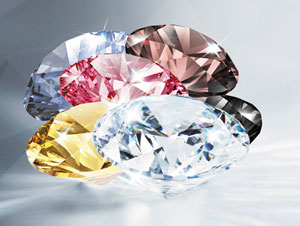
In 1789, German chemist Martin proved that zircon was not a diamond, clarifying the misconceptions about zircon. By heating the zircon with the reactive compound sodium hydroxide, he found that they reacted to form an oxide. Martin thought the oxide contained a new element. He named the new oxide Yttria Stabilized Zirconia, and the new element named zirconium.
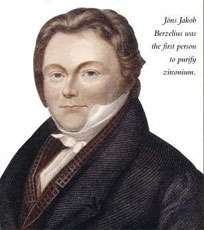
Martin was unable to extract pure zirconium because it was similar to the chemical properties of hafnium, hafnium was often found in zirconium ores with zirconium. It was not until 35 years later, in 1824, Beche Leigh Aas, a Swedish chemist, first extracted pure zirconium. At that time, there were several chemists who were also involved in the work, but none of them succeeded. Beche Leigh Aas successfully extracted pure zirconium by heating the mixture of potassium and potassium fluoride in an iron tube. The purity of the black powder zirconium was 93%. It was not until 100 years later that high purity zirconium was prepared. Today, most of the zirconium is extracted from zircon (ZrSiO4) and ZrO2, and the extraction process is known as the Kroll Process.
Zirconium's name source
Zircon comes from the Persian "Zargun". It is said that zircon jewelry is a very eye-catching color. In fact, there are many colors of zircon, red, brown, green, and yellow are common, colorless zircon is also common.
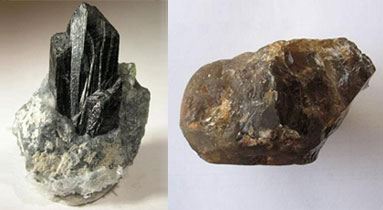
Global reserves of zirconium resources
Currently, more than 40 kinds of zirconium and hafnium deposits have been found, only 10 kinds of zirconium have mining industry value, only zircon and baddeleyite are used for industrial production.
According to the U.S. Geological Survey (USGS) statistics in 2015, there are 78 million tons of zirconium reserves around the world, zircon resource volume is over 60 million tons (ZrO2), Australia and South Africa have the largest share of reserves of zirconium, accounted for respectively 65.38% and 17.95%. Other zirconium reserves are relatively abundant in countries such as India, Mozambique, and Indonesia.
Global zirconium production
According to data released by the US Geological Survey in 2015, the global zirconium output was 1 million 540 thousand tons in 2014, a decrease of 30 thousand tons. Australia ranks first in the world with 900 thousand tons of output, accounting for 58.44% of the world's total output.
 Chin Trento