
 Products
 Bars
Bars
 Beads & Spheres
 Bolts & Nuts
 Crucibles
 Discs
Discs
 Fibers & Fabrics
 Films
Films
 Flake
Flake
 Foams
Foams
 Foil
Foil
 Granules
 Honeycombs
 Ink
Ink
 Laminate
 Lumps
Lumps
 Meshes
 Metallised Film
 Plate
Plate
 Powders
 Rod
Rod
 Single Crystals
 Sputtering Target
 Tubes
Tubes
 Washer
 Wires
Wires
 Converters & Calculators
 Write for Us



Magnetron Sputtering: The Most Common PVD Method

This article is part of the PVD Basics series. Start here or view all articles.
The Short Answer
Magnetron sputtering is the most widely used PVD method in production environments. It works by creating a plasma near a target material (the source), then using magnets to trap electrons close to the target surface. This makes the plasma denser, enabling deposition at lower pressures and higher rates than with simple sputtering.
If you work in semiconductor manufacturing, optical coating production, or hard coating applications, you have almost certainly used magnetron sputtering.
How It Works
Magnetron sputtering builds on basic sputtering with one key addition: magnets.
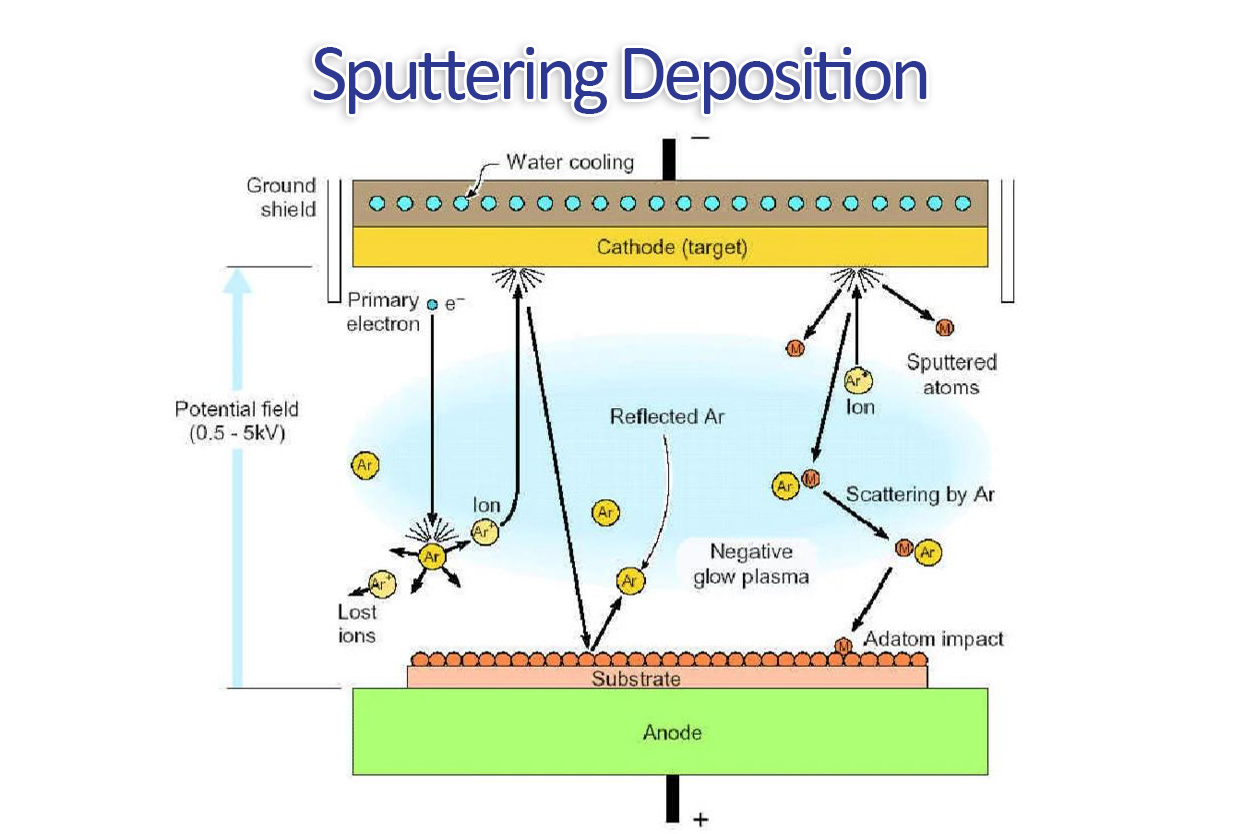
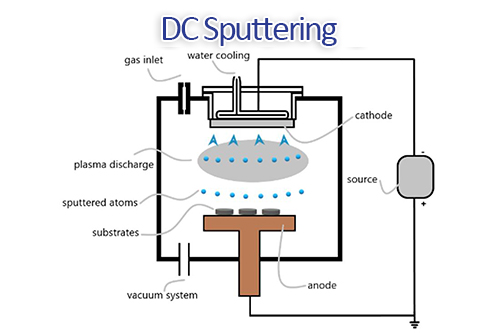
Basic sputtering (without magnets). You apply a high voltage between a target (cathode) and the substrate (anode) in a low-pressure gas environment—usually argon. The voltage ionizes the argon gas. The positive argon ions accelerate toward the negatively charged target and knock atoms off its surface. Those atoms travel to the substrate and form a thin film.
The problem: most of the electrons released from the target escape immediately. The plasma stays weak. Deposition rates are low.
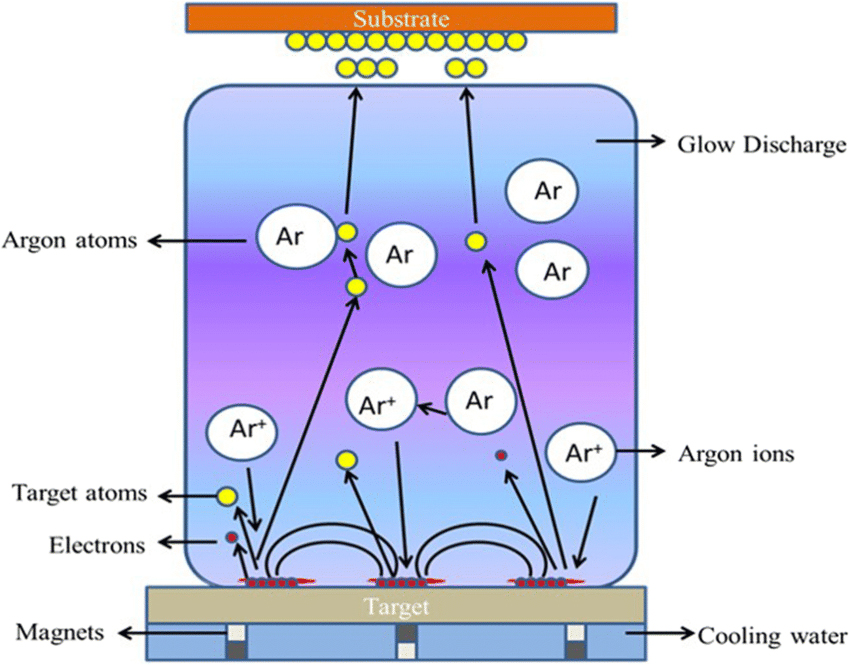
Magnetron sputtering adds magnets. A strong magnet array behind the target creates a magnetic field that traps electrons close to the target surface. Trapped electrons ionize more argon atoms. More argon ions hit the target. More target atoms are knocked loose.
The result: deposition rates increase by a factor of 10 to 100 compared to simple sputtering. You can also operate at lower pressures—down to 10^-3 Torr instead of 10^-1 Torr—which means fewer gas collisions and cleaner films.
Gupta, Jyothi & Shaik, Habibuddin & Kumar, Kilari. (2021). A review on the prominence of porosity in tungsten oxide thin films for electrochromism. Ionics. 27. 1-28. 10.1007/s11581-021-04035-8.
The Erosion Track Problem
The magnetic field is not uniform. It is strongest in a closed loop on the target surface. Electrons trap there. Plasma concentrates there. Erosion happens there.
This creates a characteristic racetrack—a ring-shaped erosion groove on the target surface.
What this means for you:
-
Target utilization is limited. A typical planar magnetron target uses only 25% to 35% of its material before the erosion reaches the backing plate.
-
The rest of the target is untouched. You throw it away.
-
This is the main downside of magnetron sputtering. Rotary targets solve this problem but come with their own trade-offs.
Key Parameters That Matter
If you are specifying or operating a magnetron sputtering system, these are the parameters you need to control.
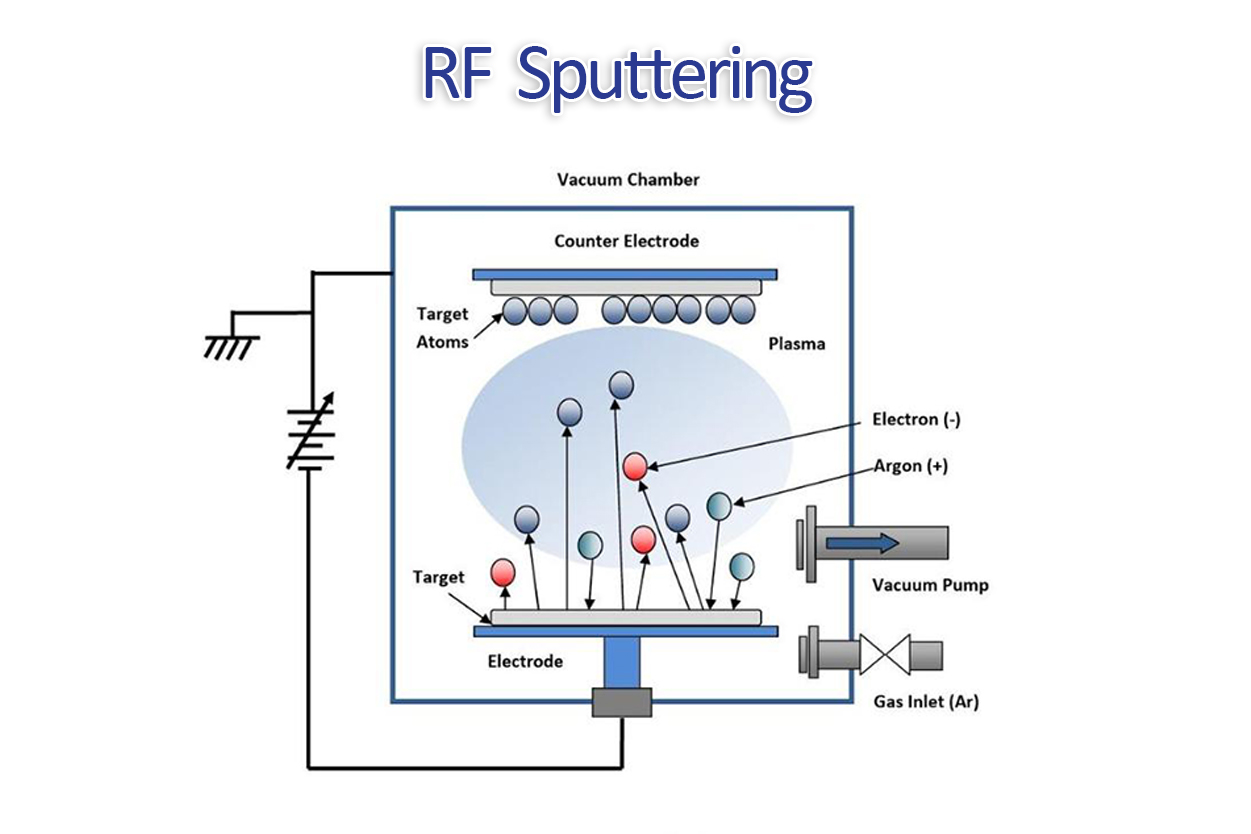
Power supply type. DC power works for conductive targets (metals). RF power works for insulating targets (ceramics, oxides). Pulsed DC is a compromise that works for reactive sputtering. Each has its own article in this series.
Pressure. Typical operating pressure for magnetron sputtering is 2 to 20 mTorr. Lower pressure gives fewer gas collisions and denser films, but slower deposition. Higher pressure gives more scattering and less directional deposition.
Target material. Purity, grain size, and density all affect film quality. A porous target spits particles. A coarse-grained target erodes unevenly.
Substrate bias. Applying a negative voltage to the substrate attracts positive ions during deposition. This densifies the film and improves adhesion but can also increase film stress.
Advantages of Magnetron Sputtering
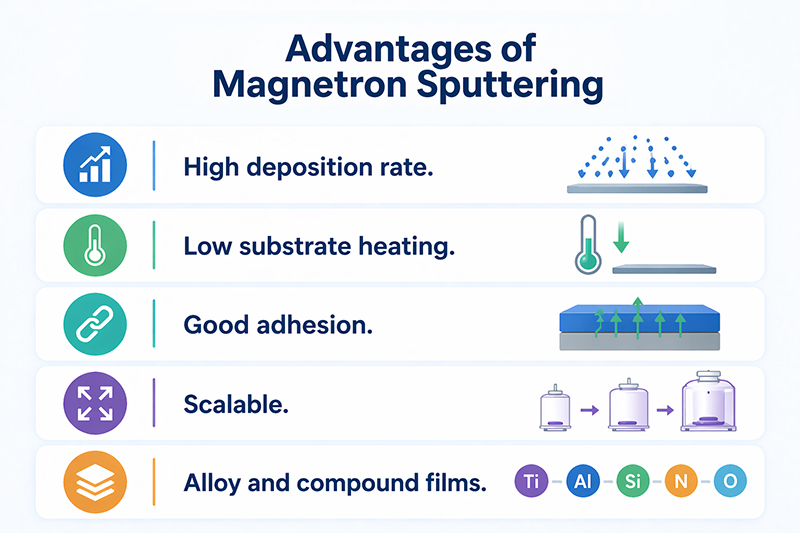
High deposition rate. The magnetic confinement makes magnetron sputtering much faster than other sputtering methods.
Low substrate heating. Most of the energy stays in the plasma near the target, not the substrate. You can deposit films onto temperature-sensitive materials like plastics.
Good adhesion. Sputtered atoms arrive with higher energy than evaporated atoms, which means better film adhesion.
Scalable. Magnetron sputtering works for small research samples and large production runs. Single targets range from 1 inch to 10 feet in length.
Alloy and compound films. You can sputter from alloy targets and get the same composition in the film. You can also introduce reactive gases (oxygen, nitrogen) to form oxides or nitrides.
Limitations
Target utilization is poor. The racetrack effect wastes most of the target. This is the single biggest complaint about planar magnetron sputtering.
Line-of-sight deposition. Like all PVD methods, magnetron sputtering is a line-of-sight process. It cannot coat the back sides of complex shapes or deep trenches effectively.
Particle generation. Arcing or target defects can generate particles that land on the substrate and cause defects. This is a major concern in semiconductor manufacturing.
Insulating targets require RF. You cannot DC sputter an insulator. You need RF power, which is more expensive and less efficient.
Common Applications
Semiconductors. Magnetron sputtering deposits metal layers (aluminum, copper, titanium, tantalum) and diffusion barriers (TiN, TaN) in chip manufacturing.
Optical coatings. Anti-reflective coatings, mirrors, and filters are often made by magnetron sputtering because of the film density and thickness control.
Hard coatings. TiN, CrN, and DLC coatings on cutting tools and molds are applied by magnetron sputtering.
Decorative coatings. The gold, black, and rainbow colors on watch cases, faucets, and automotive trim are often magnetron-sputtered.
Solar cells. Transparent conductive oxides (ITO, AZO) and metal contacts in thin-film solar cells use magnetron sputtering.
Magnetron Sputtering vs Other PVD Methods
|
Method |
Deposition Rate |
Film Density |
Substrate Temperature |
Target Utilization |
|
Magnetron Sputtering |
High |
High |
Low to moderate |
Poor (25-35%) |
|
Diode Sputtering (no magnets) |
Low |
High |
Low |
Better (~50%) |
|
Evaporation |
Very high |
Moderate |
Low to none |
N/A (material in crucible) |
|
Ion Beam Sputtering |
Very low |
Very high |
Low |
Low |
For production environments where speed matters, magnetron sputtering wins. For research or applications requiring extremely smooth films with no particles, ion beam sputtering may be better—but much slower.
The Bottom Line
Magnetron sputtering is the default PVD method for a reason. It is fast, versatile, and works on everything from 2-inch research wafers to 10-foot architectural glass panels.
The main drawback—poor target utilization—is a real cost. But for most production applications, the speed and film quality justify the waste. If target utilization is your primary concern, consider rotary targets (covered in a separate article).
Otherwise, start here. Magnetron sputtering is the most common PVD method because for most jobs, it is simply the right tool.
Brought to you by Stanford Advanced Materials, a supplier of sputtering targets and evaporation materials.
 Dr. Samuel R. Matthews