
 Products
 Bars
Bars
 Beads & Spheres
 Bolts & Nuts
 Crucibles
 Discs
Discs
 Fibers & Fabrics
 Films
Films
 Flake
Flake
 Foams
Foams
 Foil
Foil
 Granules
 Honeycombs
 Ink
Ink
 Laminate
 Lumps
Lumps
 Meshes
 Metallised Film
 Plate
Plate
 Powders
 Rod
Rod
 Single Crystals
 Sputtering Target
 Tubes
Tubes
 Washer
 Wires
Wires
 Converters & Calculators
 Write for Us



The Performance and Application of Hafnium

Hafnium, chemical symbol Hf, atomic number 72, melting point 2233℃, is a high melting point rare metal. Metal hafnium forms a layer of oxide film in the air, with strong corrosion resistance and stable chemical properties. Metal hafnium powder is very active, and is flammable in the air.
Hafnium and zirconium are symbiotic. There is no single hafnium mineral present in nature. Zirconium minerals usually contain 1% -2% hafnium. Some contain 5% hafnium. The preparation technique of hafnium is extremely complicated. Hafnium is truly a rare metal. Hafnium is mainly found in Australia, South Africa, the United States, Brazil, India and other countries. Use zirconium sand as the raw material, after extraction and separation, and we have hafnium oxide. And then, after chlorination, purification, and reduction of hafnium tetrachloride, we finally have sponge hafnium. However, sponge hafnium does not have plasticity, and needs to be iodized and melted into hafnium ingot. After further forging, sandblasting, pickling, and cold rolling, the strip, bar, and other materials are formed. By melting with other metals, various hafnium alloys are formed.
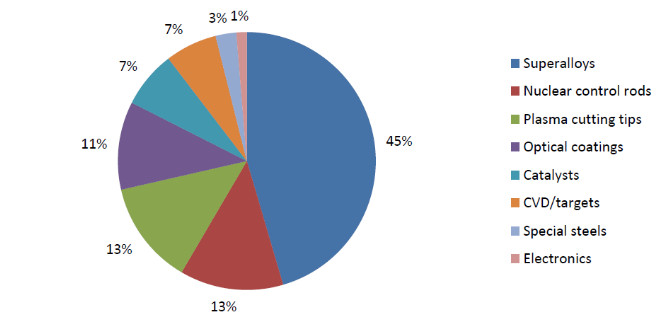
Due to its good nuclear performance, metal hafnium is widely used in the atomic energy industry. It has good welding performance, processing performance, and performance of high-temperature resistance and corrosion resistance. As a neutron absorber, it can capture a large area of thermal neutrons and can be used to produce nuclear reaction control rods and protection devices. In addition, hafnium is prone to launching electrons. It can be used as the cathode in an X-ray tube and is a common electronic material in the photovoltaic manufacturing industry. Hafnium is a good alloy material, with strong ductility, antioxidant capacity, and high-temperature resistance. Niobium-hafnium alloy containing about 10% hafnium is commonly used in the aerospace industry. Tantalum-tungsten alloy containing about 2% hafnium has a high creep strength and can be used as a protective layer material for spacecraft.
Related reading: 4 Uses Of Hafnium | The Applications Of Hafnium And Hafnium Alloys
 Chin Trento