Products
 Bars
Bars
 Beads & Spheres
 Bolts & Nuts
 Crucibles
 Discs
Discs
 Fibers & Fabrics
 Films
Films
 Flake
Flake
 Foams
Foams
 Foil
Foil
 Granules
 Honeycombs
 Ink
Ink
 Laminate
 Lumps
Lumps
 Meshes
 Metallised Film
 Plate
Plate
 Powders
 Rod
Rod
 Single Crystals
 Sputtering Target
 Tubes
Tubes
 Washer
 Wires
Wires
 Converters & Calculators
 Write for Us



What is An All-aluminum Body?

When it comes to the all-aluminum body of a car, the most well-known feature is its lightness. Besides the expensive top-of-the-line runs that use a lot of carbon fiber, lightweight car designs mostly rely on a large proportion of aluminum.
The concept of an all-aluminum body refers to that the body structure part of the car is mainly made of aluminum alloy, not only does it allow for the existence of some non-aluminum parts, but aluminum is also present in the form of alloys.
In fact, aluminum alloy is not a certain kind of alloy, there are many kinds of aluminum alloy. The internationally accepted rule is to distinguish aluminum alloy types with a four-digit and one-letter status code. For example, the 6063-T5 commonly used in the construction industry, whose first number is 1, represents pure aluminum with a purity of more than 99%; the numbers 2-8 represent alloys of aluminum and copper, manganese, silicon, magnesium, magnesium and silicon, zinc and other elements, respectively; the number 9 is the standby group. The numbers that follow are used primarily for differentiation, so the specific logic is no longer repeated. In a word, each formula of aluminum alloy has a special label to correspond to specific characteristics.
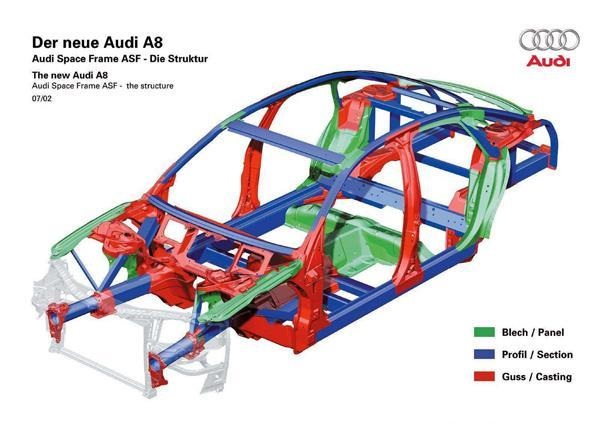
Currently, series 5 and 6 are mainly used in the manufacture of automobile all-aluminum bodies, all of which are of low density, tensile strength, and good fatigue resistance. They have higher strength performance far below the weight of steel and are widely used in Audi's ASF all-aluminum body. In addition, the 2 series and 7 series also have a small number of applications. The copper and aluminum alloy of the 2 series with high hardness can be used in somebody's sheet metal parts; the 7 series is mainly used in aerospace and military industries, which are ultra-hard, corrosion-resistant, and wear-resistant materials with an impressive price.
 Chin Trento