
 Products
 Bars
Bars
 Beads & Spheres
 Bolts & Nuts
 Crucibles
 Discs
Discs
 Fibers & Fabrics
 Films
Films
 Flake
Flake
 Foams
Foams
 Foil
Foil
 Granules
 Honeycombs
 Ink
Ink
 Laminate
 Lumps
Lumps
 Meshes
 Metallised Film
 Plate
Plate
 Powders
 Rod
Rod
 Single Crystals
 Sputtering Target
 Tubes
Tubes
 Washer
 Wires
Wires
 Converters & Calculators
 Write for Us



How to Select Electrode Materials in the EDM Industry?

With the increase of the die precision, the quantity of many difficult material parts and the maturation of EDM technology, the EDM electrode of tungsten-copper composite material becomes more and more common. Even so, it is necessary to select the electrode materials reasonably in EDM since it is an important guarantee to ensure the machining quality, while it is also necessary for every technician engaged in EDM to deeply understand the properties of EDM electrode materials.
EDM electrode materials
The electrode materials for EDM (Electrical Discharge Machining) mainly include graphite, red copper, tungsten-copper composites and so on. As all mechanical workers know, the physical properties of electrode materials have great influence on discharge erosion, electrode loss, machining speed, machining accuracy and machining stability in EDM, and the processing quality will be directly affected by using different electrode materials under the condition of parameter selection.
Red copper electrode
Red copper has high corrosion resistance due to its high heat conductivity and heat transfer coefficient. Therefore, the electrode of red copper is often used as the electrode material for the processing of small and medium cavity die parts, and it has fewer electrodes wear.
Graphite electrode
Graphite has a high melting and boiling temperature and is therefore highly resistant to corrosion. The thermal capacity of graphite is very large, and it can absorb free carbon to compensate the loss of electrode in the process of wide-pulse roughing. Besides, graphite also has the advantages of resistance to consumption, high temperature, small deformation, light quality, and high processing efficiency. However, the graphite electrode has one drawback that it has poor rigidity and is prone to crack at acute angles.
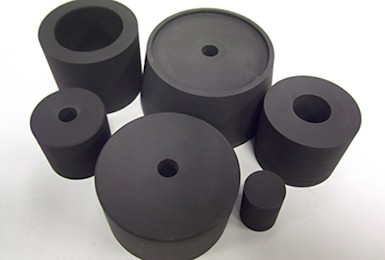
Tungsten-copper alloy electrode
The tungsten-copper composite material with a tungsten content of 50%~90% (mass fraction) combines many advantages of tungsten and copper, featuring high strength and hardness, good electrical conductivity and thermal conductivity, low thermal expansion coefficient, good arc resistance, high-temperature oxidation resistance and resistance to fusion welding. However, although tungsten-copper is the better electrode material in metals, its price is expensive and generally used for small precision processing.
How to select electrode materials?
In EDM, choosing proper electrode materials is an important factor to ensure machining quality and improve productivity. The cavity of the electrode is different in the process of using, so there is a big difference in size or shape and is difficult to standardize the tool electrode. Therefore, the following principles should be followed when selecting electrode materials.
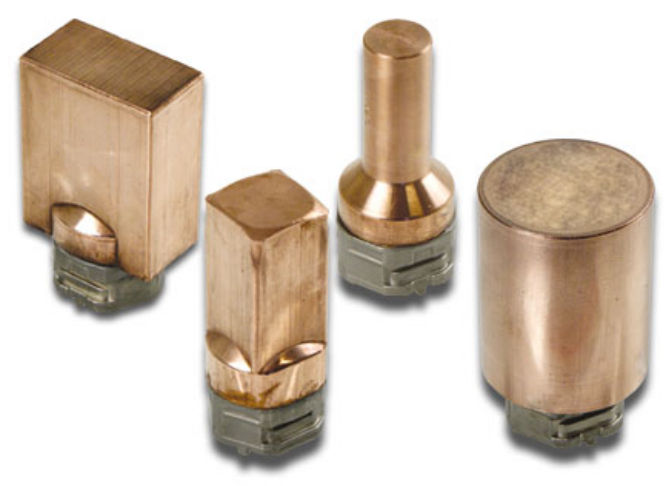
* On the basis of analyzing the characteristics and technical requirements (surface roughness, dimension, tolerance accuracy) of the workpiece, electrode materials should be selected according to the workpiece materials and technical requirements.
* Select the material with good thermal conductivity and high melting point as electrode material first.
* It takes into account the factors such as easy to shape the electrode and good machining performance so as to obtain a good EDM effect. Although the electrode materials used in EDM are mainly copper, graphite, and tungsten-copper electrodes, however, due to the properties of high-performance electrodes such as purity, viscosity, compact structure, uniformity and physicochemical properties, the selected electrodes, and processing parameters are totally different for different processing objects and requirements.
 Chin Trento