
 Products
 Bars
Bars
 Beads & Spheres
 Bolts & Nuts
 Crucibles
 Discs
Discs
 Fibers & Fabrics
 Films
Films
 Flake
Flake
 Foams
Foams
 Foil
Foil
 Granules
 Honeycombs
 Ink
Ink
 Laminate
 Lumps
Lumps
 Meshes
 Metallised Film
 Plate
Plate
 Powders
 Rod
Rod
 Single Crystals
 Sputtering Target
 Tubes
Tubes
 Washer
 Wires
Wires
 Converters & Calculators
 Write for Us



Nonlinear Optics: Key Materials and Advanced Materials

Introduction
Nonlinear optical materials have gained significant attention in recent years due to their essential role in advancing technologies in photonics, telecommunications, and laser systems. These materials exhibit unique optical properties that allow them to interact with light in ways that linear materials cannot, leading to phenomena such as second harmonic generation (SHG), optical parametric oscillation (OPO), and self-focusing.
Let’s explore key nonlinear optical materials, their characteristics, and their applications across multiple domains.
Understanding Nonlinear Optics
Nonlinear optics is the study of how light interacts with matter in a nonlinear manner, meaning that the response of the material to an electromagnetic field is not directly proportional to the field strength. This nonlinearity can lead to various phenomena, including:
- Second Harmonic Generation (SHG): The process where two photons are combined to produce a new photon with twice the energy (and half the wavelength).
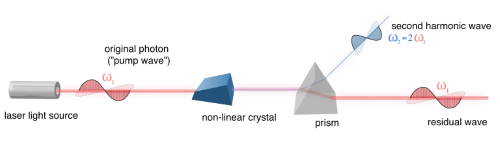 [1]
[1]
- Optical Parametric Oscillation (OPO): A process in which a nonlinear medium converts one photon into two lower-energy photons, allowing for tunable wavelength generation.
- Self-Focusing: A phenomenon where intense light beams can focus themselves due to the nonlinear refractive index change in the medium.
These phenomena make nonlinear optical materials indispensable in laser technology, telecommunications, and other optical applications.
Key Nonlinear Optical Materials
1. Beta Barium Borate (BBO)
Properties: BBO is renowned for its high damage threshold and excellent nonlinear optical properties. It has a wide transparency range, from 190 nm to 2,600 nm, making it suitable for various applications across the ultraviolet, visible, and near-infrared spectra.
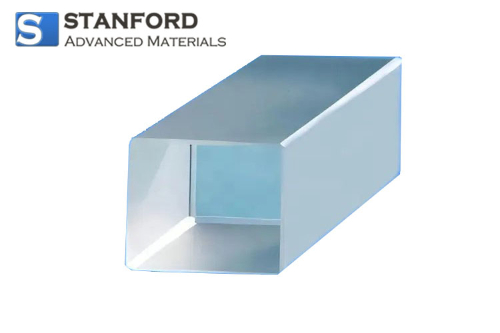
Applications: BBO is primarily used in frequency doubling and parametric oscillation. Its effectiveness in converting the frequency of laser light makes it popular in laser systems, particularly for producing green light in Nd:YAG lasers.
Related reading: From Structure to Application: Is BIBO or BBO the Better Crystal?
2. Lithium Niobate (LiNbO₃)
Properties: Lithium niobate possesses strong electro-optic and nonlinear optical properties. It is highly efficient in nonlinear processes, making it a versatile material in photonics.
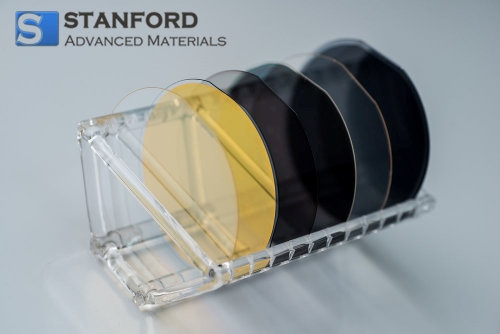
Applications: LiNbO₃ is widely used in optical modulators, frequency converters, and waveguide devices. It is also employed in second harmonic generation and optical parametric oscillation, essential for developing tunable laser sources.
3. Lithium Tantalate (LiTaO₃)
Properties: Similar to lithium niobate, lithium tantalate has strong nonlinear optical characteristics and is known for its excellent thermal stability.
Applications: LiTaO₃ is utilized in frequency conversion applications, including second harmonic generation and optical devices. Its high damage threshold makes it suitable for high-power laser applications.
4. Potassium Titanyl Phosphate (KTP)
Properties: KTP features a high nonlinear optical coefficient and good phase-matching capabilities, crucial for efficient frequency conversion.
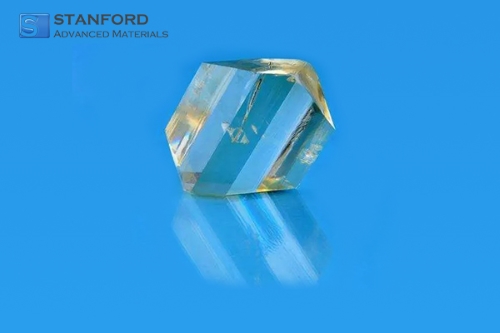
Applications: KTP is frequently used in frequency doubling applications, particularly in solid-state lasers. Its ability to generate green light from Nd:YAG lasers has made it a staple in laser pointer and projector technologies.
5. Bismuth Borate (BiBO)
Properties: Bismuth borate exhibits a high nonlinear optical coefficient and a wide transparency range, making it suitable for a variety of applications.
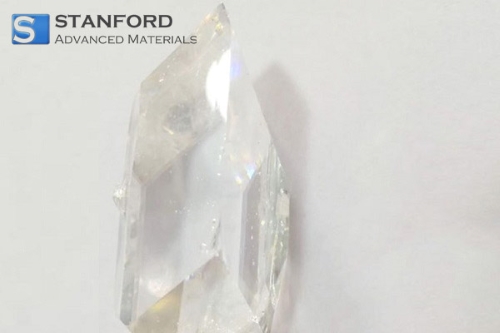
Applications: BiBO is used in nonlinear frequency conversion processes, particularly in high-power laser systems. Its efficiency in producing second harmonics makes it valuable in various laser applications.
6. Lithium Triborate (LBO)
Properties: LBO is known for its high damage threshold and good phase-matching properties, which enable efficient nonlinear interactions.
Applications: LBO is utilized in frequency conversion and as an optical parametric oscillator. Its ability to generate tunable laser wavelengths has made it popular in scientific research and industrial applications.
7. Zinc Selenide (ZnSe)
Properties: ZnSe has a wide bandgap and exhibits good nonlinear optical properties, making it a versatile material for various optical applications.
Applications: ZnSe is commonly used in laser technology, especially for infrared applications. Its nonlinear properties are harnessed in laser systems and optical coatings, enhancing their performance.
Advances in Material Science
Recent research has led to the development of novel nonlinear optical materials that enhance efficiency and broaden application scopes. Some of the notable advancements include:
1. Novel Crystal Structures
Researchers are synthesizing new crystalline materials with improved nonlinear coefficients and wider transparency ranges. For instance, Bismuth-based crystals, such as Bismuth Borate (BiBO), have shown exceptional nonlinear optical properties and are being explored for frequency conversion applications. Similarly, potassium titanyl phosphate (KTP) and its variants remain a focal point for investigations due to their robust performance in laser systems.
2. Organic Nonlinear Optical Materials
Organic materials have emerged as promising candidates for nonlinear optical applications due to their tunable properties and low-cost synthesis. Recent studies have demonstrated that conjugated polymers and small organic molecules can exhibit significant nonlinear optical responses. These materials often provide higher nonlinear coefficients compared to traditional inorganic counterparts, enabling applications in photonic devices and sensors.
3. Two-Dimensional (2D) Materials
The discovery of two-dimensional materials, such as graphene and transition metal dichalcogenides (TMDs), has opened new avenues in nonlinear optics. These materials demonstrate unique electronic and optical properties that make them suitable for applications in ultrafast photonics and integrated optical circuits. For example, graphene has shown promise in saturable absorbers for mode-locked lasers, providing a pathway to generate ultrashort pulses of light.
Conclusion
Nonlinear optical materials are fundamental to the advancement of modern photonic technologies. Materials like Beta Barium Borate (BBO), Lithium Niobate (LiNbO₃), and Potassium Titanyl Phosphate (KTP) offer high nonlinear coefficients, wide transparency, and strong phase-matching, driving advances in lasers, telecommunications, and research. As the demand for more efficient optical systems grows, these key nonlinear materials will continue to play a vital role in shaping future innovations.
Stanford Advanced Materials (SAM) is your trusted supplier with extensive experience in semiconductor materials. SAM provides a wide range of optical products, including laser crystals, nonlinear optical (NLO) crystals, prisms, beam splitters, lenses, and windows—all at competitive prices. Our offerings include Silicon wafers, Lithium Niobate, Lithium Tantalate, Sapphire, BBO, YAG, BiBO, Zinc Selenide, Magnesium Oxide, and LBO. Reach out to us for more information!
Reference:
[1] Second-harmonic generation. (2024, July 9). In Wikipedia. https://en.wikipedia.org/wiki/Second-harmonic_generation
 Chin Trento