Products
 Bars
Bars
 Beads & Spheres
 Bolts & Nuts
 Crucibles
 Discs
Discs
 Fibers & Fabrics
 Films
Films
 Flake
Flake
 Foams
Foams
 Foil
Foil
 Granules
 Honeycombs
 Ink
Ink
 Laminate
 Lumps
Lumps
 Meshes
 Metallised Film
 Plate
Plate
 Powders
 Rod
Rod
 Single Crystals
 Sputtering Target
 Tubes
Tubes
 Washer
 Wires
Wires
 Converters & Calculators
 Write for Us



Attenuation Coefficients: Basics and Applications

What Are Attenuation Coefficients
It is defined as the rate at which a wave's intensity reduces while passing through a medium. This happens because energy is being scattered and/or absorbed. The attenuation coefficient is a material constant and depends on the properties of the material and on which type of wave is being transmitted. The attenuation coefficient is measured in units of per unit length.
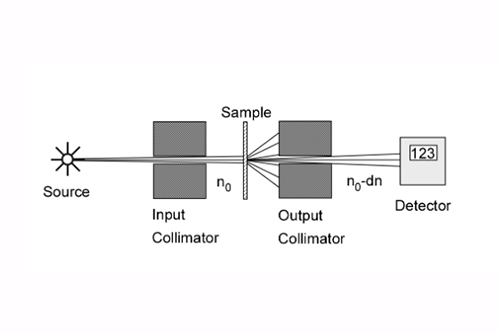
Mathematically, the attenuation coefficient "α" can be described by the following relation:
I=I0⋅e−αx
Where:
- I is the intensity of the wave after traveling through the material.
- I0 is the initial intensity of the wave.
- α is the attenuation coefficient (in units like per meter or per centimeter).
- x is the distance the wave travels through the medium.
The attenuation coefficient can vary depending on several factors, including the frequency of the wave, the properties of the material, and the type of wave involved.
Attenuation Coefficient Measurement
To calculate attenuation coefficients, the simplest method is to pass the wave through the material and measure the intensity of the wave before it goes through the material and after it comes out. This can be done with all types of waves, such as sound waves, light waves, or electromagnetic waves.
For light waves, optical attenuation measurements can be made by using a spectrophotometer or optical instruments. The instruments determine the amount of light that is scattered; hence, using such information, one can determine the coefficient of attenuation.
In the case of sound waves, particularly underwater or air-based acoustics, the value of the attenuation coefficients is measured by calculating the intensity values of sound waves at various distances away from the source of sound. The procedures involved encompass several factors such as frequency as well as the nature of the medium through which the sound waves pass.
Electromagnetic attenuation is generally measured by using devices such as signal analyzers and oscilloscopes. These devices help determine the reduction in signal strength as it passes through cables or conductive materials. Electromagnetic attenuation plays a significant role in telecommunications.
For any type of attenuation, the trick is to calculate the extent of the signal strength reduction that has been caused after traveling a known distance of the medium using the inverse of the formula above to determine the value of the attenuation coefficient.
Uses of Attenuation Coefficients
The attenuation coefficients are very important in many applications such as communication, medical, environmental, and materials engineering. Some of the important applications are as under:
Telecommunications and Networking
In telecommunications, attenuation is an important parameter in designing and managing telecommunication networks such as fiber cables and radio communication. The attenuation coefficient of the material used for cables (such as optical fibers) determines how far the signal will travel before it is required to be amplified or re-generated. A higher attenuation level indicates that there will be greater signal loss over long ranges, which in turn can hamper the quality of communication.
Medical Imaging & Diagnostics
The concept of attenuation coefficients has been widely used in medical imaging techniques such as X-ray and CT scans. The nature of attenuation of X-rays in different tissues of the body has been utilized in producing images of high resolution. It has been possible to detect abnormalities in the body through the determination of attenuation coefficients. For example, attenuation coefficients have been used in the detection of tumors in the body.
Acoustics and Sonar
Attenuation coefficients play significant roles in the field of acoustics, especially when considering sonar technology and underwater acoustics. The coefficient of attenuation essentially influences the behavior of the sound waves in water, in relation to the loss of energy of the waves along the way. The effects of sound pollution to the marine population are also identifiable through the coefficient.
Environmental Monitoring
In environment-related studies, attenuation coefficients are applied in research that focuses on pollutant or contaminant diffusion within air or water. For example, studies that evaluate water clarity or pollutant presence within water are done using the attenuation of selected light wavelengths. The concept of light and wave attenuation in air particles is also fundamental in weather and climate change studies.
Material Science and Engineering
The attenuation coefficients are significant in materials science, especially concerning the interaction between materials and radiation types. In the process of evaluating material shielding properties, such as metals and polymers, the role of the attenuation coefficient is to aid the engineer in the design process of protective shields used in radiation therapy or a reactor.
Frequently Asked Questions
Does the attenuation coefficient depend on the frequency of the wave?
Yes, the value of the attenuation coefficient depends on the frequency. This is because high frequencies are more attenuated than low ones.
Are attenuation coefficients ever negative?
They cannot be negative. A negative attenuation coefficient would mean the wave intensity was increasing. This isn't generally how things are in nature.
Temperature and Attenuation
The temperature factor affects
In many cases, temperature may be a significant factor in wave attenuation, especially in gases or liquids. For example, as temperature rises, the absorption of sound or light waves may go up, resulting in increased attenuation.
Are attenuation coefficients the same for all materials?
Well, the answer to this question is NO, as the attenuation coefficients are very material-dependent. In other words, materials such as lead are highly sensitive to X-ray attenuation coefficients, as compared to glass/plastic to wave, say.
 Chin Trento