
 Products
 Bars
Bars
 Beads & Spheres
 Bolts & Nuts
 Crucibles
 Discs
Discs
 Fibers & Fabrics
 Films
Films
 Flake
Flake
 Foams
Foams
 Foil
Foil
 Granules
 Honeycombs
 Ink
Ink
 Laminate
 Lumps
Lumps
 Meshes
 Metallised Film
 Plate
Plate
 Powders
 Rod
Rod
 Single Crystals
 Sputtering Target
 Tubes
Tubes
 Washer
 Wires
Wires
 Converters & Calculators
 Write for Us



Half-Life of Radioactive Elements

What Is Half-Life
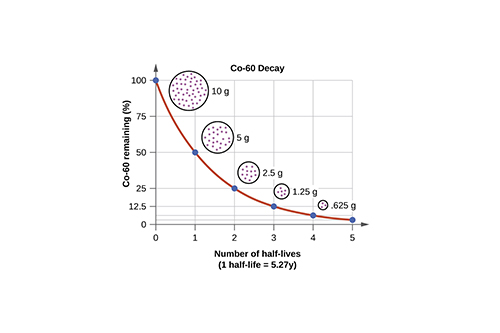
Half-life is the period required for half of the atoms in a radioactive substance to undergo decay. This fundamental concept is pivotal in understanding the stability and longevity of radioactive materials.
Radioisotopes and Their Significance
Radioisotopes are unstable atoms that emit radiation as they decay into more stable forms. They play a crucial role in fields such as medicine, archaeology, and environmental science.
Applications of Radioisotopes
- Medical Imaging and Treatment: Radioisotopes like Iodine-131 are used in diagnosing and treating thyroid conditions.
- Archaeological Dating: Carbon-14 helps determine the age of ancient artifacts.
- Environmental Monitoring: Cesium-137 tracks pollution and contamination levels.
How to Calculate Half-Life
The half-life is determined by measuring how quickly a radioactive sample decays. In practice, scientists measure the activity of a sample over time and plot the exponential decay curve. The half-life is the time it takes for the activity to drop by half.
For example, if a sample of Iodine-131 starts with 1,000 radioactive atoms and after 8 days only 500 remain, the half-life is 8 days. This pattern continues: after 16 days, 250 remain; after 24 days, 125 remain.
- Measure Initial Quantity: Determine the starting amount of the radioisotope.
- Monitor Decay: Track the reduction in quantity over specific time intervals.
- Apply Decay Rate: Use the consistent decay rate to estimate the time required for the quantity to halve.
Half-Life of Common Radioactive Elements
Half-lives vary enormously across radioisotopes—from fractions of a second to billions of years. This variation reflects the stability of the atomic nucleus. Isotopes with half-lives measured in days or years (like I-131 or Co-60) are often used in medicine and industry because their activity is high enough to be useful but decays within a practical timeframe. Those with half-lives of millions or billions of years (like U-238 or Th-232) persist in the environment for geological timescales.
|
Element |
Isotope |
Half-Life |
Decay Mode |
|
Carbon (C) |
Carbon-14 |
5,730 years |
Beta decay |
|
Uranium (U) |
Uranium-238 |
4.468 billion years |
Alpha decay |
|
Uranium (U) |
Uranium-235 |
703.8 million years |
Alpha decay |
|
Radon (Rn) |
Radon-222 |
3.8 days |
Alpha decay |
|
Thorium (Th) |
Thorium-232 |
14.05 billion years |
Alpha decay |
|
Plutonium (Pu) |
Plutonium-239 |
24,100 years |
Alpha decay |
|
Iodine (I) |
Iodine-131 |
8.02 days |
Beta decay |
|
Cobalt-60 |
5.27 years |
Beta decay and gamma emission |
|
|
Polonium (Po) |
Polonium-210 |
138.4 days |
Alpha decay |
|
Radium (Ra) |
Radium-226 |
1,600 years |
Alpha decay |
|
Strontium (Sr) |
Strontium-90 |
28.8 years |
Beta decay |
|
Cesium-137 |
30.1 years |
Beta decay |
|
|
Krypton (Kr) |
Krypton-85 |
10.76 years |
Beta decay |
|
Neptunium (Np) |
Neptunium-239 |
2.36 days |
Beta decay |
|
Tritium (H) |
Tritium-3 |
12.3 years |
Beta decay |
|
Zinc (Zn) |
Zinc-65 |
243 days |
Beta decay |
|
Chlorine (Cl) |
Chlorine-36 |
301,000 years |
Beta decay |
|
Molybdenum-99 |
65.6 hours |
Beta decay |
|
|
Radon (Rn) |
Radon-220 |
55.6 seconds |
Alpha decay |
|
Iron (Fe) |
Iron-60 |
2.26 million years |
Alpha decay |
Related Materials from Stanford Advanced Materials
While Stanford Advanced Materials (SAM) does not supply radioactive isotopes, we do provide materials used in radiation detection and shielding applications:
- Radiation shielding: Tungsten plate, rod, and custom components; lead sheet and plate; bismuth for lead‑free shielding
- Detection materials: Cesium iodide (CsI), sodium iodide (NaI) scintillation crystals
- High‑purity metals: For detector housings, instrument components, and research applications
All materials are supplied with certificates of analysis and traceability. [Browse our products] or [contact us] for specifications.
Frequently Asked Questions
What factors influence the half-life of a radioisotope?
The half-life is determined by the nuclear properties of the radioisotope, including the forces within the nucleus that affect its stability.
Why is understanding half-life important in medicine?
It helps in determining the dosage and timing for treatments using radioisotopes, ensuring effectiveness while minimizing risks.
Can the half-life of a radioisotope be altered by external conditions?
No, the half-life is an intrinsic property and remains constant regardless of environmental factors.
How is half-life used in environmental science?
It aids in tracking the persistence and movement of radioactive contaminants in ecosystems over time.
What happens to a radioisotope after several half-lives have passed?
The quantity of the radioisotope decreases exponentially, becoming negligible after multiple half-lives.
How does half-life relate to the danger of a radioactive material?
Danger depends on both half-life and decay type. A very short half-life means intense radiation initially, but the material decays quickly. A very long half-life means the material stays radioactive for extremely long periods, but its activity per unit mass is low. The most hazardous materials often have half-lives in the range of days to decades—long enough to be present for extended periods but short enough to emit significant radiation.

 Chin Trento