Products
 Bars
Bars
 Beads & Spheres
 Bolts & Nuts
 Crucibles
 Discs
Discs
 Fibers & Fabrics
 Films
Films
 Flake
Flake
 Foams
Foams
 Foil
Foil
 Granules
 Honeycombs
 Ink
Ink
 Laminate
 Lumps
Lumps
 Meshes
 Metallised Film
 Plate
Plate
 Powders
 Rod
Rod
 Single Crystals
 Sputtering Target
 Tubes
Tubes
 Washer
 Wires
Wires
 Converters & Calculators
 Write for Us



Temperature-Dependent Growth and Magnetic Characterization of FePt Thin Films for Advanced Data Storage Applications

This content is from a 2025 Stanford Advanced Materials College Scholarship submission by Frank Efe.
Abstract
Artificial Intelligence (AI) continues to reshape modern technology, placing high demands on data processing and storage capabilities. Improving the speed and capacity of electronic data storage systems, particularly hard disk drives (HDDs), is essential to meet these demands. Iron-platinum (FePt) thin films have emerged as promising materials due to their exceptional properties, such as high magnetic anisotropy, strong magnetization, large coercivity, and high thermal and chemical stability. These qualities make FePt thin films ideal candidates for advanced storage technologies, including Heat-Assisted Magnetic Recording (HAMR), which is designed to significantly enhance HDD data density. While FePt has been widely studied, a notable gap remains in understanding the mechanism behind the double magnetic switching behavior observed when these films are deposited on silicon substrates. This research explores the synthesis and characterization of FePt thin films grown on glass, silicon, and oxidized silicon substrates at room temperature, 250 °C, and 450 °C using DC magnetron sputtering. Surface morphology and crystalline structure were examined using Atomic Force Microscopy (AFM) and X-ray Diffraction (XRD), while magnetic characteristics were assessed through Magnetic Force Microscopy (MFM) and Vibrating Sample Magnetometry (VSM). Investigating the impact of growth temperature on the structural and magnetic properties of FePt films provides valuable insight for tailoring their performance in next-generation data storage systems and industrial applications.
Introduction
Neodymium alloy films have been studied extensively and widely employed for data storage applications over the years (Emmelius et al., 1989; He et al., 2022). However, because they are rare earth elements, they are expensive and easily demagnetize at very high temperatures, with little information on their electrical and magnetic properties for device fabrication (Baloni et al., 2023; Shkir et al., 2022; Yumnam et al., 2020). Ferromagnetic iron alloy films have significantly increased memory storage applications due to their well-defined structure and intriguing magnetic properties. Several studies have investigated the fascinating features of binary iron alloy thin films for device applications such as spintronics, permanent magnets, and magnetic recording media (Appel et al., 2019; Krupinski et al., 2019; Preller et al., 2020).
Among the binary iron alloys, iron platinum (FePt) films have exceptional magnetic properties such as high magnetic anisotropy, exchange coupling features, double-switching phenomena, thermal and chemical stability, and much more. These are significantly influenced by their growth conditions, such as temperature, growth time, and gas flow rate. As a result, choosing the right growth condition is critical for achieving suitable magnetic characteristics of FePt thin films (Suzuki et al., 2021). To enhance the data storage capacity of memory data storage devices, the bit alignment of magnetic recording must be changed from longitudinal to perpendicular alignment, as seen in the heat-assisted magnetic recording. However, current research is being conducted to grow high texture and associated perpendicular magnetic anisotropy in FePt thin,films (Liu et al., 2022; Shen et al., 2018; Yang et al., 2019).
Exchange bias coupling between the hard and soft phases of FePt thin films arises from the interdiffusion of transfer contact at the grain boundary and magnetostatic coupling caused by stray fields present in the hard phase (Singh et al., 2018). Depending on the growth conditions, FePt films can have two phases: cubic phase and ordered L10 phase with a randomly oriented grain structure. Unlike the granular L10 FePt films, there is an increase in the ferromagnetic resonance of the film at high temperatures. Thermal treatment has been shown to increase the perpendicular magnetic anisotropy of FePt films, resulting in increased coercivity and enhanced areal density for data storage applications (Li & Wang, 2022; Liu et al., 2022). Furthermore, increased temperature above a certain temperature may result in undesirable grain formation due to nanoparticle clumping (Goyal et al., 2019). In addition, Vashisht et al., (2021) co-deposited FeCo/FePt multilayer films on Si substrates, showing an upsurge in the crystal size of FePt grains after annealing, as well as confirmation of soft-phase magnetic behavior. The pinning dominated by domain walls is responsible for the increase in coercivity in the out-of-plane axis.
Sample preparation and Experimental details
FePt thin films were deposited using DC magnetron sputtering onto 5 × 5 mm glass substrates at substrate temperatures of room temperature (23 °C), 250 °C, and 450 °C. The glass substrates were ultrasonically cleaned in acetone for 90 minutes at 25 °C to remove surface contaminants, followed by air drying. Before deposition, substrates were preheated at 100 °C for 5 minutes to enhance adhesion. The heater was mounted within the sputtering chamber, which was evacuated to a base pressure of 10-7 Torr. Deposition was carried out at 5 mTorr argon pressure and 50 W gun power for 15 minutes, with a constant target-to-substrate distance of 40 cm. Following each deposition, the system was cooled to room temperature. These growth parameters were consistent with those reported in related studies (Alqhtany, 2017; Efe, 2023; Lisfi et al., 2017).
Results and Discussions
The surface morphology and topography of the demagnetized films were analyzed using atomic force microscopy (AFM), while magnetic domain structures were assessed using magnetic force microscopy (MFM). X-ray diffraction (XRD) was used to investigate the crystallographic structure and phase composition, and vibrating sample magnetometry (VSM) was used to evaluate magnetic properties under in-plane fields ranging from –20 to 20 kOe.
AFM revealed that at 23 °C, films showed grain clustering with some cracks and voids, suggesting poor surface diffusion. At 250 °C, grains appeared more homogeneously distributed, forming spherical features without visible cracks. At 450 °C, a uniform, crack-free surface with an average roughness of 10 nm was achieved. These results indicate that increasing the substrate temperature enhances the microstructural quality of FePt films, making them promising for device applications, particularly in magnetic storage technologies. The observed trends align with previously reported findings (Skok et al., 2022; Weisheit et al., 2004).There was no magnetic force detected between the film and the cantilever's tip, as seen in Figure 2a. This is due to the low deposition temperature of 23 ℃, which is insufficient to align the magnetic moment. As a result, at room temperature, the film features a soft phase of disordered cubic FCC phase structure properties. When the temperature was increased to 250 ℃, an island structure of the magnetic domains was discovered, which are randomly oriented out-of-plane, as illustrated in Figure 2b. Furthermore, as the substrate temperature increased to 450 ℃, there was an increase in magnetic domain contrast in the film’s magnetic image, which consists of black and white contrast that represents magnetic structures with strong interactions of either positive or negative response with the cantilever tip, as shown in Figure 2c. These domains were found to typically point to the out-of-plane component of magnetization.
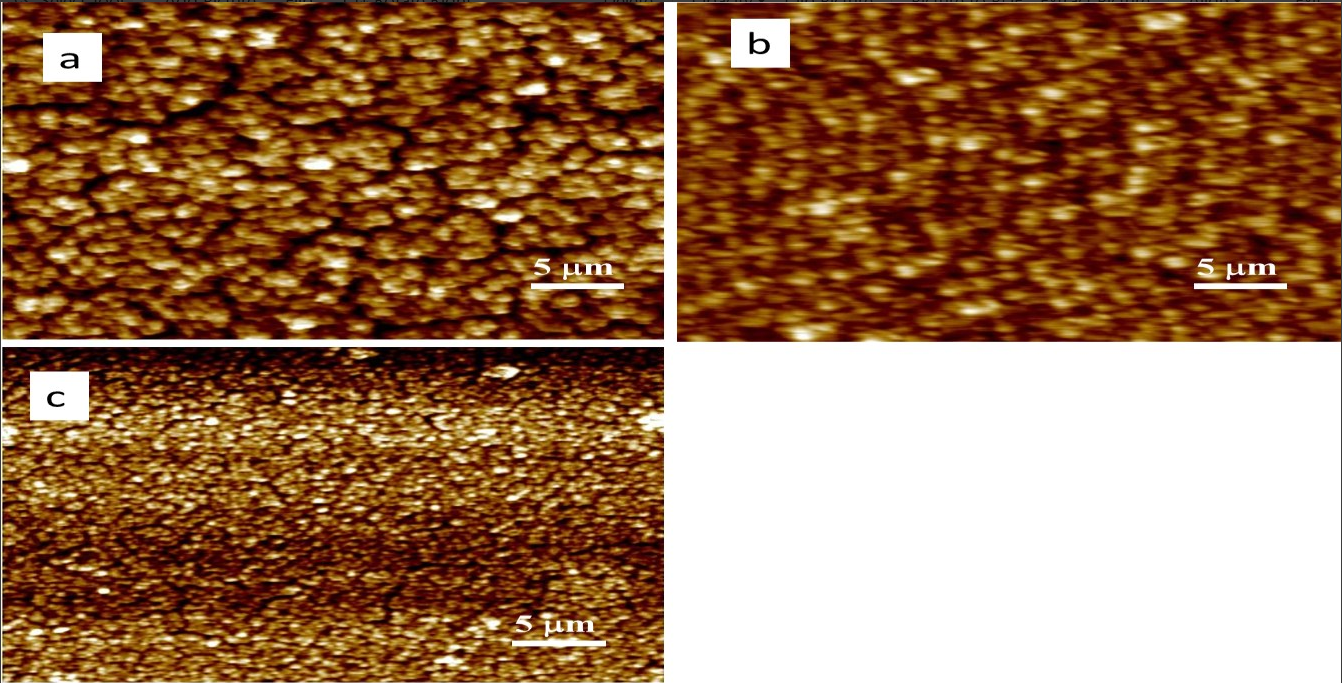
Figure 1(a-c): AFM image of the synthesized FePt films showing the topography of the grains as
substrate temperature increased from (a) 23 ℃, (b) 250 ℃, to (c) 450 ℃
In addition, the brownish portion of the magnetic domain reflects weak domains, which could be due to magnetic elements with an almost in-plane magnetization easy axis that interact weakly with the cantilever tip. As a result, the film’s entire magnetization structure is altered. This is due to the high perpendicular magnetic anisotropy of the deposited film, where the magnetization direction is aligned up and down within the domain wall. The ordered L10 face-centered tetragonal (FCT) structure of the grown films could explain the films’ significant perpendicular anisotropy at higher substrate temperatures (Lisfi et al., 2017).
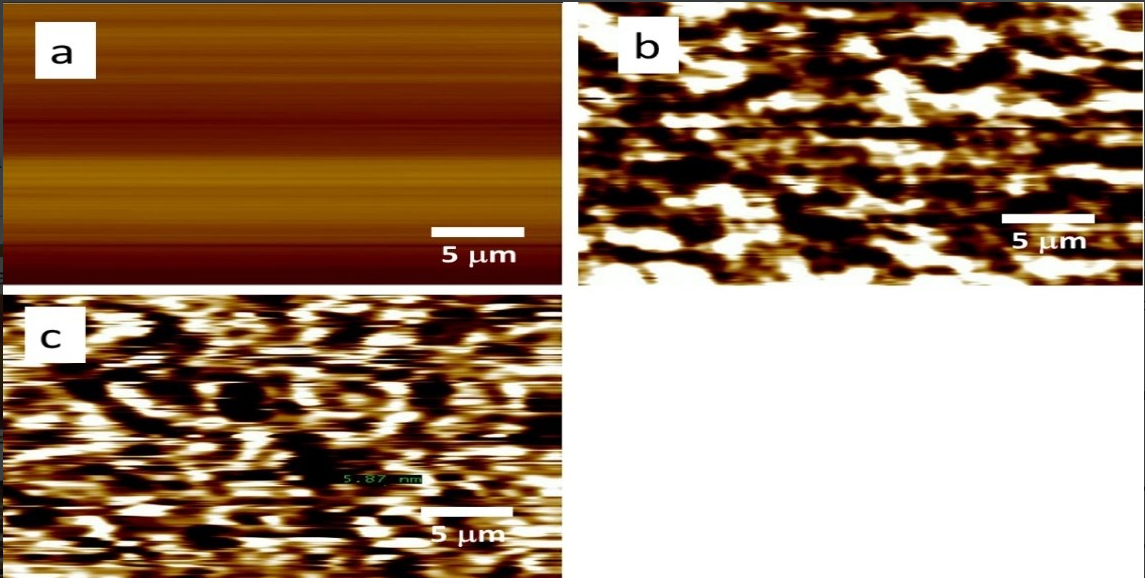
Figure 2 (a-c): MFM image of the synthesized FePt thin film showing the magnetic domains at
(a) 23 ℃ (b) 250 ℃ (c) 450 ℃
Conclusion
FePt thin films have been successfully deposited on a glass substrate at three different temperatures: room temperature, 250°C, and 450°C. Increased deposition temperature leads to an increase in grain growth with no voids and pinholes, as observed by the AFM and SEM. The magnetic force microscopy showed that the magnetic moments are oriented perpendicularly to the plane of the film. As the substrate temperature increases in the closed system containing the inert gas, the magnetic phases of the soft phase fcc-FePt film, whose atoms are randomly oriented, transition to the formation of an ordered L10 fct-FePt film on the glass substrate.
Recommendations
This study focuses on the synthesis and characterization of FePt thin films, a promising
rare metal alloy, tailored for industrial applications in magnetic data storage, particularly Heat-Assisted Magnetic Recording (HAMR). By optimizing growth conditions through substrate
temperature variation, we enhance the film’s structural and magnetic properties (work in progress),
making them suitable for high-density storage devices. The work aligns with current development
trends in rare metal utilization, addressing global demands for durable, high-performance materials
in electronics. Advancing FePt-based technologies supports the strategic shift toward efficient,
miniaturized, and energy-saving devices in the evolving data-driven industrial landscape.
References
Appel, P., Shields, B. J., Kosub, T., Hedrich, N., Hübner, R., Faßbender, J., Makarov, D., & Maletinsky, P. (2019). Nanomagnetism of Magnetoelectric Granular Thin-Film Antiferromagnets. Nano Letters, 19(3), 1682–1687. https://doi.org/10.1021/acs.nanolett.8b04681
Baloni, M., Sharma, R. C., Singh, H., Khan, B., Singh, M. K., Sati, P. C., Thakur, V. N., Kotnala, R. K., & Kumar, A. (2023). Energy storage and magnetoelectric coupling in neodymium (Nd) doped BiFeO3-PbTiO3 solid solution. Journal of Alloys and Compounds, 946, 169333. https://doi.org/10.1016/j.jallcom.2023.169333
Emmelius, M., Pawlowski, G., & Vollmann, H. W. (1989). Materials for Optical Data Storage. Angewandte Chemie International Edition in English, 28(11), 1445–1471. https://doi.org/10.1002/anie.198914453
Goyal, R., Lamba, S., & Annapoorni, S. (2019). Modelling of strain induced magnetic anisotropy in Au additive FePt thin films. Progress in Natural Science: Materials International, 29(5), 517–524. https://doi.org/10.1016/j.pnsc.2019.09.001
He, Y., Helm, T., Soldatov, I., Schneider, S., Pohl, D., Srivastava, A. K., Sharma, A. K., Kroder, J., Schnelle, W., Schaefer, R., Rellinghaus, B., Fecher, G. H., Parkin, S. S. P., & Felser, C. (2022). Nanoscale magnetic bubbles in Nd 2 Fe 14 B at room temperature. Physical Review B, 105(6), 064426. https://doi.org/10.1103/PhysRevB.105.064426
Krupinski, M., Bali, R., Mitin, D., Sobieszczyk, P., Gregor-Pawlowski, J., Zarzycki, A., Böttger, R., Albrecht, M., Potzger, K., & Marszałek, M. (2019). Ion induced ferromagnetism combined with self-assembly for large area magnetic modulation of thin films. Nanoscale, 11(18), 8930–8939. https://doi.org/10.1039/C8NR10011J
Li, W., & Wang, X. (2022). Influence of nano-twins on {001} texture of L10-FePt thin films. Applied Physics A, 128(11), 1024. https://doi.org/10.1007/s00339-022-06173-w
Lisfi, A., Pokharel, S., Akioya, O., Alqhtany, N. H., & Wuttig, M. (2017). Irreversible magnetization process and switching mechanism in L1 0 FePt thin films. AIP Advances, 7(5), 056206. https://doi.org/10.1063/1.4973759
Liu, C., Srinivasan, K., Ajan, A., McCollum, E., Kalitsov, A., Kalappattil, V., & Wu, M. (2022). Ferromagnetic resonance in FePt thin films at elevated temperatures. Journal of Magnetism and Magnetic Materials, 563, 169988. https://doi.org/10.1016/j.jmmm.2022.169988
Preller, T., Knickmeier, S., Menzel, D., Temel, B., & Garnweitner, G. (2020). Exchange Bias in FePt–FePt 3 Thin Films by Controlled Phase Transition of Blended Nanoparticle Building Blocks. Langmuir, 36(8), 2093–2101. https://doi.org/10.1021/acs.langmuir.9b02880
Shen, C. Y., Yeh, P. Y., Yuan, F. T., Chang, H. W., Lee, M. Y., Lin, D. Y., & Wang, C. R. (2018). Improved perpendicular magnetic properties of pulsed-dc-sputtered FePt thin films. Surface and Coatings Technology, 350, 795–800. https://doi.org/10.1016/j.surfcoat.2018.04.047
Shkir, Mohd., Khan, A., Imran, M., Ajmal Khan, M., Zargar, R. A., Alshahrani, T., Deva Arun Kumar, K., Mohanraj, P., Chandekar, K. V., & AlFaify, S. (2022). Spray pyrolysis developed Nd doped Co3O4 nanostructured thin films and their structural, and opto-nonlinear properties for optoelectronics applications. Optics & Laser Technology, 150, 107959. https://doi.org/10.1016/j.optlastec.2022.107959
Singh, S., Kumar, D., Bhagat, B., Choudhary, R. J., Reddy, V. R., & Gupta, A. (2018). Exchange bias effect in L1 0 -ordered FePt and FeCo-based bilayer structure: Effect of increasing applied field. Journal of Physics D: Applied Physics, 51(7), 075006. https://doi.org/10.1088/1361-6463/aaa539
Suzuki, I., Kubo, S., Sepehri-Amin, H., & Takahashi, Y. K. (2021). Dependence of the Growth Mode in Epitaxial FePt Films on Surface Free Energy. ACS Applied Materials & Interfaces, 13(14), 16620–16627. https://doi.org/10.1021/acsami.0c22510
Vashisht, G., Shashank, U., Gupta, S., Medwal, R., Dong, C. L., Chen, C. L., Asokan, K.,Fukuma, Y., & Annapoorni, S. (2021). Pinning-assisted out-of-plane anisotropy in reverse stack FeCo/FePt intermetallic bilayers for controlled switching in spintronics. Journal of Alloys and Compounds, 877, 160249. https://doi.org/10.1016/j.jallcom.2021.160249 Yang, W.-S., Sun, T.-H., Chen, S.-C., Jen, S.-U., Guo, H.-J., Liao, M.-H., & Chen, J.-R. (2019).
Comparison of microstructures and magnetic properties in FePt alloy films deposited by direct current magnetron sputtering and high power impulse magnetron sputtering. Journal of Alloys and Compounds, 803, 341–347. https://doi.org/10.1016/j.jallcom.2019.06.216
Yumnam, G., Guo, J., Chen, Y., Lauter, V., & Singh, D. K. (2020). Nonconventional magnetic phenomena in neodymium thin film. Physical Review Research, 2(4), 043018. https://doi.org/10.1103/PhysRevResearch.2.043018
 Dr. Samuel R. Matthews