Products
 Bars
Bars
 Beads & Spheres
 Bolts & Nuts
 Crucibles
 Discs
Discs
 Fibers & Fabrics
 Films
Films
 Flake
Flake
 Foams
Foams
 Foil
Foil
 Granules
 Honeycombs
 Ink
Ink
 Laminate
 Lumps
Lumps
 Meshes
 Metallised Film
 Plate
Plate
 Powders
 Rod
Rod
 Single Crystals
 Sputtering Target
 Tubes
Tubes
 Washer
 Wires
Wires
 Converters & Calculators
 Write for Us



Curie Temperature of Permanent Magnets

What Is The Curie Temperature
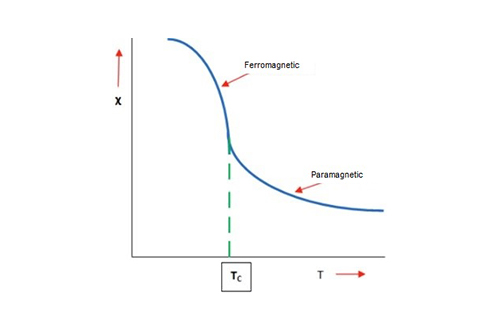
The Curie temperature or point is the main temperature above which a magnetic substance loses permanent magnetic characteristics and becomes paramagnetic. Named after the physicist Pierre Curie, the Curie temperature represents a transition between the strong magnetic behavior, called ferromagnetism, and the weak magnetic behavior, called paramagnetism, of the material.
Beyond this temperature, thermal energy disturbs the magnetic dipoles from maintaining a fixed magnetic field. Therefore, strong magnetic properties no longer occur in the material, and it is only influenced by the external magnetic fields. Once cooled down below the Curie temperature, the material gains its ferromagnetic property if it is within the material's stability range.
Factors Affecting the Curie Temperature
The Curie temperature of a material depends on a number of factors, most of which have to do with its atomic structure and the interaction between magnetic moments. Among them are the following:
1. Material Composition:
Another significant factor is the composition of the material, namely the elements that make up a material and the atomic arrangement. The Curie temperature for iron, Fe, is about 770°C, while for alloys such as neodymium-iron-boron, NdFeB, the Curie temperature is higher, which provides greater stability at higher temperatures.
2. Atomic Structure:
The Curie temperature is influenced by the type of atomic bonding and electron configuration present in the material. Consequently, materials with strong magnetic exchange interactions, such as those in rare-earth magnets, exhibit higher Curie temperatures than those with weaker interactions.
3. Magnetic Anisotropy:
Magnetic anisotropy concerns the directional dependence of a material's magnetic properties. The Curie temperature is increased with high anisotropy because, at higher temperatures, it can more effectively resist the randomizing influences of thermal energy.
4. Impurities and Defects:
The Curie temperature can be lowered by impurities and crystal defects. They introduce irregularities that disturb the alignment of the magnetic moments, which reduces the overall magnetic ordering of the material and hence lowers the temperature at which it loses its magnetization.
5. External Pressure:
Application of pressure can also affect the Curie temperature through change in the atomic spacing and bonding of the material. In some materials, increased pressure may elevate or lower the Curie temperature due to how it affects exchange interactions.
The Curie Temperature VS Maximum Operating Temperature
It is important to distinguish between the Curie temperature and maximum working temperature of permanent magnets. As both are related to the thermal limit, they are different phenomena:
· Curie Temperature:
As said earlier, this is the temperature beyond which a permanent magnet loses its permanent magnetization. If the temperature is higher than the Curie temperature, the material of the magnet becomes paramagnetic, meaning it no longer behaves like a magnet without an external field.
· Maximum Operating Temperature:
The maximum working temperature is the highest temperature at which the material can be utilized in an application without degradation in its magnetic properties. Permanent magnets may continue to work below their Curie temperature; however, the performance may fall while the temperature rises toward this limit. The factors such as reduced magnetic strength, altered coercivity, and thermal expansion may vary the performance of the magnet at high temperatures.
Thus, while the Curie temperature represents the temperature at which permanent magnetism is lost, the maximum working temperature describes the highest temperature at which a magnet can still function with minimal loss in efficiency.
The Curie Temperature of Permanent Magnets
The Curie temperature largely differs among permanent magnet types due to their different materials and structures. Herein, some of the permanent magnets in use compare their Curie temperature:
|
Magnet Type |
Curie Temperature (°C) |
|
~770 |
|
|
Nickel (Ni) |
~358 |
|
Cobalt (Co) |
~1,115 |
|
~1,300 to 1,400 |
|
|
Neodymium Iron Boron (NdFeB) |
~310 to 400 |
|
Alnico |
~850 to 1,200 |
Frequently Asked Questions
What is the Curie temperature?
The Curie temperature is the temperature above which a magnetic material loses its permanent magnetism and becomes paramagnetic. It happens when thermal energy overcomes the tendency of the magnetic moments to align within the material.
How is the Curie temperature determined?
Experimental determination of the Curie temperature is generally done by measuring magnetic properties of the material on heating. A temperature where there is a sudden drop in magnetization is considered to be the Curie temperature.
Is the Curie temperature different for all materials?
The Curie temperature is indeed very different between materials, depending on their atomic structure, composition, and magnetic interactions. Rare-earth magnets have much higher Curie temperatures compared with common materials like iron.
How does the Curie temperature affect a magnet's performance?
Above the Curie temperature, a given material will lose its permanent magnetic properties and is incapable of acting as a stable magnet. A loss of function could be disruptive when materials rely on such magnetic properties in the application.
What is the maximum working temperature of a magnet?
The maximum working temperature is the highest temperature at which a magnet can operate without significant loss of performance. This temperature is normally lower than the Curie temperature, and performance can degrade as the temperature approaches this limit.
 Chin Trento