Products
 Bars
Bars
 Beads & Spheres
 Bolts & Nuts
 Crucibles
 Discs
Discs
 Fibers & Fabrics
 Films
Films
 Flake
Flake
 Foams
Foams
 Foil
Foil
 Granules
 Honeycombs
 Ink
Ink
 Laminate
 Lumps
Lumps
 Meshes
 Metallised Film
 Plate
Plate
 Powders
 Rod
Rod
 Single Crystals
 Sputtering Target
 Tubes
Tubes
 Washer
 Wires
Wires
 Converters & Calculators
 Write for Us



What Is Neutron Cross Section

Introduction
Neutron cross sections are some of the basic parameters in nuclear physics, defining the probability of different types of interactions between neutrons and atomic nuclei. These cross sections have essential uses that run from the design of nuclear reactors to medical treatments and astrophysical research.
Neutron cross-sections are energy-dependent for a neutron, as are the types of interaction that occur between it and a nucleus: scattering, absorption, and fission are some of the important types of interactions occurring in different applications.
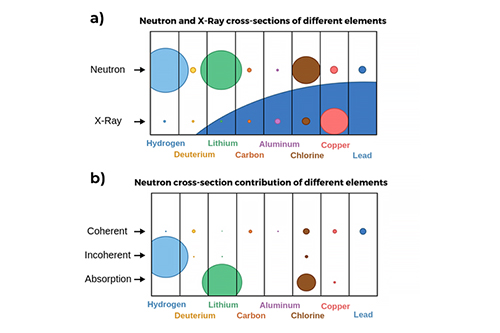
Types of Neutron Interactions
- Elastic Scattering: Neutrons collide with nuclei; there is no energy loss as neutrons change direction.
- Inelastic scattering: Some energy is transferred by the neutrons to the nucleus, exciting it.
- Absorption: Neutrons are absorbed by the nucleus, with possible radioactive decay or fission in some cases.
Applications of Neutron Cross Sections
Neutron cross-sections are crucial in various applications. In nuclear reactor design, accurate cross-section data are necessary for efficient and safe reactor operation. In medical treatments, such as neutron therapy, precise neutron interactions are used to target cancerous cells. In astrophysics, neutron cross-sections contribute to our understanding of stellar nucleosynthesis and the composition of neutron stars. In material science, neutron scattering techniques are used to study material properties.
Neutron Cross Section Table for Elements
The neutron cross section of an element represents the probability of a neutron interacting with the nuclei of that particular element. The unit is normally given in barns, where 1 barn = 10−2410^{-24} cm². This is one of the important parameters applied in nuclear physics, nuclear reactors, and radiation shielding.
Here is a table of neutron cross-sections for some common elements. This table includes total, thermal, and fission cross-sections where possible:
|
Element |
Isotope |
Total Cross Section (b) |
Thermal Neutron Cross Section (b) |
Capture Cross Section (b) |
Fission Cross Section (b) |
|
Hydrogen (H) |
Hydrogen-1 |
20.5 |
5335 |
0.33 |
0 |
|
Carbon (C) |
Carbon-12 |
1.7 |
2.2 |
0.0035 |
0 |
|
Oxygen (O) |
Oxygen-16 |
0.02 |
0.0002 |
0.0001 |
0 |
|
Uranium (U) |
Uranium-238 |
280 |
2.7 |
0.1 |
50 |
|
Uranium (U) |
Uranium-235 |
1000 |
680 |
0.3 |
5800 |
|
Thorium (Th) |
Thorium-232 |
36 |
5.7 |
0.1 |
0 |
|
Plutonium (Pu) |
Plutonium-239 |
748 |
2.6 |
0.17 |
8400 |
|
Neptunium (Np) |
Neptunium-239 |
71 |
16.5 |
0.2 |
1600 |
|
Boron (B) |
Boron-10 |
384 |
3835 |
0.005 |
0 |
|
Boron (B) |
Boron-11 |
5.5 |
3.0 |
0.01 |
0 |
|
Iron (Fe) |
Iron-56 |
2.6 |
2.2 |
0.02 |
0 |
|
Cobalt (Co) |
Cobalt-59 |
35 |
0.2 |
0.02 |
0 |
|
Copper (Cu) |
Copper-63 |
5.1 |
0.4 |
0.01 |
0 |
|
Zinc (Zn) |
Zinc-64 |
3.0 |
0.1 |
0.01 |
0 |
|
Lead (Pb) |
Lead-208 |
0.22 |
0.0004 |
0.01 |
0 |
|
Nickel (Ni) |
Nickel-58 |
3.0 |
0.03 |
0.01 |
0 |
|
Silicon (Si) |
Silicon-28 |
1.0 |
0.2 |
0.001 |
0 |
|
Aluminum (Al) |
Aluminum-27 |
1.6 |
0.3 |
0.002 |
0 |
|
Magnesium (Mg) |
Magnesium-24 |
3.2 |
1.0 |
0.02 |
0 |
|
Calcium (Ca) |
Calcium-40 |
1.1 |
0.04 |
0.0008 |
0 |
|
Argon (Ar) |
Argon-40 |
0.04 |
0.006 |
0.0006 |
0 |
- Hydrogen has an extremely high thermal neutron cross-section; hence, it finds wide application in neutron moderating applications, such as water in reactors.
- Uranium-235 and Plutonium-239: Highly fissile materials, hence find their application both in nuclear reactors and weapons.
- Boron possesses an extremely large neutron capture cross-section that makes it quite useful in neutron shielding and in control rods of nuclear reactors.
- Low neutron interaction cross-section for Lead and Iron makes them good radiation shielding materials.
- For more detailed information, please refer to Stanford Advanced Materials (SAM).
Frequently Asked Questions
What is a neutron cross section?
A neutron cross section measures the probability of a neutron interacting with a particular nucleus, measured in units called barns.
Why are neutron cross sections important in nuclear reactors?
They determine how neutrons behave within the reactor and affect the chain reaction's sustainability and reactor efficiency.
How do neutron cross sections vary with energy?
Different interactions dominate at different neutron energies; hence, the values of cross section vary across the energy ranges.
Where can I find detailed neutron cross section data?
The complete data can be found in nuclear databases, as for instance in the NNDC, and also in specialized scientific publications.
Can neutron cross-sections be used in medical applications?
Yes, they do play an important role in neutron therapy, which kills cancerous cells while minimizing damage to healthy tissue.
 Chin Trento