
 Products
 Bars
Bars
 Beads & Spheres
 Bolts & Nuts
 Crucibles
 Discs
Discs
 Fibers & Fabrics
 Films
Films
 Flake
Flake
 Foams
Foams
 Foil
Foil
 Granules
 Honeycombs
 Ink
Ink
 Laminate
 Lumps
Lumps
 Meshes
 Metallised Film
 Plate
Plate
 Powders
 Rod
Rod
 Single Crystals
 Sputtering Target
 Tubes
Tubes
 Washer
 Wires
Wires
 Converters & Calculators
 Write for Us



Introduction to Scattering

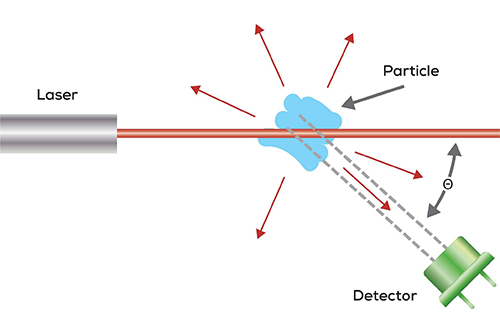
Scattering is a fundamental phenomenon where particles or waves are forced to deviate from their original trajectory due to non-uniformities in the medium or interactions with other particles. This process is essential in various scientific fields, including physics, chemistry, and astronomy.
Types of Scattering
There are various kinds of scattering, and they are classified on the basis of the type of particles or waves approaching and their interaction with matter as follows:
Elastic Scattering
In this type of scattering, there is no change in the kinetic energy of the particles or waves involved in the interaction process. This type of scattering is useful for understanding the structural properties of materials.
Inelastic Scattering
In this type of scattering, there is a transfer of energy from one object to another, thus altering their kinetic energy. This type of scattering is useful for understanding the dynamic properties of materials.
Scattering of Electromagnetic Radiation
Electromagnetic radiation scattering occurs when electromagnetic waves, such as light, interact with particles. This interaction can reveal information about the size, shape, and composition of the scattering particles.
Rayleigh Scattering
In Rayleigh scattering, the size of the particles is much smaller than the wavelength of the electromagnetic radiation. This type of scattering is responsible for the blue color of the sky.
Mie Scattering
In Mie scattering, the size of the particles is roughly the same as the wavelength of the electromagnetic radiation. This type of scattering is responsible for the color of clouds because here all the wavelengths of the electromagnetic spectrum are scattered almost equally.
Applications of Scattering
Scattering phenomena are the basis for a variety of scientific and technological applications, which are used as essential tools for the exploration of matter, its structure, and its composition over a wide range of length scales. By examining the scattering of waves or particles and how they change course upon interacting with matter, a wealth of physical and chemical information can be obtained.
In the field of materials science and materials characterization, scattering phenomena are at the core of the exploration of the micro and nano-scale structures of materials. Dynamic Light Scattering (DLS) is a powerful tool for measuring the size and size distribution of particles in a variety of materials, ranging from polymers and proteins to nanoparticles. At the atomic level, X-ray and neutron scattering are powerful tools for the exploration of the atomic and crystalline structures of solids. In the fabrication of advanced semiconductor devices, Grazing-Incidence Small Angle X-ray Scattering (GISAXS) is utilized for the surface and thin film analysis of materials, allowing for the precise identification of nanoscale pattern and defect issues.
Scattering is also a key phenomenon in medical and biological imaging. Various medical imaging tools, such as ultrasound and magnetic resonance imaging (MRI), function on the basis of wave scattering. In biological studies, Mie scattering is employed in flow cytometry to study cell size, shape, and complexity. More recently, scattering-induced light-matter interactions have been investigated in experimental cancer treatments, where plasmonic nanoparticles scatter and focus light to increase targeted therapeutic outcomes.
In optical and physical technology, scattering is intentionally designed and engineered to enhance system performance. Optical diffusers employ scattering surfaces to provide uniform illumination in display, lighting, and laser systems. In radar and remote sensing applications, scattered electromagnetic radiation is detected and analyzed to locate and identify objects from aircraft to weather patterns. In engineering and combustion studies, Mie scattering is employed to visualize flows by analyzing seeded particles, which provide critical information on turbulence, velocity, and flame dynamics.
Scattering is also responsible for many natural phenomena occurring in our daily lives. For instance, Rayleigh's law of scattering explains the color of the sky as blue because the wavelength of sunlight is scattered more by the particles in the atmosphere. Similarly, Mie's law of scattering explains the color of clouds as white or gray due to the presence of larger particles such as water droplets.
At a more fundamental level, the experiments involving scattering are essential in physics research. In particle and nuclear physics, the experiments involving the scattering of particles—using S-matrix theory—are essential in understanding the structure of matter and the forces binding particles and atoms together. In fact, the S-matrix theory is a mathematical tool used to explain the behavior of particles and atoms.
In conclusion, the concept of scattering is a unifying concept that brings our observations into the realm of physical reality. Whether we talk about advanced materials and medical diagnostics, the color of the sky and clouds, or the deepest layers of matter, the concept of scattering is essential and has remained an indispensable tool in our scientific and technological pursuits.
For more information, please check Stanford Advanced Materials (SAM).
Frequently Asked Questions
What is scattering in physics?
Scattering is the deflection of particles or waves from their original path due to interactions with other particles or irregularities in a medium.
How does Rayleigh scattering affect the color of the sky?
Rayleigh scattering causes shorter wavelengths of light, like blue, to scatter more than longer wavelengths, making the sky appear blue.
What is the difference between elastic and inelastic scattering?
Elastic scattering preserves the kinetic energy of the particles or waves, while inelastic scattering involves an energy transfer, changing their kinetic energy.
Where is Mie scattering commonly observed?
Mie scattering is commonly seen in phenomena like white clouds and fog, where particles are similar in size to the wavelength of visible light.
Why is understanding scattering important in material science?
Scattering helps analyze the structural properties of materials at the microscopic level, aiding in the development and characterization of new materials.
 Chin Trento