Products
 Bars
Bars
 Beads & Spheres
 Bolts & Nuts
 Crucibles
 Discs
Discs
 Fibers & Fabrics
 Films
Films
 Flake
Flake
 Foams
Foams
 Foil
Foil
 Granules
 Honeycombs
 Ink
Ink
 Laminate
 Lumps
Lumps
 Meshes
 Metallised Film
 Plate
Plate
 Powders
 Rod
Rod
 Single Crystals
 Sputtering Target
 Tubes
Tubes
 Washer
 Wires
Wires
 Converters & Calculators
 Write for Us



Case Study: Harnessing Yttrium Oxide for Advanced Lighting Solutions

Introduction
Yttrium Oxide (Y2O3) plays a crucial role in the field of lighting, where its unique properties contribute to enhancing the efficiency, longevity, and quality of various lighting technologies. From traditional incandescent bulbs to modern LED systems, Y2O3 is employed to achieve improved performance and innovation. This article is going to explore the specific uses of Yttrium Oxide in the lighting industry.

Figure 1. The Lighting Industry
Applications of Yttrium Oxide for Advanced Lighting Solutions
Phosphor for Fluorescent Lighting:
Y2O3 is a vital component in the creation of phosphors used in fluorescent lighting. Phosphors are materials that emit visible light when exposed to ultraviolet (UV) or other higher-energy radiation. Y2O3 is often doped with rare earth elements to create phosphors that emit various colors of light. These phosphors are coated on the inner surface of fluorescent tubes and lamps. When the UV radiation generated by the discharge of mercury vapor interacts with the phosphor, visible light is emitted. This process allows fluorescent lighting to produce a wide range of colors and improve overall energy efficiency compared to incandescent bulbs.
High-Intensity Discharge (HID) Lamps:
Y2O3 is also utilized in High-Intensity Discharge (HID) lamps, which include metal halide and sodium vapor lamps used for various lighting applications. It is added to the lamp's arc tube or bulb to enhance the stability and color rendering capabilities of the lamp. This addition contributes to the production of more uniform and natural light, crucial in applications such as outdoor lighting and sports stadiums.
LED Phosphors:
In the realm of light-emitting diodes (LEDs), Y2O3 serves as a critical component for creating phosphors that enable LEDs to emit light of different colors. LEDs emit blue or UV light, and by combining Yttrium Oxide-based phosphors with the emitted light, a wide spectrum of colors can be achieved. This is integral for producing white light in LEDs, which is then used for general lighting and displays.
Optical Coatings:
Y2O3 is also utilized in optical coatings for various lighting components, such as reflectors and lenses. These coatings can improve light transmission, reflection, and dispersion properties, contributing to the overall efficiency and quality of lighting systems.
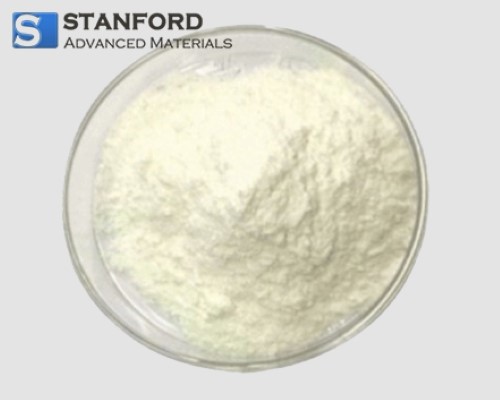
Figure 2. Yttrium Oxide Powder
Conclusion
In essence, Yttrium Oxide is significant in the realm of illumination technology from enhancing the color quality of fluorescent lighting to enabling the color versatility of LEDs and improving the efficiency of HID lamps. Yttrium Oxide demonstrates its capacity to contribute to advancements in lighting that cater to both energy efficiency and quality of illumination.
Stanford Advanced Materials (SAM) has 20 years of experience manufacturing and distributing Yttrium Oxide (Y2O3). Send us an inquiry if you are interested.
 Chin Trento