
 Products
 Bars
Bars
 Beads & Spheres
 Bolts & Nuts
 Crucibles
 Discs
Discs
 Fibers & Fabrics
 Films
Films
 Flake
Flake
 Foams
Foams
 Foil
Foil
 Granules
 Honeycombs
 Ink
Ink
 Laminate
 Lumps
Lumps
 Meshes
 Metallised Film
 Plate
Plate
 Powders
 Rod
Rod
 Single Crystals
 Sputtering Target
 Tubes
Tubes
 Washer
 Wires
Wires
 Converters & Calculators
 Write for Us



Stainless Steel Honeycomb for the Waterjet Cutting

What Is Waterjet Cutting?
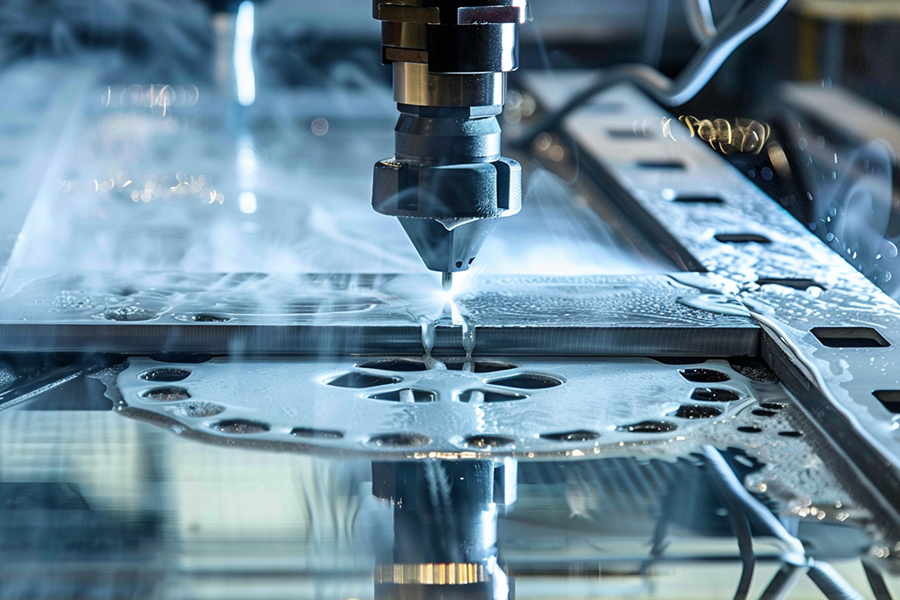
Waterjet cutting uses a high-pressure water stream to cut materials. The water is often mixed with an abrasive such as garnet. The stream cuts through metals, stone, glass, and composite materials. Machines range in size from small, bench-top units to large industrial systems. The waterjet system works by pressurizing water to nearly 60,000 pounds per square inch.
Benefits of Waterjet Cutting
There are several advantages of waterjet cutting.
It is a cold cutting process, and therefore, there is no heat-affected zone. This is very helpful in maintaining the integrity of the material.
The cut edges are smooth and require little finishing. The material produces less waste and has high precision. The process does not disturb the inner structure, even when cutting thick materials.
The process can be used to cut a variety of materials, ranging from soft aluminum to hard ceramics. The waterjet process is flexible, and it can easily cut curves and details.
Several industries opt for waterjet cutting because of its safety and flexibility. The high pressure involved in the process eliminates the need for secondary processing.
Why Use Stainless Steel Honeycomb for the Waterjet Cutting?
Stainless steel honeycomb is an ideal support material for waterjet cutting.
The honeycomb pattern ensures equal support for the material being cut. Stainless steel provides superior corrosion resistance. Its composition is robust and light. The honeycomb pattern ensures no vibrations occur, providing a consistent surface.
In waterjet cutting, the support material needs to securely hold the material being cut and withstand the erosive effects of the abrasive water jet. Stainless steel honeycomb satisfies these requirements.
Stainless steel honeycomb is widely used in industries where accuracy is paramount by many manufacturers. Aerospace components that need to have smooth edges and precise measurements benefit from a stable support surface. The honeycomb material is reusable and requires little maintenance. Its modular design enables the user to easily replace damaged parts without having to replace the entire support surface.
How to Use Stainless Steel Honeycomb for the Waterjet Cutting?
The application of stainless steel honeycomb in waterjet cutting systems is also applicable in various fields.
- In the automobile sector, the cutting of parts is done with high accuracy.
- In the aerospace industry, the consistency and reliability provided by honeycomb supports are greatly appreciated.
- In the construction industry, the cutting of materials such as stone and glass is done with high accuracy using waterjets and honeycomb supports.
- In addition, the fields of design and art also take advantage of the fine details that can be created on a supported surface by waterjet cutting.
- Laser cutting may produce heat-affected zones, but waterjet cutting with a stainless steel honeycomb support does not have this problem at all. Many metal fabrication facilities have incorporated stainless steel honeycomb beds into their waterjet cutting systems because of this.
Comparison with Other Support Materials
Other support materials include ceramics, plastics, or even composite boards.
Some of these may be cheaper but often lack the strength and durability of stainless steel honeycomb. Ceramics can be brittle and risk cracking under intense water pressure. Plastic supports may warp or degrade with repeated waterjet use. Composite boards can be affected by the abrasive nature of the water and cutting media. In contrast, stainless steel honeycomb maintains its dimensions and supports the workpiece with consistent firmness. Many businesses compare the long-term costs and benefits. Stainless steel honeycomb often pays off because it is reusable, resists wear, and enhances the accuracy of cuts. Its uniform structure reduces irregularities that might lead to unexpected tool wear or imprecise cuts.
Conclusion
Waterjet cutting employs stainless steel honeycomb in many cutting applications. Its benefits include cold cutting without a heat-affected zone and the ability to work with many materials. Stainless steel honeycomb provides even support, resists corrosion, and reduces vibrations during cutting. Its design and strength make it a top choice when compared with other support materials. Industries such as aerospace, automotive, and construction have documented improved outcomes using these supports. For more honeycomb products, please check Stanford Advanced Materials (SAM).
Frequently Asked Questions
F: What are the typical pressures used in waterjet cutting?
Q: Pressures up to 60,000 pounds per square inch are common.
F: How does stainless steel honeycomb improve cut quality?
Q: It provides firm support and minimizes vibrations during the cutting process.
F: Can waterjet cutting handle thick materials?
Q: Yes, waterjet cutting efficiently processes thick materials without compromising quality.
 Chin Trento