
 Products
 Bars
Bars
 Beads & Spheres
 Bolts & Nuts
 Crucibles
 Discs
Discs
 Fibers & Fabrics
 Films
Films
 Flake
Flake
 Foams
Foams
 Foil
Foil
 Granules
 Honeycombs
 Ink
Ink
 Laminate
 Lumps
Lumps
 Meshes
 Metallised Film
 Plate
Plate
 Powders
 Rod
Rod
 Single Crystals
 Sputtering Target
 Tubes
Tubes
 Washer
 Wires
Wires
 Converters & Calculators
 Write for Us



Mass Flow or Volumetric? Choosing the Right GC Flow Control

Understanding the Types of Flow in Gas Chromatography
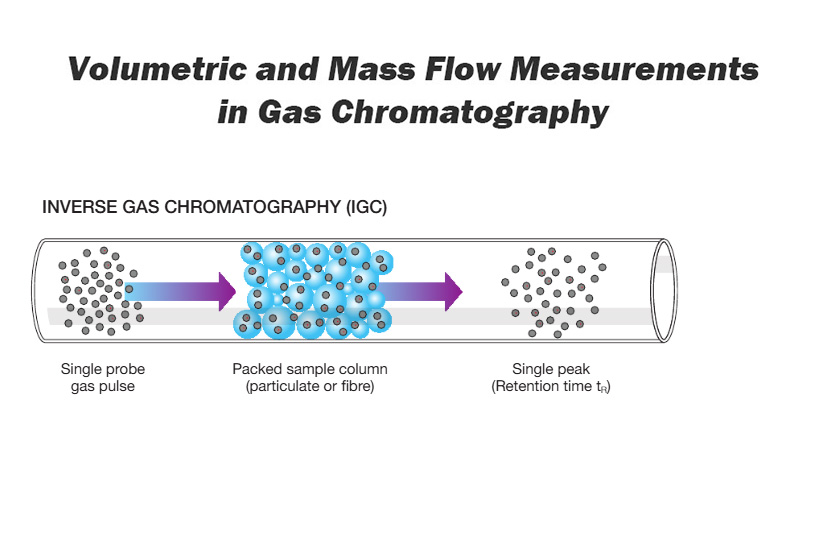
Choosing between volumetric and mass flow control for your GC system can impact accuracy, cost, and reproducibility. Here is what you need to know to make the right decision. Gas chromatography needs gas flow control for accurate analysis. Two general types of flow measurements are utilized in the practice: volumetric and mass flow.
Volumetric flow measures the volume of gas passing through a system per unit time. The flow is usually measured in terms of standardized units such as milliliters per minute.
Mass flow measures the quantity of gas passing through a system per unit time. It differs from volumetric flow in that it remains reliable even as temperature and pressure are fluctuating.
What Is Volumetric Flow?
--Volumetric Flow Measurement
Volumetric flow is measured with straightforward, practical instruments in the majority of gas chromatography laboratories.
One of the common methods involves the use of bubble meters, which rely on the movement of a visible bubble through a graduated tube. Another common device is the flow calibrator, which is designed to give direct reading of the volume and velocity of gas. However, these devices can be affected by gas properties.
Volumetric flow is extremely prone to fluctuations in temperature and pressure. For instance, a slight rise in temperature might enlarge the gas volume while pressure change might bring unpredictable outcomes. There has to be a constant calibration and adjustment to maintain precision.
--Typical Uses of Volumetric Flow Measurement
Volumetric flow measurements are often used in routine analysis where the gas conditions are tightly controlled. Older labs continue to use many of these instruments because the method is easy and low-cost. Where ultimate accuracy is less critical, volumetric measurement is an excellent choice.
What Is Mass Flow?
--Mass Flow Measurement in Practice
Mass flow controllers, or MFCs, have sensors that measure the density and velocity of the gas to determine its mass. They control the flow of gas with high accuracy even when the conditions are altered. Built-in algorithms adjust readings in real time for optimal accuracy.
MFCs are also more precise than most volumetric instruments. Stability over a wide range of operating conditions means less maintenance and more consistent results. In addition, the controllers allow gas chromatography systems to be automated, reducing human error.
--Typical Applications of Mass Flow Measurement
The majority of new gas chromatography systems have MFCs as a standard feature. The majority of laboratories that require high analytical precision, such as environmental test laboratories or research laboratories, use mass flow controllers because they provide stable operation.
Volumetric vs. Mass: Key Differences
When choosing between volumetric and mass flow techniques, there are a number of factors to consider.
• Response to environmental conditions
While volumetric flow will change with temperature and pressure, mass flow will not. This becomes significant in applications where environmental conditions are not stable.
• Equipment and maintenance
Volumetric devices tend to be less complicated and easier to maintain. Mass flow controllers are more advanced and require modern calibration methods but offer better performance in challenging applications.
• Cost and complexity
Cost is an important consideration in most labs. Volumetric devices are cheaper and easy to design. Mass flow systems are relatively more expensive but offer the precision that advanced research demands. Whether to utilize one or the other is typically determined by the requirements of each gas chromatography system.
How to Choose: A Decision Framework
| If your lab... | Recommended flow control | Why |
|---|---|---|
| Performs routine analysis under stable lab conditions | Volumetric | Lower cost, simpler maintenance, sufficient accuracy |
| Experiences fluctuating temperature or pressure | Mass flow | Unaffected by environmental changes, ensures reproducibility |
| Requires high precision (e.g., research, environmental testing) | Mass flow | Superior accuracy and stability |
| Has limited budget and existing volumetric instruments | Volumetric | Cost-effective; can be calibrated regularly to maintain accuracy |
| Is purchasing a new GC system | Mass flow | Industry standard; enables automation and reduces human error |
Conclusion
In summary, both volumetric and mass flow measurements possess their own strengths in gas chromatography. Volumetric methods are a simple but effective solution for the majority of routine analyses. They are uncomplicated but could be prone to environmental variations. Mass flow controllers are more precise, stable, and automatable. They excel at challenging and advanced applications despite the complexity and higher cost.
For most routine applications with stable laboratory conditions, volumetric flow control remains a cost-effective choice. However, for labs requiring high precision, automation, or operating in variable environments, mass flow controllers are the recommended standard. For high-purity materials used in gas chromatography, please visit Stanford Advanced Materials (SAM).
Frequently Asked Questions
Q: What is volumetric flow measurement?
A: It measures the volume of gas passing through a system per unit time and is influenced by changes in temperature and pressure.
Q: What are the main benefits of mass flow controllers?
A: They offer high accuracy, improved stability, and ease of automation for gas chromatography systems.
Q: Which flow measurement is best for routine laboratory work?
A: For routine analysis under stable conditions, volumetric flow control is a cost-effective choice. For labs with variable environments or high precision needs, mass flow is recommended.
Reference:
[1] Ali, Shaukat & Burnett, Daniel & Garcia, Armando & Langley, Nigel & Lan, Yidan. (2010). Surface Energy Properties of Soluplus ® by Inverse Gas Chromatography. 10.13140/2.1.2723.1048.
 Chin Trento