Products
 Bars
Bars
 Beads & Spheres
 Bolts & Nuts
 Crucibles
 Discs
Discs
 Fibers & Fabrics
 Films
Films
 Flake
Flake
 Foams
Foams
 Foil
Foil
 Granules
 Honeycombs
 Ink
Ink
 Laminate
 Lumps
Lumps
 Meshes
 Metallised Film
 Plate
Plate
 Powders
 Rod
Rod
 Single Crystals
 Sputtering Target
 Tubes
Tubes
 Washer
 Wires
Wires
 Converters & Calculators
 Write for Us



Platinum vs Palladium vs Rhodium: A Technical Guide to Six Precious Metal Catalysts

Introduction
Precious metals like platinum, palladium, rhodium, ruthenium, iridium, and gold drive billions of dollars in annual chemical production. I have worked with these metals for more than 20 years, and I see that people often choose platinum because it is familiar and reliable. But platinum can be expensive. The right metal to use depends on the chemical reaction. For example, palladium is good for hydrogenation, platinum is good for oxidation, and rhodium or iridium are good for carbonylation.
When it comes to purchasing precious metal catalysts, I focus on two main points. First, some reactions need a metal, and there is no substitute. For example, petroleum reforming needs platinum, and automotive catalysts need a mix of platinum, palladium, and rhodium. Second, the cost of the metal is not the thing to consider. The metal's resistance to poison, how long it lasts, and how much it can be recovered are also important.
Why These Six Metals?
These six metals are special because they do not corrode easily. They have the balance of electrons to react with other molecules. They can withstand temperatures and corrosive atmospheres that would destroy other metals like iron or nickel. Silver and osmium also have activity, but they have some problems. Silver tarnishes in sulfur-containing feeds, and osmium forms a compound. The six metals I am talking about are chosen because they are resistant to corrosion and have safe and practical catalytic activity.
It is also important to be able to recover the metal after it is used. Precious metals do not change chemically during the reaction, so they can be. Reused. The recovery rate is usually over 95%, which is why leasing is often preferred for large-scale operations. Without this, the cost would be too high.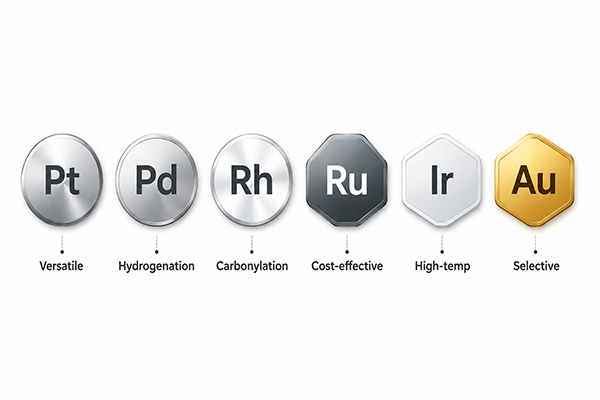
Comparison of Six Precious Metal Catalysts
While all six are "precious," their catalytic personalities are distinctly different. The table below summarizes these key characteristics:
| Metal | Best For | Core Reactions | Typical Application | Watch Out For |
|---|---|---|---|---|
| Platinum (Pt) | All-purpose performer | Reforming, hydrogenation, oxidation | Petroleum reforming, fuel cells, three-way catalysts | Sinters above 800°C |
| Palladium (Pd) | Hydrogenation specialist | Hydrogenation, cross-coupling, oxidation | Pharmaceutical intermediates, Suzuki coupling, and exhaust purification | Sulfur poisoning—even ppm levels |
| Rhodium (Rh) | Carbonylation expert | Hydroformylation, carbonylation | Acetic acid production, NOx reduction | Extremely expensive; use at trace levels |
| Ruthenium (Ru) | Cost-effective alternative | Hydrogenation, Fischer-Tropsch, ammonia synthesis | Green hydrogen electrolysis, ammonia production | Unstable in alkaline conditions |
| Iridium (Ir) | High-temperature stability | Oxidation, C-H activation | High-temperature combustion, specialty chemicals | Difficult to dissolve; recycling is expensive |
| Gold (Au) | Low-temperature selectivity | Selective oxidation, CO oxidation | Low-temperature CO oxidation, propylene oxide | Only works as nanoparticles (<5 nm) |
Palladium is often better than platinum for hydrogenation, but it can be deactivated by impurities. Even a small amount of sulfur can stop palladium from working. Platinum is more resistant to poison. It is slower than palladium. Ruthenium is cheaper than palladium. It has a different selectivity profile. Gold only works as nanoparticles, and larger particles are not effective.
Selection by Reaction Type
Choosing the right catalyst always starts with understanding the reaction, not just picking a metal.
For hydrogenation, palladium is usually the go-to thanks to its speed, selectivity, and low-temperature performance. Platinum works too, but is slower. Ruthenium performs well for specific substrates like aromatics and fatty acids. For more details, see our technical guide on common reaction types in homogeneous precious metal catalysis.
For oxidation, platinum remains the standard. Gold is useful for selective oxidation, while palladium works but tends to deactivate faster.
In reforming, platinum has no real competitor. Promoters like rhenium or tin may be added, but platinum is the core metal.
For carbonylation, only rhodium and iridium work. Rhodium is more active, whereas iridium shines in high-temperature stability.
Low-temperature CO oxidation. Gold nanoparticles are the sole choice for low-temperature CO oxidation; nothing else works below 100°C.
If the best option is unclear, palladium is a safe starting point. Its versatility in hydrogenation makes it the default for many industrial reactions.
Industry Case Studies
The following examples illustrate how the choice of metal directly impacts process economics.
Case Study 1: Petroleum Reforming – Platinum
In catalytic reforming, naphtha is converted into high-octane gasoline components. The metal must dehydrogenate cycloalkanes into aromatics without excessive cracking. Platinum excels here, balancing C-H activation with carbon-carbon retention. Promoters like rhenium or tin may improve stability, but platinum remains irreplaceable after decades of optimization. For a refinery producing 30,000 barrels/day, using platinum instead of palladium can boost liquid yield by 5-8% per barrel.
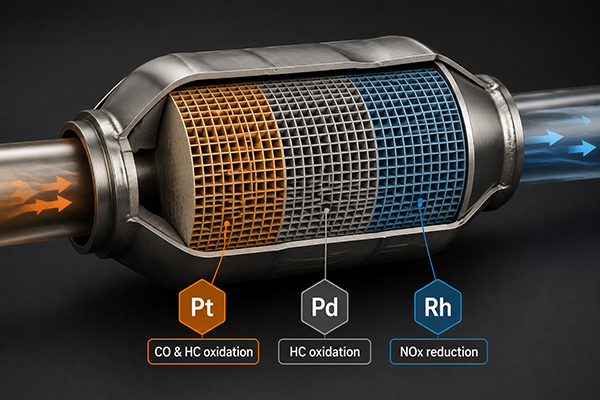
Case Study 2: Automotive Three-Way Catalysts – The Platinum-Palladium-Rhodium Trio
Automotive catalytic converters use all three metals. Platinum handles CO and hydrocarbon oxidation. Palladium often replaces platinum because it is cheaper and more active for certain hydrocarbons. Rhodium alone reduces NOx efficiently. Typical converters contain 1-3 g Pt, 1-5 g Pd, and 0.1-0.3 g Rh, with ratios shifting according to metal prices. During the 2020-2021 palladium price spike, some formulations swapped in more platinum, but rhodium remains essential for NOx control.
Cost and Market Factors
Prices of precious metals fluctuate constantly, directly affecting catalyst costs. Approximate relative prices as of early 2026 are shown below:
| Metal | Relative Cost | Key Consideration |
|---|---|---|
| Palladium (Pd) | Lowest (baseline) | Auto catalyst demand driver |
| Platinum (Pt) | 1.0 - 1.5x Pd | More poison-resistant than Pd |
| Ruthenium (Ru) | 2 - 4x Pd | Growing demand for electrolysis |
| Gold (Au) | 10 - 15x Pd | Catalytic use is niche |
| Rhodium (Rh) | 20 - 40x Pd | Irreplaceable for NOx reduction |
| Iridium (Ir) | 25 - 50x Pd | Extreme scarcity, high-temp niche |
Note: These ratios can shift quickly; always check current spot prices before quoting.
Forms and Supports
In industry, bulk metals are rarely used on their own. The metal is dispersed on a support, which strongly affects activity, selectivity, and lifespan.
Alumina (Al2O3) is the go-to support for most reactions, though its acidity can cause side reactions. Silica (SiO2) is more neutral and preferred when acidity is a concern. Carbon supports are common in pharmaceutical manufacturing because the metal can be recovered by burning off the carbon. Ceria (CeO2) stores oxygen, which is why it's widely used in automotive catalysts.
Physical form matters too. Powder is typical for batch reactors. Pellets or extrudates fit fixed-bed reactors. Monoliths, like honeycomb structures, suit high-flow applications such as catalytic converters.
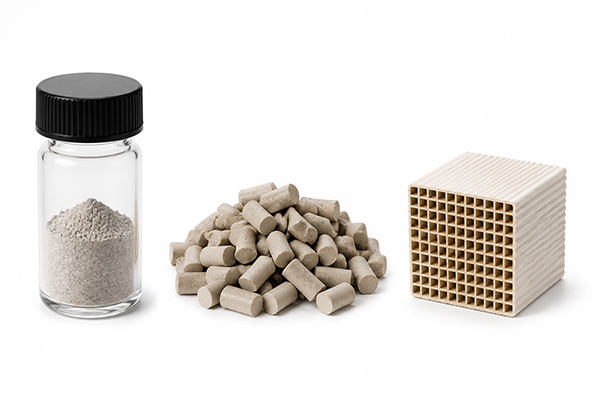
Be specific when ordering. Instead of asking for a 'palladium catalyst,' specify something like '5% Pd on activated carbon, powder, 100g.' Otherwise, you'll get whatever the supplier has on hand.
For a detailed guide to selecting the right support material, see our technical white paper: Precious Metal Catalysts: The Performance Amplifier – The Support.
Information Required for Quote
To get an accurate quote, include these details when contacting suppliers:
- Metal type and loading (e.g., 5% Pt, 1% Pd)
- Support material (Al₂O₃, SiO₂, C, CeO₂, etc.)
- Physical form (powder, pellets, extrudates, monolith)
- Particle size range (if powder)
- Quantity (grams for research, kilograms for pilot runs, metric tons for production)
- Special requirements (reduced or oxidized form, passivation, inert gas packaging)
Example: 5% Pd on activated carbon, powder, 45-150µm, 500g, reduced and passivated, shipped under argon.
Need a custom formulation? Stanford Advanced Materials (SAM) offers tailored metal loadings, support materials, and particle sizes to match your exact reaction requirements. Contact our catalyst team to discuss your specifications.
Conclusion
I see a clear pattern: successful engineers ask about the feed, temperature, and tolerated byproducts. Those who don't often just grab platinum by habit.
The case studies show that metal choice affects economics, like higher liquid yield in refining or swapping platinum and palladium when prices change. Initial cost is just one factor; poison resistance, lifespan, and recoverability often matter more.
My advice: don't pick platinum automatically. If you're unsure which metal fits your reaction, run a test or contact our technical team—they've seen it all and can point you to the right choice.
References
- Haruta, M. (2004). Gold as a novel catalyst in the 21st century. Gold Bulletin, 37(1), 27-36.
- Hagen, J. (2015). Industrial catalysis: A practical approach (3rd ed.). Wiley-VCH.
- Johnson Matthey. (2025). Precious metal catalysts: Technical data sheets.
- Johnson Matthey. (2026). Platinum 2026 annual review.
- Sinfelt, J.H. (1989). Bimetallic catalysts: Discoveries, concepts, and applications. Exxon Monograph Series.
- U.S. Department of Energy. (2024). Hydrogen and fuel cell technologies office: Catalyst research summary. DOE/EE-2450.
- U.S. Geological Survey. (2025). *Mineral commodity summaries 2025: Platinum-group metals*.
 Dr. Samuel R. Matthews