
 Products
 Bars
Bars
 Beads & Spheres
 Bolts & Nuts
 Crucibles
 Discs
Discs
 Fibers & Fabrics
 Films
Films
 Flake
Flake
 Foams
Foams
 Foil
Foil
 Granules
 Honeycombs
 Ink
Ink
 Laminate
 Lumps
Lumps
 Meshes
 Metallised Film
 Plate
Plate
 Powders
 Rod
Rod
 Single Crystals
 Sputtering Target
 Tubes
Tubes
 Washer
 Wires
Wires
 Converters & Calculators
 Write for Us



5 Reasons Why Cubic Boron Nitride Outperforms Traditional Abrasives

Introduction
Cubic boron nitride is a cutting-edge abrasive material that has taken the industry by surprise. Traditional abrasives like aluminum oxide and silicon carbide served us well in earlier times. However, cubic boron nitride has proven its value now. It was developed to meet high-performance demands. In simple words, it removes material faster and with less wear.
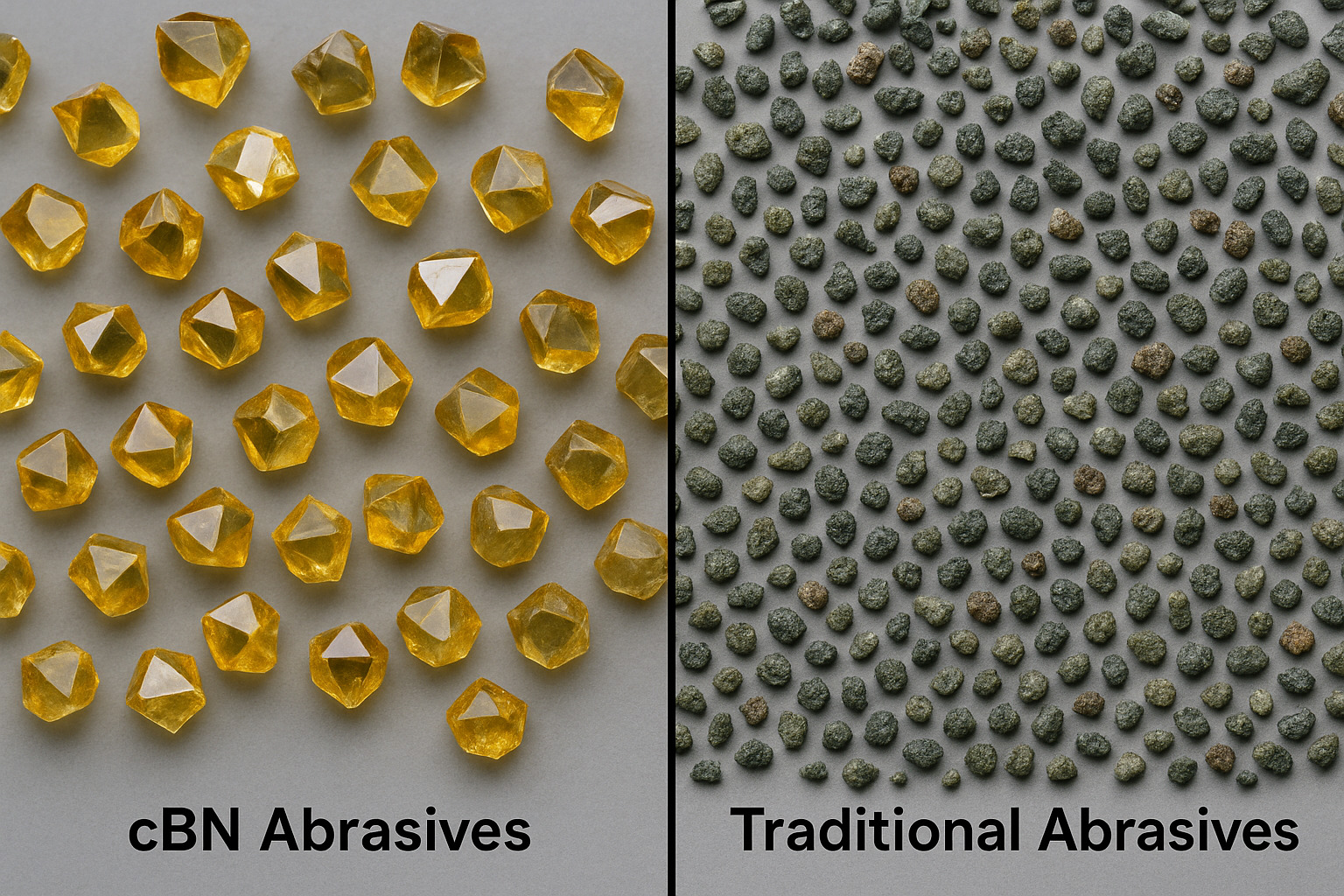
Why Cubic Boron Nitride Outperforms Traditional Abrasives
1. Hardness and Wear Resistance
Cubic boron nitride has a high level of hardness. When I was young in the field, hardness was a key factor in choosing materials. The typical hardness of cubic boron nitride is around 40 to 45 gigapascals. Traditional abrasives generally have lower values. For example, aluminum oxide scores around 20 gigapascals. The difference matters when working on hard materials such as hardened steel. A more wear-resistant abrasive keeps its shape longer. This means fewer replacements and less downtime in production shops.
Further reading: Why is Cubic Boron Nitride Called a Superhard Material?
2. Thermal Stability
One of the challenges in grinding is handling high temperatures. Cubic boron nitride stands up well under heat. It maintains its structure when temperatures rise above 800 degrees Celsius for brief periods. Traditional abrasives may not have this tolerance or may start to break down. In my early experiments, I noted that heat management is essential in every mechanical process. When grinding or cutting metals at high speeds, the workpiece and abrasive interact in a very hot environment. Cubic boron nitride wheels create less heat over time. They also allow better cooling during the process. This property not only adds to the wheel’s longevity but also improves safety in the workshop. Shops working with high temperatures have noted fewer accidents and a smoother work process when switching to cubic boron nitride.
3. Chemical Inertness
Chemical reaction between the abrasive and the workpiece is another challenge. Cubic boron nitride is more chemically inert than many traditional abrasives. This means it does not react easily with the metals it grinds. Many traditional abrasive particles can interact with ferrous materials and cause premature wear. I recall many instances when a traditional abrasive wheel would quickly lose its effectiveness on hardened steel. Cubic boron nitride maintains its chemical stability in most metal grinding operations. This is especially important in machining applications where oxidation or chemical wear is a risk. With fewer chemical reactions, the final surface finish is smoother. Operations that demand precise tolerances prefer cubic boron nitride because of its consistent behavior.
4. Consistent Grain Size and Quality
The uniformity of abrasive grains plays a big role in performance. Cubic boron nitride is manufactured with a very consistent grain size. I have worked simultaneously with different companies. They all noted that consistency in grain size leads to predictable performance. Traditional abrasives sometimes have variations due to how they are made. This can lead to uneven grinding and variable surface finishes. A consistent abrasive helps operators get a repeatable result. In one example from a local automotive parts plant, they switched to cubic boron nitride wheels. The uniform grain structure improved the surface finish of critical components. In turn, this reduced waste and improved productivity. Consistency is key in industries where precision matters.
5. Economic Efficiency
At first glance, cubic boron nitride may seem more expensive. However, its benefits ensure long-term savings. Fewer replacements and less downtime add up to a lower overall cost. Many facilities are investing in cubic boron nitride baskets. They reported a decrease in maintenance costs over time. In addition, the improved productivity means that more parts are finished in less time. Workshops that switched noted savings in labor and energy expenses. I remember a case where a small machine shop saved thousands of dollars over a year after making the switch. The higher upfront cost is offset by long-term efficiency. It is a wise economic choice when durability and performance are essential.
Conclusion
Cubic boron nitride offers clear advantages over traditional abrasive materials. Its high hardness and wear resistance make it suitable for grinding hardened materials. Its thermal stability and chemical inertness add to its reliability in high-speed operations. The uniform grain size leads to consistent results. Finally, the overall economic efficiency makes it a smart choice for the industry. For more boron nitride materials, please check Stanford Advanced Materials (SAM).
Frequently Asked Questions
F: Why is cubic boron nitride harder than traditional abrasives?
Q: Cubic boron nitride has a bonded structure with a hardness of around 40-45 gigapascals, surpassing standard abrasives.
F: How does cubic boron nitride handle high temperatures?
Q: It maintains its integrity in environments reaching 800 degrees Celsius for short periods.
F: What benefits do uniform grain sizes bring?
Q: A uniform grain size ensures consistent grinding, improved surface finish, and predictable performance.
 Chin Trento