Products
 Bars
Bars
 Beads & Spheres
 Bolts & Nuts
 Crucibles
 Discs
Discs
 Fibers & Fabrics
 Films
Films
 Flake
Flake
 Foams
Foams
 Foil
Foil
 Granules
 Honeycombs
 Ink
Ink
 Laminate
 Lumps
Lumps
 Meshes
 Metallised Film
 Plate
Plate
 Powders
 Rod
Rod
 Single Crystals
 Sputtering Target
 Tubes
Tubes
 Washer
 Wires
Wires
 Converters & Calculators
 Write for Us



MAX Phase Ceramics vs. Traditional Ceramics: What Is the Difference?

Introduction
In today’s material science landscape, ceramics play a key role in many applications. Traditional ceramics have long been used in various industries due to their hardness and high-temperature stability. However, there is another class of ceramics that has attracted much attention. These are the MAX Phase ceramics.
MAX Phase ceramics are called such due to their unique layered structure. They combine some of the very best traits of metals and ceramics. Traditional ceramics also perform well in many areas but come with certain drawbacks. In this article, we discuss both types in detail.
MAX Phase Ceramics vs. Traditional Ceramics
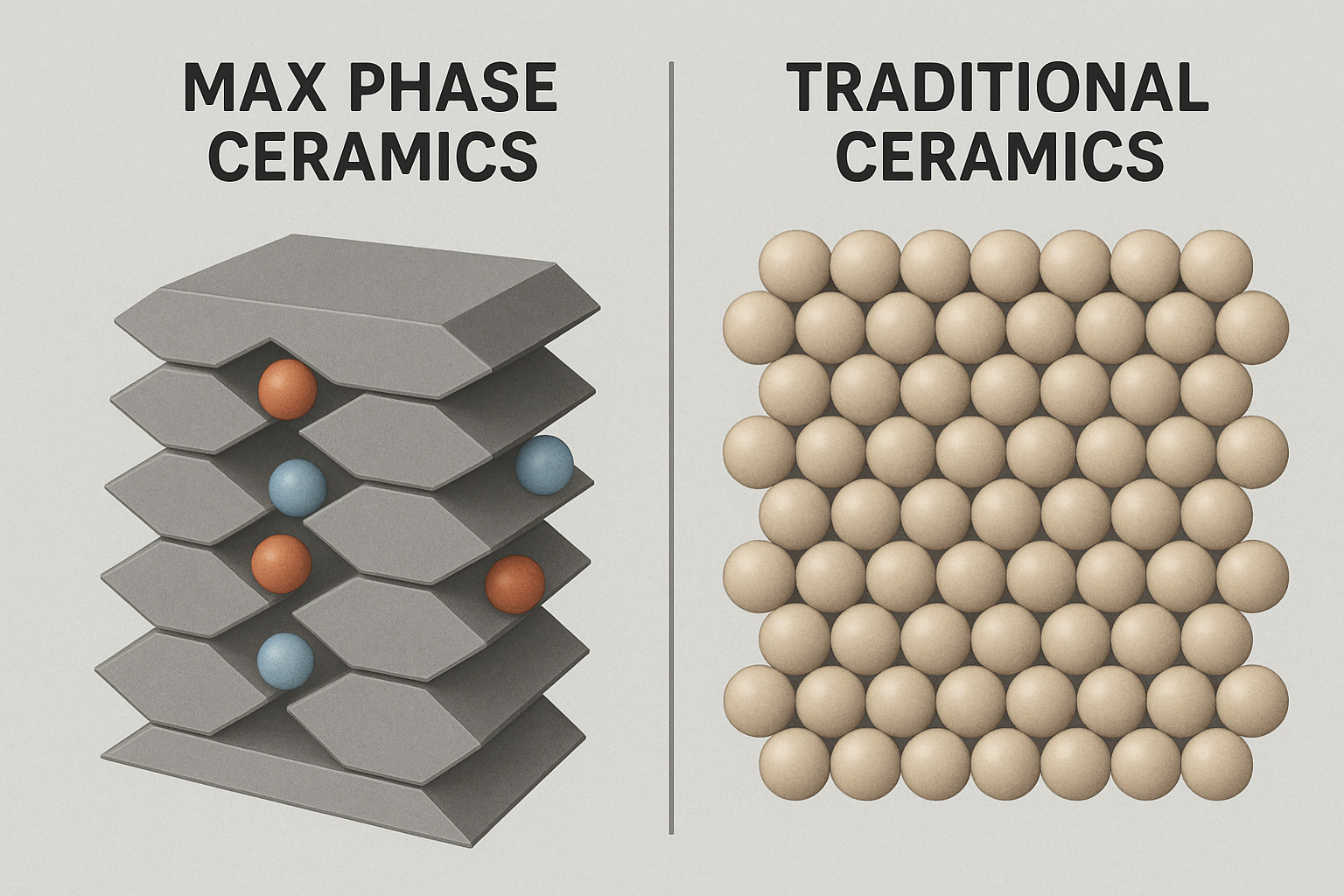
Traditional ceramics have been around for centuries. They are made from non-metallic, inorganic materials. Examples of traditional ceramics include alumina (aluminum oxide) and silicon carbide. These materials carry a reputation for hardness, high wear resistance, and high melting points. Traditional ceramics are used in everyday objects as well as in high-temperature components. For instance, porcelain mugs, tiles, cutting tools, and parts for engines come from this family of materials.
Even though traditional ceramics are hard and stable, they do have one big weakness. They are brittle. A small crack can lead to failure, and this brittleness restricts their use in applications where shock resistance is needed. Specific cases have shown that ceramic brake discs, though hard, must be handled carefully when used in harsh conditions since too much stress can lead to cracks.
In contrast, MAX Phase ceramics have a layered structure that merges characteristics of metals and ceramics. Their chemical formula is often written as Mₙ₊₁AXₙ, where M is an early transition metal, A is an element like aluminum, and X is carbon or nitrogen. This special arrangement gives them a set of intriguing attributes. In everyday terms, MAX Phase ceramics are not as brittle as traditional ceramics. They have the ability to absorb stress better, thanks to a structure that allows some plasticity. In several studies, these ceramics have shown not only high-temperature stability but also some repair-like capabilities when damage occurs.
Let me give an example using titanium aluminum carbide. In one case, engineers tested titanium aluminum carbide in high-temperature conditions. The material kept its shape under loads and did not shatter easily. Data revealed that its elasticity is more akin to metals than what is seen in traditional ceramics. The improved toughness makes it attractive for applications where durability is paramount. Even if a crack appears, its layered structure helps in redistributing the stress. This means that components made from MAX Phase ceramics are less likely to fail catastrophically when exposed to sudden impacts.
Another interesting property of MAX Phase ceramics is their ability to conduct electricity and heat. Traditional ceramics are usually good electrical insulators. In contrast, MAX Phase ceramics are used in settings where some form of electrical conductivity is an advantage. For example, in some heat exchangers or electronic substrates, the conductivity of MAX Phase ceramics plays a crucial role. Data shows that the level of thermal conductivity in MAX Phase ceramics can be five times higher than that seen in traditional ceramics. Specific cases have noted that this property allows for better management of thermal loads in high-performance engines and electronic components.
Traditional ceramics, on the other hand, are prized for applications where insulation is key. In household cooktops, ceramic parts help to ensure that heat is used efficiently while remaining safe to touch. Their high resistance to wear makes them ideal for cutting tools and wear parts in engines. However, when harsh mechanical stress comes into play, these materials may crack, which is why MAX Phase ceramics can have an edge in particular settings.
There is also a difference in processing and cost. Traditional ceramics tend to be processed by sintering powders at high temperatures. This method has been refined for many years and is cost-effective for mass production. MAX Phase ceramics require a controlled environment and careful treatment to maintain their unique structure. Their manufacture might be a bit more expensive at first, but the performance gains can justify the cost in critical applications.
In a practical setting, consider the component parts in an engine. Traditional ceramics may be used in parts like turbine blades where high temperatures are expected, but the brittleness can lead to sudden failure. MAX Phase ceramics, with their ability to absorb shock and reshape slightly under stress, show promise in reducing the likelihood of cracks. Engineers have used these ceramics in pilot tests, measuring thermal expansion and stress distribution under heat loads. Data indicated that while traditional ceramics showed abrupt thermal failures beyond certain temperatures, MAX Phase ceramics managed stress distribution more evenly.
Another example is in the area of electrical contacts. While traditional ceramics serve as insulators, in industries that require a combination of strength and conductivity, MAX Phase ceramics shine. Their mixture of ceramic hardness with metal-like electrical properties situates them in a niche that is not well served by traditional ceramics. The case studies in electronic packaging highlight that MAX Phase ceramics can provide a reliable platform where both mechanical resistance and some level of conductivity are needed.
The debate between using traditional ceramics versus MAX Phase ceramics ultimately depends on the application. SIMPLY put, if the system only requires high hardness and stability with little chance of mechanical stress, traditional ceramics are often enough. However, where shock absorption, conductivity, and the ability to handle rapid changes are needed, MAX Phase ceramics offer a promising alternative.
Many engineers have noted that the unique structure of MAX Phase ceramics allows them to be polished to a high finish. This is in contrast with traditional ceramics which usually require coating or additional finishing work. The ability to polish MAX Phase ceramics to an almost mirror-like finish facilitates their use in precision instruments and higher-end components. In some medical devices, for example, the smooth surface and reliable performance add up to an improved product that lasts longer under repeated use.
Conclusion
In summary, the main differences lie in toughness, conductivity, and stress response. MAX Phase ceramics provide a mix of toughness and conductive performance, while traditional ceramics excel in hardness and high-temperature endurance but are prone to brittleness. Industries that require balanced performance may lean toward MAX Phase ceramics. Meanwhile, cost-effective applications may stick with traditional ceramics. For more comparison article, please visit Stanford Advanced Materials (SAM).
Frequently Asked Questions
F: What makes MAX Phase ceramics less brittle than traditional
ceramics?
Q: Their layered structure acts like a built-in shock absorber, reducing the
chance of sudden failure.
F: Do MAX Phase ceramics conduct heat better than
traditional ceramics?
Q: Yes, they typically have up to five times higher thermal conductivity.
F: Can traditional ceramics be used in high-temperature
applications?
Q: Yes, they are excellent for high-temperature use but are more prone to
cracking under impact.
 Chin Trento