Products
 Bars
Bars
 Beads & Spheres
 Bolts & Nuts
 Crucibles
 Discs
Discs
 Fibers & Fabrics
 Films
Films
 Flake
Flake
 Foams
Foams
 Foil
Foil
 Granules
 Honeycombs
 Ink
Ink
 Laminate
 Lumps
Lumps
 Meshes
 Metallised Film
 Plate
Plate
 Powders
 Rod
Rod
 Single Crystals
 Sputtering Target
 Tubes
Tubes
 Washer
 Wires
Wires
 Converters & Calculators
 Write for Us



What Are Nonlinear Crystals

What Makes A Nonlinear Crystal?
A nonlinear crystal is a substance with a response varied by the light intensity. Their output is not proportionally equal to input light unlike regular crystals. They have special molecular or atomic arrangements that allow light waves to blend and generate new frequencies. Put simply, when light is directed through a nonlinear crystal, the light can change color or split into multiple beams of different energies.
These crystals help in creating effects such as frequency doubling, or second harmonic generation. For instance, an infrared laser beam can be converted into visible green light through this process. Nonlinear crystals also play a role in processes such as sum-frequency and difference-frequency generation. The nature of these crystals is highly dependent on the intensity of light and the specific direction of the crystal itself.
Further reading: Linear & Nonlinear Optical Crystals Explained
Key Optical Properties of Nonlinear Crystals
Nonlinear crystals are characterized by certain optical features. Among the key features is the nonlinearity coefficient. The coefficient will tell us about the effectiveness with which a crystal can convert one frequency of light into another. A commonly used crystal may have a coefficient of about 2.5 picometers per volt and therefore be valuable in certain laser uses.
A second characteristic is the phase matching condition. Phase matching is vital for effective frequency conversion. It is achieved when the different waves of light travel at speeds that allow them to interact constructively. The condition relies on the birefringence of the crystal, the presence of two distinct refractive indices. The majority of experiments stabilize the exact angle of the crystal in relation to the beam of light in order to obtain the best outcome.
The transparency range of a nonlinear crystal is also of most importance. A crystal should allow the passing of the incident as well as generated frequency of light without loss. For instance, beta barium borate (BBO) crystals have been observed to perform satisfactorily in an ultraviolet to infrared wide wavelength range. This piece of information is important in selecting the suitable crystal for an application.
The interaction of light with nonlinear crystals is among the most intriguing aspects of optics. The electric field of light interacting with the crystal lattice when it passes through the crystals will modify the behavior of light. The crystal will react nonlinearly when the intensity of the light is high enough. A collimated laser beam is often used to ensure the effect can be easily observed.
One typical use is frequency doubling. A beam of a specific infrared frequency can exit a crystal as a beam twice that frequency, i.e., visible light. Nonlinear crystals will also combine two or more frequencies of light into one or disperse a beam into two or more new beams. Scientists and engineers control the incident light and crystal orientation to steer the output with accuracy. This effect has created many valuable uses in devices today.
General Types of Nonlinear Crystals
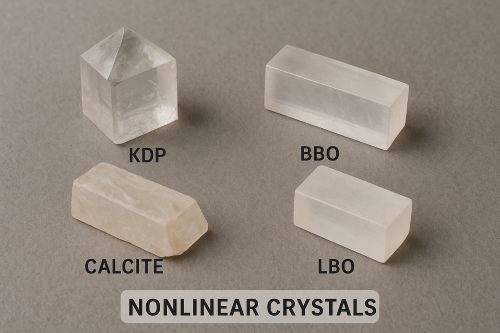
There are a number of nonlinear crystals present in the laboratory and industry. Beta barium borate (BBO) is one of the most common. It is used very commonly for frequency conversion of ultraviolet light. Potassium titanyl phosphate (KTP) is another highly demanded crystal used commonly in green light generation from infrared lasers. Lithium niobate is renowned because of its excellent nonlinearity and applications in optical modulation and frequency conversion.
Other crystals, including ammonium dihydrogen phosphate (ADP) and deuterated potassium dihydrogen phosphate (DKDP), possess unique applications. They offer unique characteristics that can be applied to specific applications. Crystal selection relies on wavelength range, conversion efficiency, and thermal stability. Each crystal possesses strengths and weaknesses that make them suitable for specific applications in optical experiments and industrial processes.
Applications in Lasers, Photonics, and Frequency Conversion
Nonlinear crystals find broad applications in the field of lasers and photonics. Laser frequency conversion allows devices to generate wavelengths that are not available freely from laser media. An example is a standard Nd:YAG laser source which emits infrared light and can generate visible green light as it passes through a frequency doubling crystal like KTP.
They are also used in pervasive photonics equipment. Fiber optic systems sometimes require light of other frequencies, and the crystals help generate them. Industrial applications include laser cutting and processing of material. Accuracy offered by nonlinear crystals here is critical to allow clean cuts and minimal heat damage.
The conversion process in these crystals is underpinned by stringent data. As an example, phase matching angles and the conversion efficiency are recorded precisely. Most labs make use of crystals with up to around 50 percent conversion efficiency in ideal conditions. This reliability accounts for why nonlinear crystals play key roles in present-day optical configurations and science equipment.
Conclusion
Nonlinear crystals are major components of the majority of photonic and optical technologies. They respond to the light intensity in an unusual way. Their particular properties allow frequency conversion of light and the creation of new light colors. With ordinary materials like BBO, KTP, and lithium niobate, they are used in laboratory experiments as well as industrial applications. Their utilization is the basis of most laser systems and frequency converters. For more optics, please visit Stanford Advanced Materials (SAM).
Frequently Asked Questions
F: What is a nonlinear crystal?
Q: A crystal that changes the frequency of light when high-intensity light passes through it.
F: How does phase matching affect light conversion?
Q: Phase matching synchronizes light waves to produce effective frequency conversion.
F: What is an example of one of the common applications of nonlinear crystals?
Q: They are used to convert infrared light to visible light in laser systems.
 Chin Trento