
 Products
 Bars
Bars
 Beads & Spheres
 Bolts & Nuts
 Crucibles
 Discs
Discs
 Fibers & Fabrics
 Films
Films
 Flake
Flake
 Foams
Foams
 Foil
Foil
 Granules
 Honeycombs
 Ink
Ink
 Laminate
 Lumps
Lumps
 Meshes
 Metallised Film
 Plate
Plate
 Powders
 Rod
Rod
 Single Crystals
 Sputtering Target
 Tubes
Tubes
 Washer
 Wires
Wires
 Converters & Calculators
 Write for Us



Titanium Fiber Felt Gas Diffusion Layer: Enhancing Fuel Cell Performance

Introduction
Fuel cells have grown more significant over the years. They are functional based on many components. The gas diffusion layer is one of the most significant components. Titanium fiber felt gas diffusion layer is a new alternative that is more efficient.
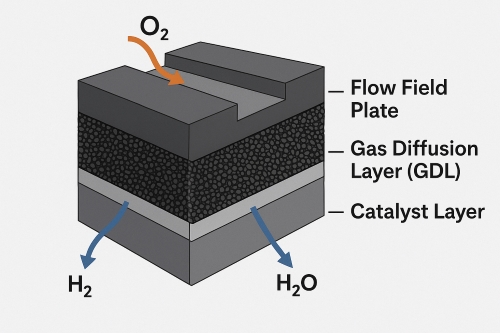
What Is Gas Diffusion Layer?
The gas diffusion layer is a fuel cell component that distributes the gases evenly in the system. It also enables water management and mechanical strength. An effectively designed gas diffusion layer enables the chemical reactions to take place at a steady rate.
What Is Titanium Fiber Felt Gas Diffusion Layer?
This type of gas diffusion layer is made from titanium fibers. The fibers are felted into a sheet that is porous. The high-quality metal fibers ensure structure continuity with excellent electrical conductivity and corrosion resistance. The result is a material that functions well under the high demands of fuel cell operation.
Properties of Titanium Fiber Felt
The titanium fiber felt has some interesting properties:
• High porosity with 80% to 90% percentages. This provides ease in the passage of gases.
• Excellent corrosion resistance. This is important when it undergoes long exposure in harsh environments.
• Good mechanical strength. This can withstand the compression and pressure common in fuel cell stacks.
• Lightweight. Fuel cells perform better with lighter materials.
• Higher electrical conductivity compared to some carbon-based layers. This helps the overall cell efficiency.
These properties have been known to improve the life and efficiency of the fuel cell, as shown by research.
Manufacturing Methods
Titanium fiber felt is produced through a series of operations. Titanium fibers are cut to length initially. The fibers are then developed into a mat via operations like wet-laying or needle-punching. A sintering operation follows. Sintering joins the fibers together without any other materials. It preserves the porosity and strength of the felt. Present methods allow for strong, uniform layers suitable for fuel cell applications.
Performance in Fuel Cells
A fuel cell's operation relies on uniform gas distribution and effective water management. The titanium fiber felt gas diffusion layer excels in both these respects. Fuel cells incorporating this material exhibit improved current distribution and stability. In testing, many have observed performance improvements of 10% or greater compared to standard layers. The improved water handling reduces flooding, a common problem with fuel cells. The outcome is more stable operation over time.
Advantages Compared to Carbon-Based Gas Diffusion Layers
Carbon-based gas diffusion layers have been the norm for decades. However, they do have known drawbacks. Titanium fiber felt gas diffusion layers offer several benefits:
• Enhanced corrosion resistance at high potential and humidity.
• Enhanced mechanical durability from repeated operating cycles.
• Enhanced electrical conductivity is due to the metal fibers.
• Enhanced thermal stability during high-heat durations.
These advantages make the titanium fiber felt option more reliable for demanding applications.
Applications of Titanium Fiber Felt Gas Diffusion Layer
Titanium fiber felt gas diffusion layer is finding its way into various fuel cell applications:
• In proton exchange membrane fuel cells for transportation, it aids in attaining higher life and stable operation.
• In stationary power systems, it aids in maintaining efficiency during varying loads.
• Scientists also have visions for its application in backup power supplies and aerospace.
For instance, automotive fuel cells using this material have shown reduced degradation over time, which means lower maintenance.
Further reading: Gas Diffusion Layers: Why Fiber Felts Are the Preferred Choice
Conclusion
In conclusion, the titanium fiber felt gas diffusion layer has great potential for enhancing the performance of fuel cells. Its conductivity, strength, corrosion resistance, and high porosity make fuel cells run smoothly and efficiently. The manufacturing processes preserve these advantages without making the cost prohibitive. Its improvement in performance and usefulness over carbon-based layers renders it a viable option for use in future applications. With fuel cell technology still evolving, this material can be expected to have a growing role in helping to provide extended life and improved efficiency of power systems.
Frequently Asked Questions
F: In what way is titanium fiber felt better than carbon-based layers?
Q: It offers improved corrosion resistance, mechanical strength, and electrical conductivity.
F: How is titanium fiber felt gas diffusion layer manufactured?
Q: Titanium fibers are felted into a mat and sintered to bond the fibers with the preservation of porosity.
F: Is the fuel cell overall efficiency improved by this material?
Q: Yes, its properties allow for improved gas and water management, leading to improved fuel cell performance.
 Chin Trento