Products
 Bars
Bars
 Beads & Spheres
 Bolts & Nuts
 Crucibles
 Discs
Discs
 Fibers & Fabrics
 Films
Films
 Flake
Flake
 Foams
Foams
 Foil
Foil
 Granules
 Honeycombs
 Ink
Ink
 Laminate
 Lumps
Lumps
 Meshes
 Metallised Film
 Plate
Plate
 Powders
 Rod
Rod
 Single Crystals
 Sputtering Target
 Tubes
Tubes
 Washer
 Wires
Wires
 Converters & Calculators
 Write for Us



Case Study: Niobium Mesh for Titanium Anodizing Basket

Stanford Advanced Materials is a reliable supplier of advanced materials and has been at the forefront of special product supply in an array of industries for many years. More recently, the company provided support to a high-technology manufacturing project for the production of a titanium anodizing basket; this special basket for titanium anodizing called for a custom-made solution using a special type of niobium mesh-a practical solution for the critical need in the titanium anodizing industry.

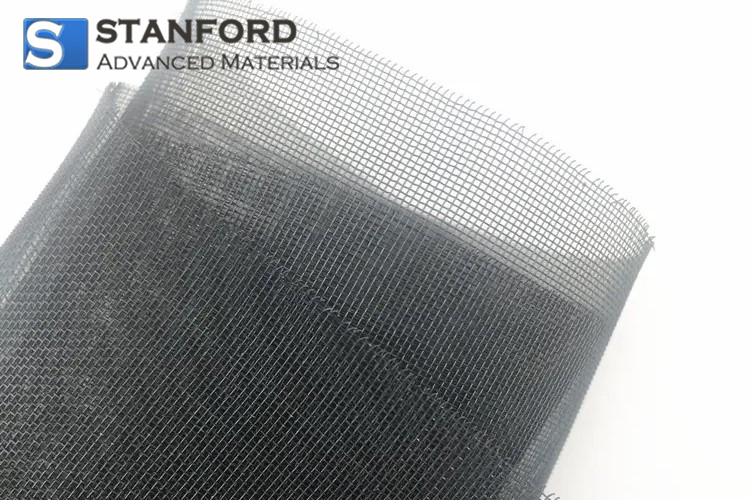
Fig. 1 Niobium Mesh
The Challenge
The project entailed the prototyping of a titanium anodizing basket that would be resistant to the very corrosive and high-temperature environment in the anodizing process. Some of the technical demands of this basket were as follows:
- Corrosion Resistance: Titanium anodizing involves immersion of titanium parts in an electrolytic bath in very high voltages and acidic conditions; the basket materials should therefore be resistant to such corrosion.
- Structural Integrity at High Temperatures: Anodizing and post refining processes are performed at high temperatures. The material selected to make the basket needed to retain structural integrity without deforming or weakening under these conditions.
- Compatibility with Titanium Anodizing Process: The material must support the titanium parts while keeping accurate dimensional tolerances to allow uniform coating during the anodizing process.
The material operating in such conditions needed to be durable and not too expensive, keeping all the properties it had. The ease of use required making this basket practical for manufacturing facilities.
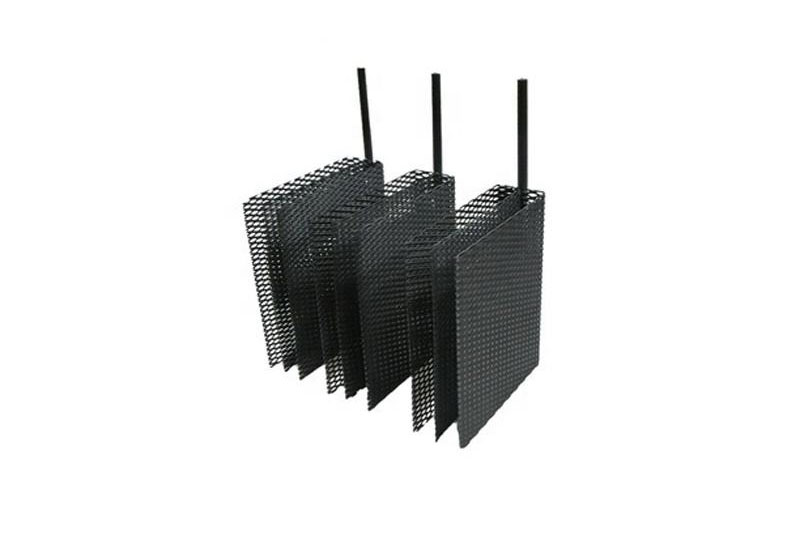
Fig. 2 Titanium Anodizing Basket
The Solution
After carefully considering the requirements of the project, the technical advisors at SAM recommended the use of niobium mesh for the construction of the prototype anodizing basket. Niobium was chosen to meet key requirements such as:
1. Corrosion Resistance: Niobium is highly resistant to corrosion, mainly in acidic conditions. This makes it very ideal for use in anodizing baths. Unlike materials such as stainless steel, that may corrode or degrade over time in such environments, niobium maintains its structural and chemical integrity throughout the anodizing process.
2. High-Temperature Stability: The resistance of Niobium to high temperatures is very good, and it is important for maintaining the stability of the anodizing basket during the heating phase of the anodizing process. Because of its very high melting point (in excess of 2,400°C), when such heat is applied, it will not deform or lose strength.
3. Durability and Strength: Niobium combines strength and flexibility in a unique way. It can be fabricated into a mesh that is lightweight yet strong, ensuring that the basket is durable while still being able to handle the weight of the titanium parts being anodized.
4. Customization: SAM worked closely with the customer to design a custom niobium mesh basket using the client's specified dimensions and design criteria. The mesh was specially tailored to ensure the best possible support for the titanium parts during anodizing to achieve maximum uniformity and quality of the anodized coating.
The Results
The prototype niobium mesh basket worked very well in the anodizing process for titanium. The main deliverables from the project were:
- Cost-Effective: The cost of using niobium was relatively affordable compared to other materials such as platinum or graphite used for anodizing baskets, which may be more expensive and short-lived. Niobium mesh replaced them, offering a longer life and less frequent change-out.
- Compatibility with Titanium Anodizing: The basket supported the titanium parts effectively during the anodizing, thus maintaining uniform coating thickness. These are very important features for the look, performance, and durability of the anodized titanium parts themselves.
What Is Niobium Mesh?
The mesh is made from niobium, a transition metal with excellent properties at high temperatures and in corrosive conditions. Niobium mesh is either woven or expanded from sheets of niobium to form a network-like material with thin, fibrous strands capable of supporting and holding various materials.
Applications of Niobium Mesh
The element Niobium boasts excellent resistance to oxidation, corrosion, and high temperatures, hence being widely used in aerospace, electronics, and chemical processing.
- Aerospace: Niobium is utilized in aerospace industries because it offers resistance to high temperatures and corrosion, hence making it the perfect candidate for parts exposed to extreme conditions.
- Chemical Processing: Niobium mesh is used in reactors and other chemical-processing equipment, where its resistance to corrosion is an essential factor.
- Electrochemical Applications: Niobium is used both in electrochemical cells as well as in other electrochemical uses, where its resistance to corrosion and to high temperatures is considered an advantage.
- Medical Devices: Niobium is used in medical implants and devices because of its biocompatibility; the applications require strong but non-reactive material.
Conclusion
This project presented Stanford Advanced Materials with an opportunity to showcase SAM's capability in offering value-added material solutions for various advanced manufacturing applications. The utilization of niobium mesh for the prototype titanium anodizing basket resolved many critical issues concerning corrosion, high-temperature stability, and durability and thus was regarded as an ideal solution to meet customer anodizing requirements. The capability of SAM to fabricate and customize niobium mesh to cater to the specific needs of the project further enhanced its reputation as a reliable source for advanced materials in the high-tech manufacturing sector.
 Dr. Samuel R. Matthews