Products
 Bars
Bars
 Beads & Spheres
 Bolts & Nuts
 Crucibles
 Discs
Discs
 Fibers & Fabrics
 Films
Films
 Flake
Flake
 Foams
Foams
 Foil
Foil
 Granules
 Honeycombs
 Ink
Ink
 Laminate
 Lumps
Lumps
 Meshes
 Metallised Film
 Plate
Plate
 Powders
 Rod
Rod
 Single Crystals
 Sputtering Target
 Tubes
Tubes
 Washer
 Wires
Wires
 Converters & Calculators
 Write for Us



High Purity Lithium Metal Foil Delivers Safer Anode Performance for Advanced Battery Research

Customer Background
A well-regarded team based in France, active in the energy storage sector, sought to advance their battery research initiatives. Their focus has been on safer and more efficient anode materials for both advanced lithium battery and solid-state battery configurations. Known for cautious process development, the team had engaged in multiple research programs and had built a reputation for rigorously evaluating any new material for compatibility with their cell designs. They required a supplier capable of providing ultra-high purity lithium metal foil, produced to tight dimensional tolerances, and certified to support the demanding safety aspects inherent in their testing protocols.

Challenge
The project's challenge extended beyond supplying a conventional lithium foil. The research unit needed a product that met several strategic technical requirements:
• Lithium purity had to be controlled at a minimum of 99.99% to eliminate impurities that could compromise battery performance.
• The foil was required to be exceptionally thin – around 20 microns – with a tolerance of ±1 micron, to achieve the ideal balance between mechanical flexibility and anode efficiency.
• Safety was paramount. The processing chain demanded controlled oxidation levels and specialized packaging to both maintain the reactivity levels of the lithium while mitigating the risk of accidental exposure.
Additionally, the research timeline was constrained by a short lead time requirement. Previous suppliers had not consistently met delivery schedules when cast against the project's narrow window, which risked delaying critical phases in the battery development process.
Why They Chose SAM
After evaluating multiple suppliers, the team opted for Stanford Advanced Materials (SAM) due to our 30+ years of experience and our proven global supply chain. Early communications revealed that our technical support team not only understood the rigorous purity and thickness demands but also took a proactive approach in understanding how the microstructural properties of the metal foil could affect battery performance. We provided detailed feedback on the benefits of a tightly controlled grain structure and recommended packaging improvements that reduced oxidation risk during transit.
Our ability to validate product specifications against real-world processing constraints, as well as our readiness to adjust production parameters to match the customers' testing conditions, was a significant factor in their decision-making process.
Solution Provided
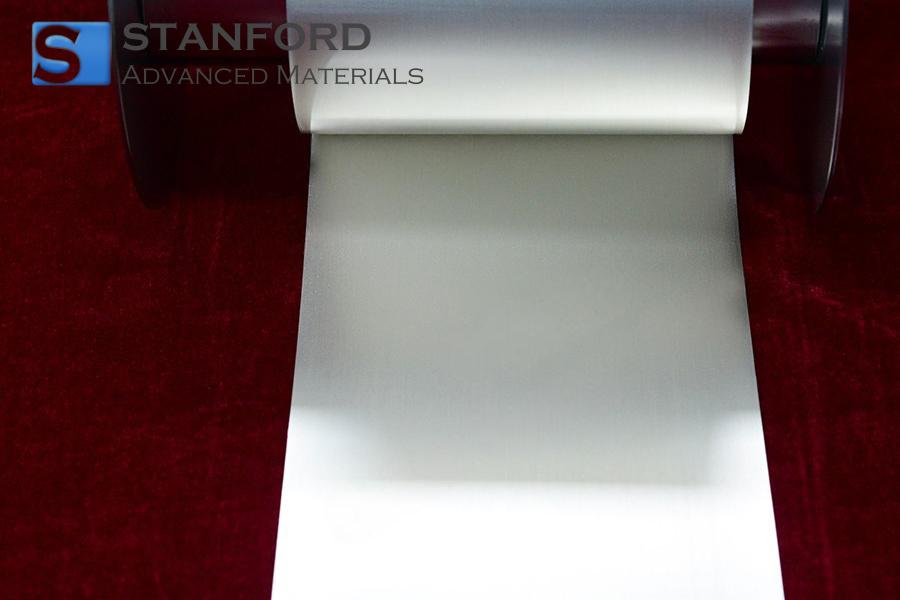
SAM supplied a custom-configured lithium metal foil designed specifically for advanced battery research. The product was produced using high-purity lithium alloy techniques to guarantee a purity level of at least 99.99%. Recognizing the critical sensitivity of the anode in lithium battery systems, we maintained the foil thickness consistently at 20 microns ±1 micron, ensuring that slight variations did not introduce mechanical or electrical instabilities during experiments.
Several technical details were carefully managed:
• The foil's microstructure was enhanced to reduce internal stress, which reduced the risk of micro-cracking during repeated battery charge cycles.
• To address the safety and handling concerns, each roll was vacuum-sealed in a nitrogen-filled environment to limit surface oxidation and prolong the foil's shelf-life.
• The product was dimensionally stabilized through precision rolling processes that ensured uniformity across each shipment.
We also incorporated customized operational protocols that included a recommended storage temperature range (typically between -20°C to 25°C) and specific handling instructions to maintain the reactive surface integrity until the point of use. Special attention was given to the packaging details, with each batch encased in a layered barrier system to meet the safety and transport standards required by the energy storage research community.
Results & Impact
The tailored solution from SAM led to more consistent performance during battery assembly tests. The strict adherence to the ℅ 99.99 purity standard, combined with the maintained thin gauge at 20 microns, allowed the research team to observe a stable anode behavior that reduced variability in their experimental cycles. Notably, the enhanced microstructure contributed to improved thermal stability, resulting in a more reliable cyclic performance over extended testing durations.
The robust packaging and controlled environment measures minimized oxidation before usage, reducing the need for additional in-lab purification processes. This not only accelerated the experimental timeline but also lowered the risk of safety incidents during handling. The reliable delivery times maintained within a three-week schedule clearly contributed to keeping the critical path of their project intact.
Key Takeaways
The case highlights the necessity for precision in both material specifications and logistical execution in energy storage research applications. High purity levels, precise thickness control, and a keen focus on safety protocols are essential when materials are directly responsible for the stability and performance of battery systems.
Working with SAM allowed the research team to concentrate on process innovations rather than material inconsistencies. The emphasis on vacuum-sealed packaging and strict temperature recommendations shows that even incremental improvements in material handling can translate to measurable performance advantages in advanced battery applications.
Ultimately, effective communication on detailed technical criteria and adherence to rigorous standards are what facilitate faster iterations in research and contribute towards safer, more reliable energy storage solutions.
 Dr. Samuel R. Matthews