Products
 Bars
Bars
 Beads & Spheres
 Bolts & Nuts
 Crucibles
 Discs
Discs
 Fibers & Fabrics
 Films
Films
 Flake
Flake
 Foams
Foams
 Foil
Foil
 Granules
 Honeycombs
 Ink
Ink
 Laminate
 Lumps
Lumps
 Meshes
 Metallised Film
 Plate
Plate
 Powders
 Rod
Rod
 Single Crystals
 Sputtering Target
 Tubes
Tubes
 Washer
 Wires
Wires
 Converters & Calculators
 Write for Us



Yb:CaF2 Crystal for High-Power Laser Gain Applications in Photonics

Customer Background
Our customer is a prominent photonics firm based in the United States. They specialize in developing high-power solid-state laser systems used in advanced manufacturing and precise photonic applications. Their product portfolio includes laser modules for materials processing, medical imaging, and scientific instrumentation. With the rapid evolution of laser technology, they required a laser gain medium with minimal performance variation over prolonged use. Although their team excels in system design and integration, they had to rely on external expertise for customized materials with exacting quality and lead time constraints.

Challenge
The production challenge centered on the fabrication of a Yb:CaF2 crystal that would meet stringent performance criteria for laser gain media. Our customer needed a material demonstrating exceptional optical clarity, low defect density, and high purity levels, given that even minute imperfections could disrupt the coherent performance in laser systems.
Specifically, the crystal had to fulfill several technical constraints:
- The doping concentration of ytterbium needed to be controlled accurately within ±0.002 atomic fraction to ensure optimal laser gain.
- The crystal dimensions were critical; the dimensions required were nominal 10.00 mm x 10.00 mm x 3.00 mm with dimensional tolerance tightly controlled at ±0.10 mm.
- Surface finish played a major role. The crystals required dual-sided polishing achieving an average surface roughness (Ra) of less than 0.5 µm to reduce scatter and maximize optical efficiency.
Furthermore, there were real-world constraints regarding production volumes and the need for a reduced lead time to meet the customer's tight project schedules. Previous attempts with alternative suppliers faced delays of several weeks that risked the overall production timeline of their final laser systems.
Why They Chose SAM
The customer approached us at Stanford Advanced Materials (SAM) with a clear need for reliability and expertise in precision optical materials. Our reputation for handling over 10,000 materials and supporting 10,000+ customers worldwide gave them confidence that we could deliver under demanding technical and time constraints.
During initial discussions, our team found that minor deviations in the customer's documentation suggested that the previous supplier's processes were insufficiently stable for yield-critical production runs. They recognized our capability in both advanced material processing and a responsive global supply chain. Additionally, our longstanding 30+ years of industry experience provided them the technical assurance to match their high standards.
Solution Provided
At SAM, our approach began with an in-depth review of the Yb:CaF2 crystal specifications. Our experienced engineers worked collaboratively with the customer to fine-tune the material formulation and processing methods to tackle both performance and production timeline challenges.
Material formulation involved ensuring the base CaF2 crystal maintained a purity of 99.99%, crucial for minimizing trace impurities that could impair optical performance. We incorporated ytterbium doping using a controlled pre-mixing process. The doping concentration was carefully set to the customer's requirements with an uncertainty margin not exceeding ±0.002, using high-precision weighing and mixing equipment.
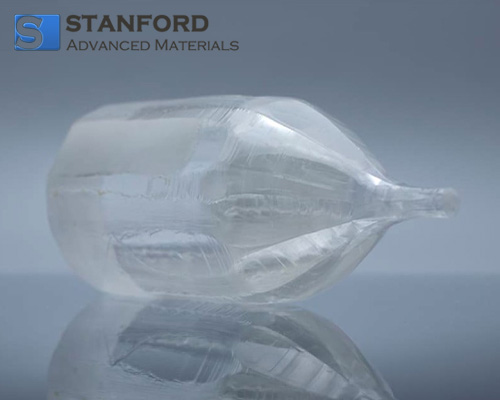
The growth process employed the Bridgman method to produce large, uniform crystals. During initial testing, we noticed minor variations in crystal clarity, prompting us to implement an in-line optical monitoring system. This allowed us to adjust growth parameters in real time. The resultant Yb:CaF2 crystals were then cut to dimensions of 10.00 mm x 10.00 mm x 3.00 mm, with a strict tolerance of ±0.10 mm. Our mechanical cutting equipment, calibrated daily, ensured that these specifications were maintained over every batch.
Next, the surface polishing step was critical. We adopted a dual-sided polishing method, which yielded a surface roughness (Ra) consistently under 0.5 µm. This step was monitored through contact profilometry to guarantee no micro-scratches or defect sites could cause unwanted scattering losses in the laser system.
In addition to manufacturing precision, we accelerated production lead times by optimizing our supply chain logistics. With manufacturing lead time reduced to 4-6 weeks, we were able to meet the client's schedule demands without compromising the rigorous quality controls. Each crystal was packaged under nitrogen atmosphere to prevent any moisture-induced degradation, and detailed certificates of analysis were provided with each shipment, documenting dimensions, doping levels, purity, and surface finish results.
Results & Impact
Following the implementation of SAM's tailored solution, the customer achieved significant improvements in both performance and scheduling:
· The Yb:CaF2 crystals exhibited excellent optical transparency with negligible scatter losses, essential for the stable operation of high-power lasers.
· Consistency across batches improved markedly, with doping levels maintained at the required ±0.002 atomic fraction and dimensions kept within the ±0.10 mm tolerance range.
· Surface integrity was preserved, as each crystal demonstrated a surface finish better than Ra 0.5 µm, ensuring minimal light loss and reliable laser operation over long durations.
The integrated approach also provided a marked reduction in the overall lead time, aligning well with the project's tight deadlines. Our early internal process corrections, prompted by observations during initial polishing, contributed directly to meeting the customer's specifications without additional rework or testing delays.
The solid-state laser systems incorporating our crystals exhibited enhanced stability, with improved lasing efficiency and reduced thermal degradation. The customer reported fewer instances of performance drift during extended operations, which is critical in industrial settings where laser output consistency is non-negotiable.
Key Takeaways
Precision in material specifications, such as controlled crystal dimensions and exact dopant concentrations, can make all the difference in laser performance. Our work on the Yb:CaF2 crystal underscores the importance of real-time process adjustments and rigorous quality control measures in producing a reliable laser gain medium.
While technical precision is paramount, meeting tight production schedules is equally critical. By streamlining our material processing and supply chain logistics, we were able to offer a solution that not only met performance metrics but also delivered on lead time. This case exemplifies how a holistic approach — combining material science expertise, process monitoring, and agile production methods — can satisfy the complex demands of modern photonic applications.
Our team at SAM remains committed to engineering rigorous, customized material solutions. Such collaborations highlight the value of integrating detailed technical insight with flexible production strategies to support high-stakes industrial applications.
 Dr. Samuel R. Matthews