
 Products
 Bars
Bars
 Beads & Spheres
 Bolts & Nuts
 Crucibles
 Discs
Discs
 Fibers & Fabrics
 Films
Films
 Flake
Flake
 Foams
Foams
 Foil
Foil
 Granules
 Honeycombs
 Ink
Ink
 Laminate
 Lumps
Lumps
 Meshes
 Metallised Film
 Plate
Plate
 Powders
 Rod
Rod
 Single Crystals
 Sputtering Target
 Tubes
Tubes
 Washer
 Wires
Wires
 Converters & Calculators
 Write for Us



Aluminum Phosphate Supply with Full Chemical Specifications for Dental and Medical Production

Customer Background
A UK-based manufacturer serving the dental and medical sector needed a reliable source of aluminum phosphate for an internal production line tied to formulation and quality validation work. The material was not being used as a casual raw input. It sat inside a controlled manufacturing process where composition records, traceability, and batch consistency mattered just as much as the powder itself.
Their team had already completed early qualification work and now needed a supplier that could provide 300 kg in one coordinated lot, with full chemical specifications for quality assurance. That included documented composition data, impurity reporting, and packaging that would hold up through receiving, sampling, and storage without moisture pickup or contamination concerns.
During initial review, it was clear the customer was trying to avoid the usual disruption that comes when a technically acceptable material arrives with incomplete paperwork. That kind of gap can slow release testing. Sometimes it stalls a full production run.
Challenge
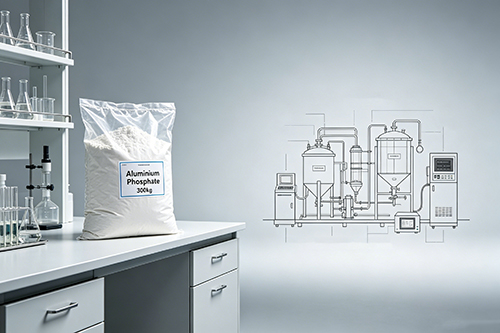
The project had several practical constraints. First, the customer required 300 kg of aluminum phosphate, not a small lab sample. The quantity had to support production planning, which meant the lot needed to be available in a single supply window rather than pieced together over multiple shipments.
Second, the material had to meet a tightly defined chemical profile. They requested high-purity aluminum phosphate with complete specification data, including assay, impurity limits, and lot-level documentation. For a regulated dental and medical workflow, vague supplier certificates were not enough. They needed evidence that the material was consistent from drum to drum.
A third constraint was handling. Aluminum phosphate can be sensitive to moisture during storage and transfer, so packaging needed to reduce caking and preserve flow characteristics. The customer also needed a lead time that fit their validation schedule. Delays would have pushed back internal testing and release checks.
Why They Chose SAM
The customer selected Stanford Advanced Materials (SAM) because we could meet both the material and documentation requirements without forcing them into a compromise. We have more than 30 years of experience supporting advanced materials programs, and our team is used to working with customers who need more than a standard catalog shipment.
What mattered here was consistency. SAM was able to provide aluminum phosphate in custom quantities from kilograms to metric tons, and our supply chain team could align the lot size with the customer's production demand. We also provided the technical documents they needed for qualification, including chemical specification sheets and batch identification details.
Our team found that the customer was especially focused on downstream compliance. That suggested the real issue was not just getting the powder on site. It was making sure the receiving team could accept it quickly and the QA group could sign off without back-and-forth clarification.
Solution Provided
We supplied 300 kg of aluminum phosphate with a specification package prepared for quality assurance review. The material was produced to a high-purity target and supplied in controlled packaging to reduce exposure during transit and storage. Each lot was labeled for traceability, and the documentation included composition data, impurity information, and supporting chemical specifications.
Three technical points were handled carefully. The first was purity control. The customer required a consistent composition profile, so we aligned the lot against a defined assay range and verified the material against specification before shipment. The second was particle handling and packaging. The product was packed in sealed containers designed to limit moisture uptake and keep the material free-flowing during receiving. The third was documentation. Every container carried clear lot identification, and the paperwork package was organized so the QA team could compare it directly against their incoming inspection checklist.
We also coordinated timing so the shipment matched the customer's scheduled intake window. That sounds simple. It usually is not. Bulk material programs often slip because the paperwork is ready before the freight, or the freight arrives before the internal approval slot opens. We kept both aligned.
Results & Impact
The customer received the full 300 kg lot on schedule and was able to move into internal verification without rework on the supplier side. The complete chemical specification package reduced review time, which helped their quality team release the material faster.
From a process standpoint, the most visible benefit was consistency. The customer reported stable handling behavior during weighing and transfer, with no unexpected clumping or contamination concerns during receipt. The sealed packaging did its job. That saved time during opening, sampling, and storage.
Just as important, the documentation gave their QA group what they needed for traceability. There were no missing values to chase down and no need for repeated clarification with the supplier. For a dental and medical production environment, that kind of predictability matters. It keeps the focus on manufacturing rather than paperwork recovery.
Key Takeaways
This project showed that even a straightforward inorganic material can become a bottleneck when specification control is incomplete. Aluminum phosphate is not difficult to source in principle, but sourcing it with reliable chemistry, proper packaging, and full supporting documentation is a different matter.
Stanford Advanced Materials (SAM) met the customer's requirements by combining product consistency, custom lot sizing, and disciplined paperwork support. SAM delivered the material in a form that fit the customer's production and quality workflow, not just their procurement request.
For regulated manufacturing teams, that distinction is often the real value. The material arrives, the documents match, and the line keeps moving.
 Dr. Samuel R. Matthews