
 Products
 Bars
Bars
 Beads & Spheres
 Bolts & Nuts
 Crucibles
 Discs
Discs
 Fibers & Fabrics
 Films
Films
 Flake
Flake
 Foams
Foams
 Foil
Foil
 Granules
 Honeycombs
 Ink
Ink
 Laminate
 Lumps
Lumps
 Meshes
 Metallised Film
 Plate
Plate
 Powders
 Rod
Rod
 Single Crystals
 Sputtering Target
 Tubes
Tubes
 Washer
 Wires
Wires
 Converters & Calculators
 Write for Us



Controlled Molecular Weight Hyaluronic Acid Powder for Cosmetic and Medical Formulation Development

Customer Background
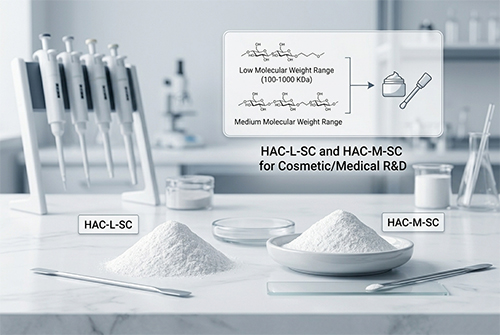
A formulation laboratory working on skin-care and wound-care prototypes needed hyaluronic acid powders in several molecular weight ranges, mainly low to medium grades around 100–1000 kDa, to compare viscosity, hydration response, and film-forming behavior across different product concepts. Their work sat at the point where lab data starts to matter. If the raw material varies from batch to batch, the whole set of test results becomes hard to trust.
The team was not buying at production scale. They needed 10–50 g lots for screening, which sounds small, but it is often where material consistency matters most. During initial testing, we noticed they were spending too much time compensating for powder variability. One batch dispersed quickly, another clumped slightly, and a third produced a different gel feel at the same concentration. That made formulation comparisons messy.
Challenge
Their main issue was reproducibility. They needed hyaluronic acid powders with controlled molecular weight distribution, consistent moisture behavior, and reliable purity so each trial could be compared on equal footing. The target was not just "HA powder." It was multiple grades that would hold stable enough to support formulation work.
A few constraints shaped the project:
· Molecular weight range needed to cover low to medium grades, with reference bands around 100–1000 kDa.
· Purity had to remain high enough to avoid interference in cosmetic and medical screening.
· Packaging needed to protect the powder from moisture pickup during short-term lab use.
· Lead time had to fit a fast R&D cycle, where delayed samples can stall the next round of testing.
The lab also wanted a supplier who could handle small quantity requests without treating them as an afterthought. That is a common pain point. Some vendors are comfortable with bulk supply, but less responsive when the order is only a few tens of grams.
Why They Chose SAM
They selected Stanford Advanced Materials (SAM) because we could provide multiple hyaluronic acid powder grades from the same sourcing channel, along with the flexibility to supply small quantities without compromising material control. Our team found that this mattered just as much as the spec sheet. In R&D, timing and batch consistency are often linked.
The customer also needed a supplier that understood how lab work is actually done. A formulation team does not want a long explanation. They want material that behaves the same way tomorrow as it did today. SAM's ability to support custom quantities, combined with our experience across advanced materials and controlled supply chains, made the decision easier.
We also discussed moisture sensitivity early in the process. That suggested a simple packaging change would save them from unnecessary re-drying and sample loss later.
Solution Provided
SAM supplied hyaluronic acid powders in multiple molecular weight grades, including low and medium ranges suited to the customer's screening program. We kept the material specification focused on what the lab actually needed: consistent molecular weight distribution, high purity, and stable handling during storage and weighing.
To make the samples more usable in practice, we provided:
· Small-lot packaging in 10–50 g quantities for bench-scale trials
· Controlled lot labeling by molecular weight grade for clean sample tracking
· Moisture-protected packing to reduce clumping during storage and opening
· Consistent purity control so the powder could be compared across formulation runs without additional correction steps
During sample preparation, our team paid attention to flow and handling. Hyaluronic acid is not a forgiving powder. It can bridge, absorb moisture, and change behavior if the packaging or storage conditions are sloppy. We therefore selected packaging that reduced exposure during routine lab handling. The customer also appreciated that each grade arrived with clearly separated documentation, which made internal tracking easier when multiple scientists were running parallel tests.
We kept the communication practical. No unnecessary back-and-forth. The lab needed samples, not a long project.
Results & Impact
After receiving the materials, the customer was able to run side-by-side formulation trials with far less variability between batches. Their team reported more stable hydration response across repeated tests, and the powder behavior during weighing and dispersion was more predictable. That alone saved time.
The most useful result was not dramatic. It was consistency. The same molecular weight grade produced similar results from one sample to the next, which gave the R&D group more confidence in their viscosity measurements and gel development work. That suggested the material itself was no longer the main variable.
A few practical benefits stood out:
· Faster screening because the team no longer had to re-check every sample for handling issues
· Cleaner comparison between low and medium molecular weight grades
· Less material waste due to moisture-related clumping
· Better internal confidence when moving a candidate formula toward pilot testing
For a formulation lab, those are meaningful gains. They reduce noise in the data and shorten the path to a usable prototype.
Key Takeaways
Small-quantity supply can be just as demanding as bulk procurement, especially when the material is hyaluronic acid powder used in cosmetic and medical formulation work. Molecular weight control, purity, and packaging stability all affect the test outcome. If those factors drift, the data drifts with them.
Stanford Advanced Materials (SAM) helped the customer keep the material side under control by supplying multiple grades, protecting the powder from moisture exposure, and supporting a tight lab timeline. We have seen this pattern many times: when the raw material is consistent, the formulation team spends less time troubleshooting and more time making decisions. That is usually where the real progress begins.
 Dr. Samuel R. Matthews