
 Products
 Bars
Bars
 Beads & Spheres
 Bolts & Nuts
 Crucibles
 Discs
Discs
 Fibers & Fabrics
 Films
Films
 Flake
Flake
 Foams
Foams
 Foil
Foil
 Granules
 Honeycombs
 Ink
Ink
 Laminate
 Lumps
Lumps
 Meshes
 Metallised Film
 Plate
Plate
 Powders
 Rod
Rod
 Single Crystals
 Sputtering Target
 Tubes
Tubes
 Washer
 Wires
Wires
 Converters & Calculators
 Write for Us



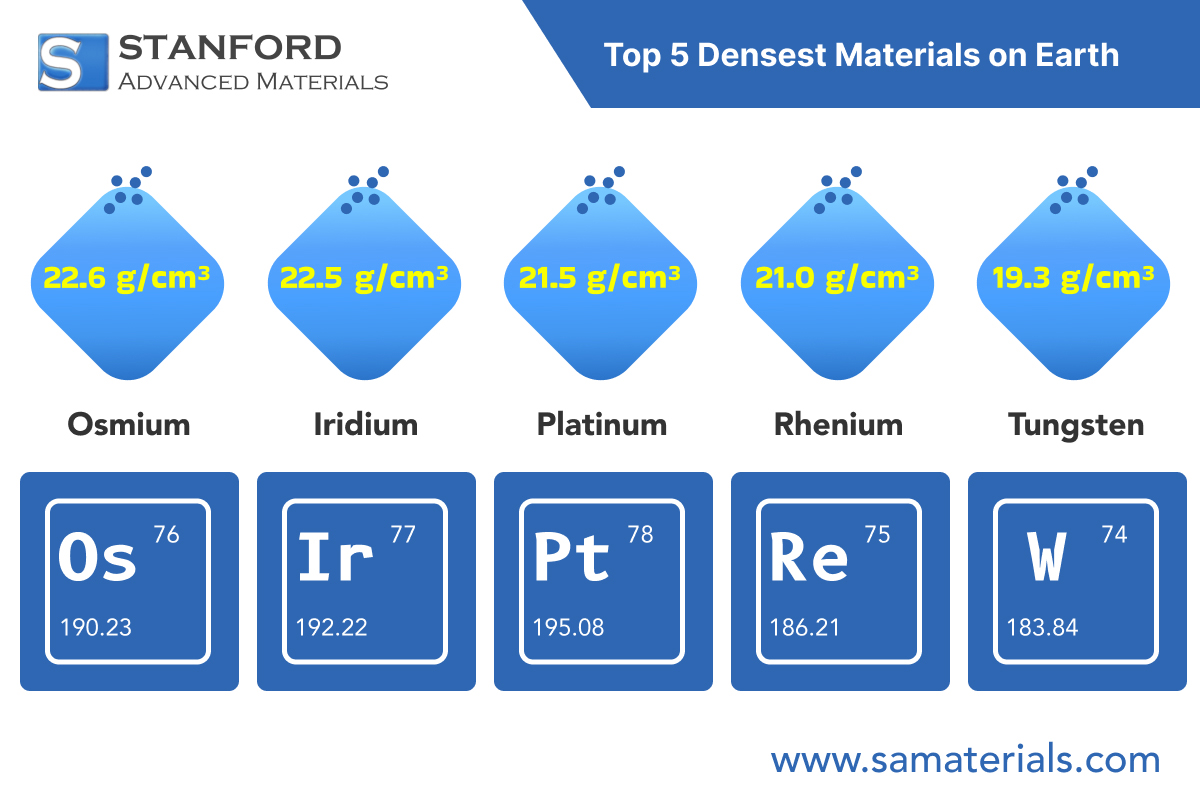
Top 5 Densest Materials on Earth

Introduction
Density matters in engineering and science. It refers to how closely packed a material is. The denser a material is, the more mass it has in a limited amount of volume. Physicists, chemists, and engineers study density so that they can choose the right material for the right job. In everyday life, density translates into strength, weight, and stability.
| Rank | Material | Density (g/cm³) | Key Property | Common Use |
|---|---|---|---|---|
| 1 | Osmium | 22.59 | Hard, bluish | Fountain pen tips, electrical contacts |
| 2 | Iridium | 22.56 | Corrosion-resistant | Spark plugs, crucibles |
| 3 | Platinum | 21.45 | Tarnish-resistant | Jewelry, catalytic converters |
| 4 | Rhenium | 21.02 | High-temp stability | Jet engine superalloys |
| 5 | Gold | 19.30 | Malleable, corrosion-resistant | Jewelry, coins, electronics |
| 5 | Tungsten | 19.30 | High melting point | Filaments, tools |
Osmium - Approximately 22.59 g/cm³
Osmium is generally spoken of as the densest naturally occurring element. It has a density of about 22.6 grams per cubic centimeter. Osmium is hard and blue in color. Osmium is used when a high level of durability is needed, e.g., in fountain pen tips and electrical contacts. Some fountain pen tips contain osmium alloys because they need to withstand years of use. In scientific equipment, its durability prevents it from deforming under a high level of usage.
Osmium is also used in scientific equipment where high mass within a small volume is essential for stability and precision. Its density provides stability and precision. Osmium is unique among all the metals. Being very dense, even a thin layer can be utilized as a protective coating for parts that undergo ongoing friction or heat.
Iridium - Approximately 22.56 g/cm³
Iridium has a density of approximately 22.56 g/cm³, making it nearly as dense as osmium. The dense metal is very resistant to corrosion. Certain high-end electrical contacts and high-performance spark plugs make use of iridium because of its resistance to high temperatures. High durability is greatly preferred in these items.
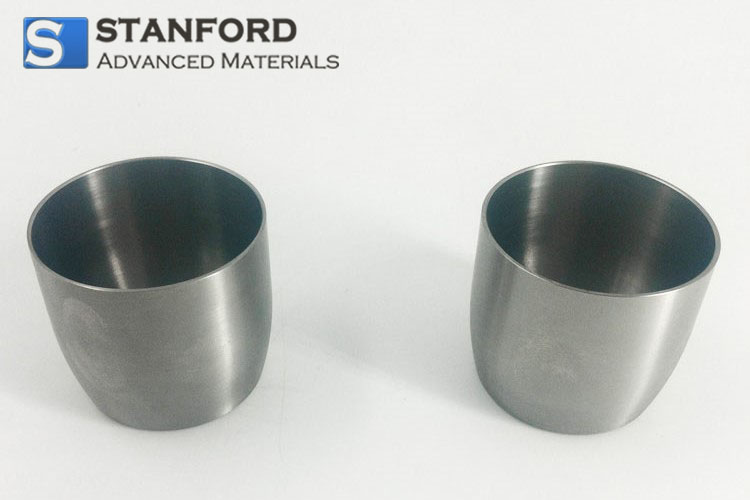
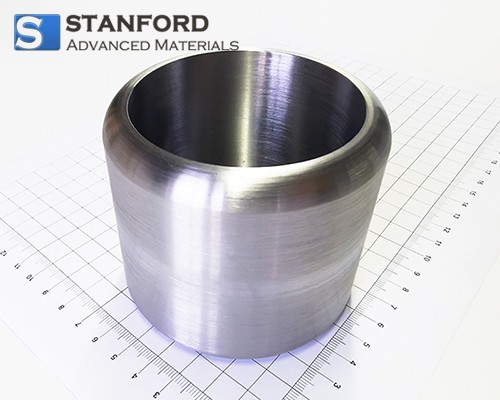
Also, iridium is used in high-heat-withstanding laboratory crucibles. Various industrial applications take advantage of its strength and stable nature. Iridium's wear resistance makes it an immediate choice for applications where reliability is crucial. Decades of industrial experience have shown that small quantities of iridium go a long way in equipment efficacy.
Platinum - The density is approximately 21.45 g/cm³
The density of platinum is approximately 21.45 grams per cubic centimeter. Platinum is also famous for its beauty and resistance to tarnish, making it extremely popular in jewelry and investment products. People often prefer platinum in engagement rings and high-end watches. Its beauty is accompanied by its functional reliability.
In modern industry, platinum serves an important chemical role. It is utilized in catalytic converters as a catalyst. The converters remove harmful gases from automobile exhausts. In many chemical reactions, a minute amount of platinum speeds up the reaction without being consumed. Its utility in these processes is underpinned by decades of industrial use. Platinum's reliability in both ornamental and industrial applications has been proven over the years.
Rhenium - Approximately 21.02 g/cm³
Rhenium is not as well-liked as the metals mentioned above but is quite valuable in certain industries. It possesses the density of approximately 21.0 grams per cubic centimeter. Rhenium is used extensively in high-temperature superalloys. These alloys are used in jet engine and industrial gas turbine parts. The ability of rhenium-containing alloys to perform under harsh conditions gives safety and efficiency to high-performance equipment.
In addition, rhenium prolongs the life of engine components. Its stability serves to decrease the maintenance cost of large machines. Despite being costly and rare, rhenium's value in high-demand applications justifies the expense. It is a perfect example of a material where weight, strength, and heat resistance are perfectly balanced.
Gold or Tungsten - Approximately 19.30 g/cm³
Gold and tungsten share the same densities of approximately 19.3 grams per cubic centimeter. Gold is famous for its aesthetic appeal and as a form of money throughout history. Gold is malleable and soft. Humans have been using gold for centuries in jewelry, coins, and art. Its density and corrosion resistance are among its appeals.
Tungsten, on the other hand, is a very hard metal. It is used in the production of high-temperature light bulb filaments and rugged tools. Tungsten's high melting point, in addition to its density, makes it ideal for uses in which durable, hard materials are required. The tungsten and gold options depend on whether strength or beauty is of greater importance.
Conclusion
Understanding the densest substances in the world gives an insight into the world of high-performance metals. Osmium, iridium, platinum, rhenium, gold, and tungsten all find different uses in daily life and high-tech industries because of their worth. Their weight and density make them useful for specific purposes, such as high-wear components of equipment, stable catalysts in chemical reactions, and highly sought-after decorative pieces.
Frequently Asked Questions
Q: Why is osmium so expensive despite being less useful than platinum?
A: Osmium is extremely rare in the Earth's crust and difficult to process due to its high melting point and toxicity. Its scarcity and challenging refinement make it costly.
Q: Can tungsten be used as a substitute for gold in any applications?
A: Yes. Tungsten has the same density as gold, so it is sometimes used as a gold substitute in jewelry, coins, and radiation shielding where appearance is not critical. However, tungsten lacks gold's corrosion resistance and malleability.
Q: Which of these densest metals is most suitable for high-temperature applications?
A: Tungsten has the highest melting point (3,422°C), followed by rhenium (3,186°C). Both are used in extreme environments like jet engines and light bulb filaments. Platinum and iridium offer excellent corrosion resistance at high temperatures but melt at lower points.
 Chin Trento