Products
 Bars
Bars
 Beads & Spheres
 Bolts & Nuts
 Crucibles
 Discs
Discs
 Fibers & Fabrics
 Films
Films
 Flake
Flake
 Foams
Foams
 Foil
Foil
 Granules
 Honeycombs
 Ink
Ink
 Laminate
 Lumps
Lumps
 Meshes
 Metallised Film
 Plate
Plate
 Powders
 Rod
Rod
 Single Crystals
 Sputtering Target
 Tubes
Tubes
 Washer
 Wires
Wires
 Converters & Calculators
 Write for Us



Density: Measurement and Common Materials

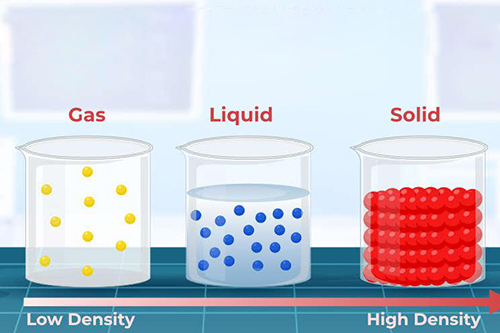
What Is Density
Density describes how much mass is contained in a given volume and thus is one of the basic properties of matter. It is an essential parameter in many applications in science and engineering, since it determines the material choice and its behavior in different conditions.
Density Measurement
Density measurement is a vital component of laboratory and industrial work. The following are some of the most common techniques applied in measuring density:
Mass and Volume Method
The most straightforward way to determine an object's density is through its mass and volume measurement, then applying the formula:
Density=Mass/Volume
Archimedes' Principle
The principle involves the submergence of an object in a fluid, with the volume determined from the displacement of fluid, which then provides a basis for calculating the density of that object.
Pycnometer Method
A pycnometer is a special container designed to measure with great accuracy the density of liquids and solids by determining their volume through displacement.
Density of Common Materials
Here is a table summarizing the density of some common materials. Density is mass per unit volume, usually expressed in the units grams per cubic centimeter (g/cm³) or kilograms per cubic meter (kg/m³).
|
Material |
Density (g/cm³) |
Density (kg/m³) |
Notes |
|
2.70 |
2700 |
Lightweight, commonly used in aerospace and automotive. |
|
|
Copper |
8.96 |
8960 |
Heavy metal with high electrical conductivity. |
|
Steel (Carbon Steel) |
7.85 |
7850 |
Common structural material, strong and durable. |
|
Cast Iron |
6.90 |
6900 |
Used in heavy-duty applications like engine blocks. |
|
4.43 |
4430 |
Strong, lightweight, and corrosion-resistant. |
|
|
Stainless Steel (304) |
7.93 |
7930 |
Corrosion-resistant, used in food processing and marine environments. |
|
Brass |
8.50 |
8500 |
Alloy of copper and zinc, used in plumbing and electrical applications. |
|
Lead |
11.34 |
11340 |
Very dense, used in radiation shielding and batteries. |
|
19.25 |
19250 |
Extremely dense, used in high-temperature and radiation shielding applications. |
|
|
Nickel |
8.90 |
8900 |
Often used in alloys and as a coating for corrosion resistance. |
|
Gold |
19.32 |
19320 |
Dense, highly valued precious metal. |
|
Silver |
10.49 |
10490 |
Valuable metal used in jewelry and electronics. |
|
Wood (Oak) |
0.75-0.85 |
750-850 |
Density varies depending on wood type and moisture content. |
|
Concrete |
2.30 |
2300 |
Density depends on the mix; used in construction. |
|
Glass |
2.40-2.80 |
2400-2800 |
Used in windows, containers, and electronics. |
|
Polyethylene (Plastic) |
0.91-0.96 |
910-960 |
Lightweight plastic commonly used for packaging. |
|
Wood (Pine) |
0.50-0.65 |
500-650 |
Lighter than oak, used for furniture and construction. |
|
Carbon Fiber |
1.60-2.00 |
1600-2000 |
Lightweight, high-strength composite material. |
|
Glass Fiber |
2.50-2.70 |
2500-2700 |
Strong composite material used in aerospace and marine. |
|
Rubber |
1.10-1.60 |
1100-1600 |
Used in tires, seals, and flexible components. |
|
Silicon |
2.33 |
2330 |
Common in electronics and solar cells. |
|
1.85 |
1850 |
Lightweight, high-strength material used in aerospace and nuclear applications. |
Notes: Applications requiring mass or stability are usually made with higher density materials, such as tungsten or lead, while applications, for which weight reduction is important, are normally made with lower density materials such as aluminum or plastics. For more advanced materials, please check Stanford Advanced Materials (SAM).
Applications of Density
Density is crucial in a wide variety of areas:
• Engineering: Choosing materials of appropriate densities for structural parts.
• Geology: Mineral identification and geological formation knowledge.
• Manufacturing: material consistency and quality control.
• Environmental Science: Modelling distribution of pollutants in water and air.
Factors Affecting Density
Factors that can affect the density of a material include:
• Temperature: With increased temperature, the general trend is a decrease in density due to expansion.
• Pressure: Increased pressure can compress materials, hence increasing their density.
• Composition: Intrinsic density is determined by elemental makeup and molecular structure.
Frequently Asked Questions
What is the formula for calculating density?
Density is determined by the object's mass divided by its volume: Density = Mass/Volume.
Why is density an important factor in the selection of materials?
Its density will determine the potential use of the material due to weight or strength requirements.
How does temperature affect the density of liquids?
With rising temperature, liquids usually expand and their density decreases.
Can density be used to identify substances?
Yes, the density can be a unique property that helps determine and differentiate substances.
What is the difference between mass and density?
The mass of an object is the amount of matter in it, whereas the density is defined as mass per unit volume.

 Chin Trento