
 Products
 Bars
Bars
 Beads & Spheres
 Bolts & Nuts
 Crucibles
 Discs
Discs
 Fibers & Fabrics
 Films
Films
 Flake
Flake
 Foams
Foams
 Foil
Foil
 Granules
 Honeycombs
 Ink
Ink
 Laminate
 Lumps
Lumps
 Meshes
 Metallised Film
 Plate
Plate
 Powders
 Rod
Rod
 Single Crystals
 Sputtering Target
 Tubes
Tubes
 Washer
 Wires
Wires
 Converters & Calculators
 Write for Us



Top-Performing Optical Crystals for Advanced Photonics

In practical photonic systems, only a limited number of crystal materials combine optical excellence with mechanical robustness, manufacturability, and long-term stability. The following crystal families are among the most important in advanced photonics.
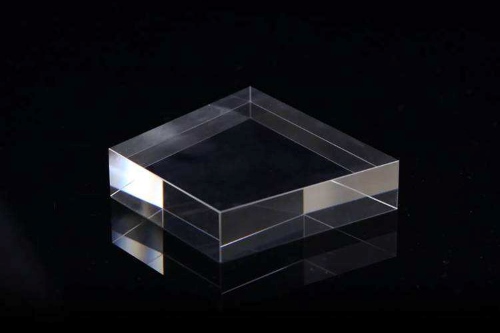
Sapphire (Single-Crystal Al₂O₃) – Strength and Thermal Stability
Single-crystal sapphire is a popular optical material in photonics due to excellent mechanical strength, thermal stability, and high optical transparency. Sapphire can transmit light in the ultraviolet region up to the infrared region.
In more advanced applications of photonics, sapphire is widely utilized as optical windows, substrates, and protective components in high-power laser systems. The high melting point and thermal shock resistance of sapphire make it an ideal material for operation in extreme temperatures and high laser fluence. Although sapphire is birefringent and requires precise orientation in high-precision optics, its ruggedness makes it an essential material in aerospace, military, and high-power laser applications.
Yttrium Orthovanadate (YVO₄) – High Gain for Compact Lasers
Yttrium orthovanadate (YVO₄) is an important crystal in compact and diode-pumped solid-state lasers. Compared to YAG, YVO₄ has higher absorption and emission cross-sections when doped with neodymium ions, making it an efficient lasing material in compact laser cavities.
This crystal material is especially suited for low- to medium-power lasers where compactness and high efficiency are essential. YVO₄ is also widely used in frequency-doubled laser applications owing to its desirable birefringence characteristics. Nevertheless, its lower thermal conductivity compared to YAG requires special attention to thermal management in high-power laser applications.
Lithium Triborate (LBO) – Nonlinear Optics for High Power
Lithium triborate, or LBO, is one of the most important nonlinear optical materials that is frequently employed for frequency conversion. LBO is recognized for its high transparency range, high damage threshold, and thermal stability. LBO is frequently employed for second and third harmonic generation in high-power lasers. Its non-hygroscopic nature and forgiving phase-matching characteristics make LBO easier to work with than other nonlinear materials. These characteristics have made LBO a standard material in industrial, scientific, and medical applications using high-power lasers.
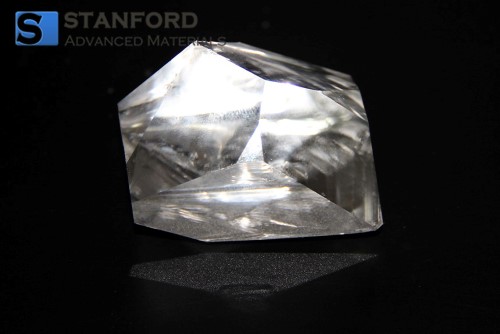
Beta Barium Borate (BBO) – Efficient Frequency Conversion
Beta barium borate, or BBO, is a nonlinear optical material that is frequently employed due to its high nonlinear coefficients and wide range of phase matching. BBO is particularly effective for UV and visible wavelength conversion.
While BBO offers high conversion efficiency, it is more mechanically fragile and hygroscopic than LBO. As a result, it is often used in controlled environments where maximum nonlinear performance is required, such as ultrafast laser laboratories and research-grade photonic systems.
Calcium Fluoride (CaF₂) – Low Dispersion and Wide Transparency
Calcium fluoride is a fluoride crystal prized for its exceptionally low optical dispersion and broad transparency range, extending from the deep ultraviolet into the infrared. These properties make CaF₂ ideal for high-precision imaging, lithography, and spectroscopy systems.
In advanced photonics, CaF₂ is often used for lenses, windows, and prisms where chromatic aberration must be minimized. Its relatively low refractive index and good resistance to laser damage further support its use in high-performance optical assemblies.
Yttrium Aluminum Garnet (YAG) – The Industry Standard Laser Crystal
Yttrium Aluminum Garnet (Y₃Al₅O₁₂) or YAG, for short, is one of the most popular optical crystals in photonics. It has achieved widespread popularity due to the combination of excellent optical transparency, high thermal conductivity, and excellent mechanical stability.
The most popular application of YAG crystals is in the form of a laser crystal. It can be doped with different rare earth ions to produce different laser crystals, e.g., Nd:YAG, Yb:YAG, Er:YAG. YAG laser crystals can withstand high optical intensity. They also possess a low thermal lens effect. In addition, the optical transparency of YAG crystals ranges from the visible region to the mid-infrared region.
Zinc Selenide (ZnSe) – Infrared Performance Leader
Zinc selenide is a key optical crystal for infrared photonics, particularly in the mid-infrared range. It offers high transmission in the 0.6–20 µm region and is commonly used in CO₂ laser systems, thermal imaging, and infrared spectroscopy.
ZnSe combines good optical clarity with manageable thermal properties, making it suitable for laser optics such as lenses and windows. However, it is softer than oxide crystals, which requires careful handling and protective coatings in demanding environments.
Characteristics of Optical Crystals Used in Advanced Photonics
All the major features of the optical crystals discussed above are summarized in Table 1 to provide a quick overview for optical system design and material selection.
|
Optical Crystal |
Transparency Range |
Key Advantages |
Typical Photonics Applications |
|
Sapphire |
UV to IR |
Extreme durability, thermal stability |
Optical windows, substrates |
|
YVO₄ |
Visible to near-IR |
High gain, efficient absorption |
Compact diode-pumped lasers |
|
LBO |
UV to IR |
High damage threshold, thermal stability |
Frequency conversion |
|
BBO |
UV to visible |
High nonlinear efficiency |
UV generation, ultrafast lasers |
|
CaF₂ |
Deep UV to IR |
Low dispersion, high optical clarity |
Imaging, lithography, spectroscopy |
|
YAG |
Visible to mid-IR |
High thermal conductivity, mechanical strength |
Solid-state lasers, laser hosts |
|
ZnSe |
Visible to mid-IR |
Strong IR transmission |
CO₂ lasers, IR optics |
For more information, please check Stanford Advanced Materials (SAM).
Conclusion
Top-performing optical crystals are the backbone of advanced photonics. From robust oxide crystals like YAG and sapphire to highly efficient nonlinear materials such as LBO and BBO, each crystal offers a distinct balance of optical, thermal, and mechanical properties. As photonics continues to evolve toward higher power, greater precision, and new spectral regimes, the role of high-quality optical crystals will remain central to technological progress.
 Dr. Samuel R. Matthews