Products
 Bars
Bars
 Beads & Spheres
 Bolts & Nuts
 Crucibles
 Discs
Discs
 Fibers & Fabrics
 Films
Films
 Flake
Flake
 Foams
Foams
 Foil
Foil
 Granules
 Honeycombs
 Ink
Ink
 Laminate
 Lumps
Lumps
 Meshes
 Metallised Film
 Plate
Plate
 Powders
 Rod
Rod
 Single Crystals
 Sputtering Target
 Tubes
Tubes
 Washer
 Wires
Wires
 Converters & Calculators
 Write for Us



Flexural Strength Champions: Ceramics, Metals, and Advanced Composites

Ceramics: Brittle but Mighty
Ceramic materials seem to be weak at first glance. With good design, they can be very strong. Let us consider some common ceramics.
• Zirconia (Yttria Stabilized Tetragonal Zirconia Polycrystal): Withstanding temperature up to 900°C and having a flexural strength of approximately 1200 MPa, this ceramic enjoys transformation toughening that provides resistance to slow crack growth.
• Silicon Carbide: With a working temperature of around 400°C, it has a flexural strength of almost 600 MPa. SiC is a hot favorite for extreme environments due to its high-temperature stability.
• Alumina (Aluminum Oxide): It possesses a maximum service temperature of around 300°C with a strength of around 500 MPa. Because of its wide availability and stable performance, it is popular in engineering.
• Glass-Ceramics: They possess good performance up to 300°C with a strength of around 450 MPa. They are used from optical devices to dental uses. They incorporate the properties of glass and crystalline phases for improved reliability.
Ceramics show excellent potential in spite of their brittleness as they are traditionally known to possess. Their enhanced microstructure gives them surprising strength.
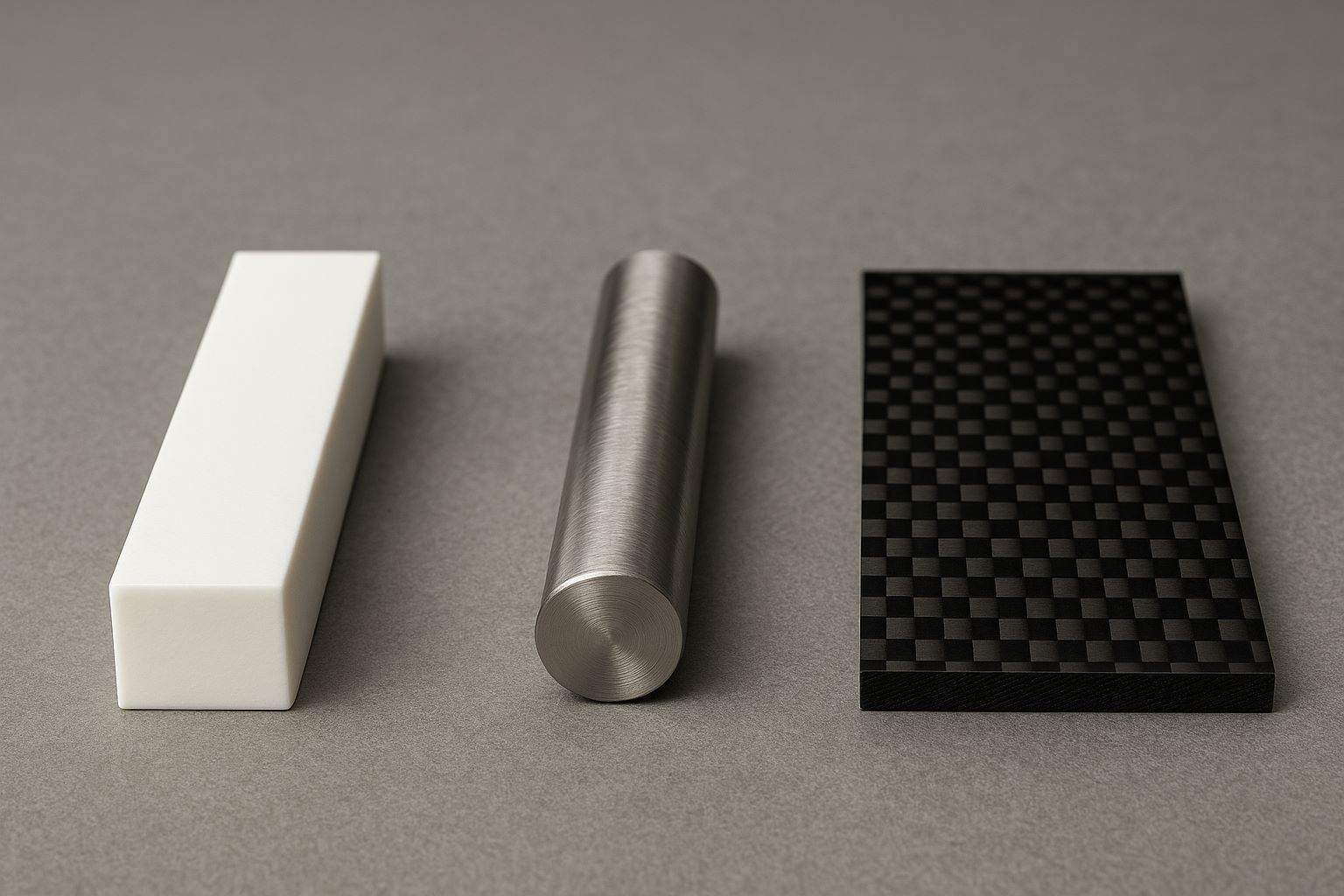
Metals: Toughness Takes Precedence over Peak Strength
Metals are another story. They present toughness rather than reaching the ultimate in flexural strength.
• Tool Steels and Maraging Steels: Operating at a temperature of around 300°C, these steels possess a flexural strength of about 400 MPa. They exhibit a reasonable balance of toughness, reliability, and wear resistance.
• Titanium Alloys (e.g., Titanium-6Al-4V): These alloys possess decent performance around 200°C with a flexural strength of about 300 MPa. They are well known for excellent toughness and for possessing very good corrosion resistance. Metals often provide ductility that ceramics don't.
This material class excels in shock absorption and durability applications. They are utilized in fields where the strength of a stable metal backbone is needed.
Advanced Composites: Engineered for Strength
High-performance advanced composites are created. They allow us to create properties according to need.
• Carbon Fiber Reinforced Polymer: This composite has a withstanding capacity up to 500°C and flexural strength around 1500 MPa. In spite of the fact that its performance is directional (anisotropic), it has the highest strength in comparison to a lot of useful materials.
• Glass Fiber Reinforced Polymer: With a moderate temperature of 300°C and strength of about 600 MPa, this composite is cheaper. Its wide use can be seen in many everyday applications.
• Aramid Fiber Composites (Kevlar): Functioning at around 400°C, these composites possess strength of about 600 MPa. They are well known for their impact resistance and use in protection equipment.
These tailored composites give the engineer the ability to combine light weight and high strength. This design flexibility makes them indispensable in modern structures.
Nanomaterials and Theoretical Limits
Nanomaterials push the boundaries of possibility. They offer a vision of the future of improved flexural performance.
• Graphene: This single-atom layer of carbon possesses a theoretical flexural strength of approximately 130 Gigapascals. The numbers speak of its potential in ultra-strong design.
• Carbon Nanotubes: With theoretical strengths over 100 Gigapascals, these materials are at the forefront of material science. They hold the future of lightweight, high-strength applications.
While these figures are theoretical, they guide research and point toward future applications that one day will be mainstream.
Applications of High-Flexural-Strength Materials
Materials with high flexural strength have everyday and high-end uses.
• Aerospace: Light composites, such as carbon fiber reinforced polymer and silicon carbide ceramics, are utilized to make efficient aircraft structures.
• Biomedical Implants: Zirconia and titanium alloys make medical implants reliable. They are strong and biocompatible and hence apt.
• Electronics and Optics: Alumina substrates and glass-ceramics find application in sensitive optical devices. They offer clarity and strength.
• Automotive and Civil Engineering: High performance composites and even ultra-high performance concrete (UHPC) contribute to enhancing safer and stronger designs in vehicles and structures.
The convergence of the different classes of materials guarantees that there is always a right tool for the job at hand. Temperature limits, strength values, along with cost, are taken into account by the engineer to pick the most suitable candidate.
Conclusion
Each class has its due place in modern engineering. Ceramics overcome the brittleness limitation by enhanced toughness. Metals supply toughness consistently for everyday operations. Advanced composites offer tailor-made solutions. Nanomaterials provide a glimpse of the potential in future engineering developments. With good fundamentals and careful use of design principles, these materials habitually push the limits of performance. They are the flexural strength champions in their own right.
Frequently Asked Questions
F: Why are ceramic materials strong despite their brittleness?
Q: They use mechanisms such as transformation toughening to avert crack propagation.
F: Why are advanced composites chosen for high-performance applications?
Q: They attain a mix of lightness and high strength through property tuning.
F: In what ways are metals different from ceramics and composites?
Q: Metals incorporate extra toughness and ductility while ceramics and composites are specialists in high strength.
 Chin Trento