
 Products
 Bars
Bars
 Beads & Spheres
 Bolts & Nuts
 Crucibles
 Discs
Discs
 Fibers & Fabrics
 Films
Films
 Flake
Flake
 Foams
Foams
 Foil
Foil
 Granules
 Honeycombs
 Ink
Ink
 Laminate
 Lumps
Lumps
 Meshes
 Metallised Film
 Plate
Plate
 Powders
 Rod
Rod
 Single Crystals
 Sputtering Target
 Tubes
Tubes
 Washer
 Wires
Wires
 Converters & Calculators
 Write for Us



All about High-Flexural-Strength Ceramics

Introduction
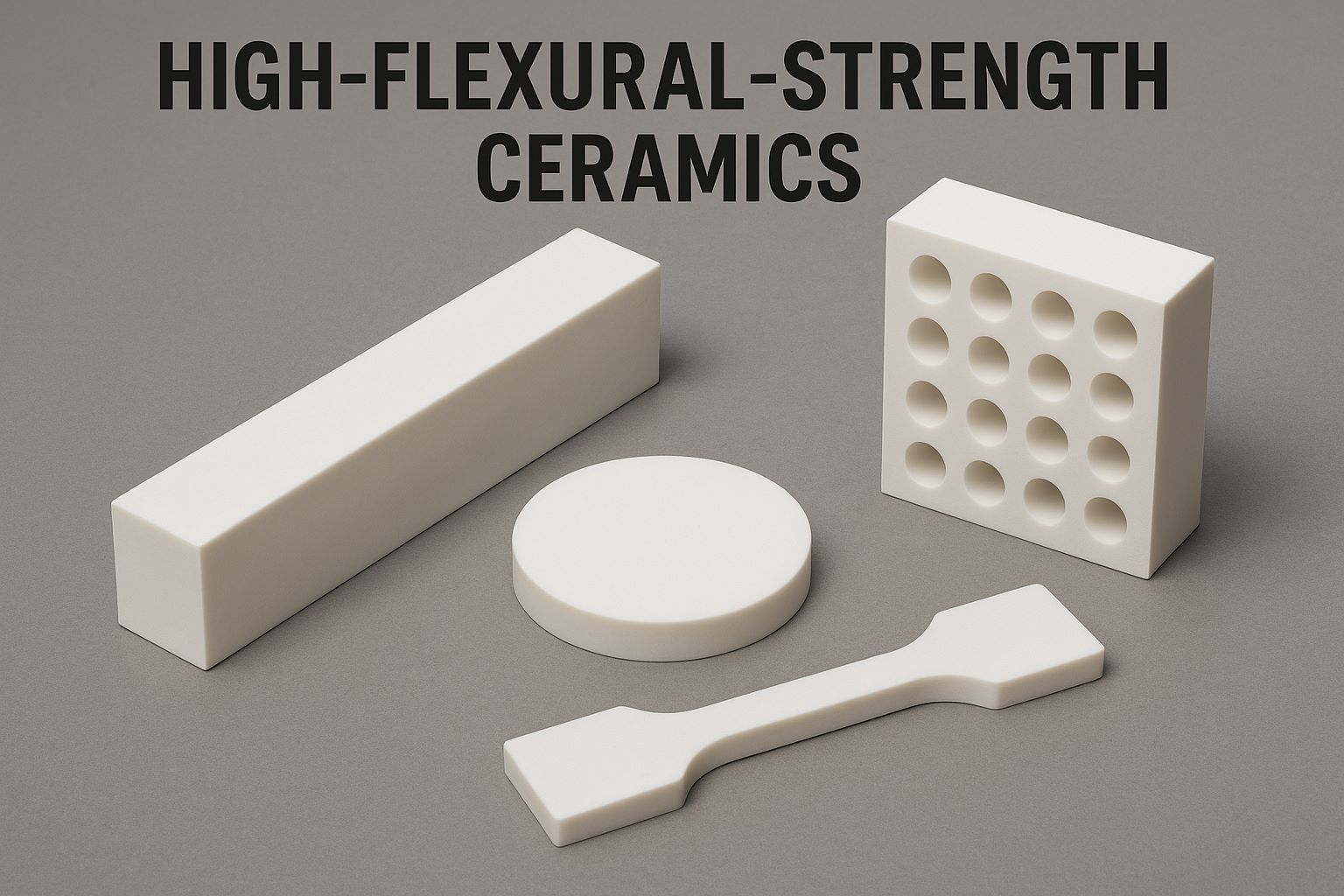
Ceramics hold an important place in science and engineering. Ceramics with high flexural strength can bear bending forces despite their brittle nature. They are used in fields ranging from aerospace to medical implants. We will take a look at what flexural strength means, how it is tested, what factors affect it, and which ceramic families stand out.
What Flexural Strength Is and Why It Matters For Brittle Ceramics
Flexural strength is the ability of a material to resist bending. Brittle ceramics tend to crack under stress. A higher flexural strength means a ceramic can handle more bending before failure. This property proves very useful in many practical applications. For example, dental implants and cutting tools require materials that resist cracking even under load. In everyday terms, strong ceramics are like the trusted brick in a wall. They hold up well against bending and help avoid sudden breakage.
When ceramics are analyzed in mechanical applications, flexural strength is one of the key criteria. Engineers design parts to withstand fatigue and bending forces in operation. With higher flexural strength, the ceramics can be used in tough environments. This makes them a natural choice in areas where metals or polymers might not meet the requirements.
Testing Methods: 3-Point and 4-Point Bending
Flexural strength is measured using several methods. The two most common tests are the three-point bending test and the four-point bending test. In the three-point bending test, a sample is supported at two points while a load is applied at a single point in the middle. This method is straightforward and gives a good idea about the bending strength. The four-point bending test uses two load points that apply stress evenly. Both methods reveal how a ceramic will behave under real-world conditions. However, the choice of test may depend on the shape and size of the sample, as well as the expected stress distribution in the final application.
These tests are standard in laboratories and have been used for many years to ensure quality control. They are simple yet effective ways to measure performance. In many cases, engineers compare the results to ensure that ceramic components can handle the forces they will encounter during use.
Key Factors Affecting Flexural Strength: Porosity, Grain Size, Flaws, Microstructure
Several factors play a role in the flexural strength of ceramics. Porosity is one key factor. Porous materials have tiny holes that can weaken the ceramic. Reducing porosity through improved processing techniques often improves strength. Grain size is another important factor. Smaller, uniform grains usually lead to a material with better flexural strength because they help distribute stress more evenly. Flaws, such as tiny cracks or inclusions, can act as starting points for failure. Controlling these flaws during production enhances the overall reliability of the ceramic. Finally, the overall microstructure plays a significant role. A well-controlled microstructure leads to improved strength and toughness. Engineers spend much time optimizing these factors to develop ceramics that meet the strict requirements of high-performance applications.
High-Flexural-Strength Ceramic Families
Below are some of the most interesting ceramic families known for their high flexural strength.
1.
Zirconia Tetragonal Zirconia Polycrystal
The ceramics in this family withstand temperatures up to 900°C. They can
handle stress levels up to 1200 MegaPascals. These ceramics are favored in
dental and structural applications because of their impressive toughness and
strength.
2.
Zirconia Toughened Alumina
This ceramic family stands strong up to about 800°C. They offer flexural
strength of up to 1100 MegaPascals. The mix of zirconia
and alumina gives the material improved resistance, making it suitable for
wear-resistant parts and cutting tools.
3.
Silicon Carbide
Ceramics within this group hold good performance at temperatures near 400°C.
They exhibit flexural strength of up to 600 MegaPascals. Silicon Carbide is known for its excellent
thermal conductivity and is used in high-speed bearings and industrial
components.
4.
High-Purity Alumina
This ceramic’s performance reaches temperatures of around 300°C. They have a
flexural strength that can reach up to 500 MegaPascals. High-purity alumina is
often found in electronic substrates and wear-resistant applications.
5.
Glass-Ceramics
This material endures temperatures around 300°C. They display flexural
strength values of up to 450 MegaPascals. Glass-ceramics are widely known for
their unique combination of properties. They are used in cooktop panels and
medical implants owing to their high strength and durability.
Conclusion
High-flexural-strength ceramics are critical in many applications where resistance to bending and cracking is required. For more information, please check Stanford Advanced Materials (SAM).
Frequently Asked Questions
F: What is flexural strength in ceramics?
Q: It is the measure of a ceramic's ability to resist bending forces.
F: How does porosity affect ceramic strength?
Q: Higher porosity leads to lower strength and more chances of fracture.
F: What are common tests for ceramic flexural strength?
Q: Three-point bending and four-point bending tests are most common.
 Chin Trento