Products
 Bars
Bars
 Beads & Spheres
 Bolts & Nuts
 Crucibles
 Discs
Discs
 Fibers & Fabrics
 Films
Films
 Flake
Flake
 Foams
Foams
 Foil
Foil
 Granules
 Honeycombs
 Ink
Ink
 Laminate
 Lumps
Lumps
 Meshes
 Metallised Film
 Plate
Plate
 Powders
 Rod
Rod
 Single Crystals
 Sputtering Target
 Tubes
Tubes
 Washer
 Wires
Wires
 Converters & Calculators
 Write for Us



Gallium: Element Properties and Uses

Description
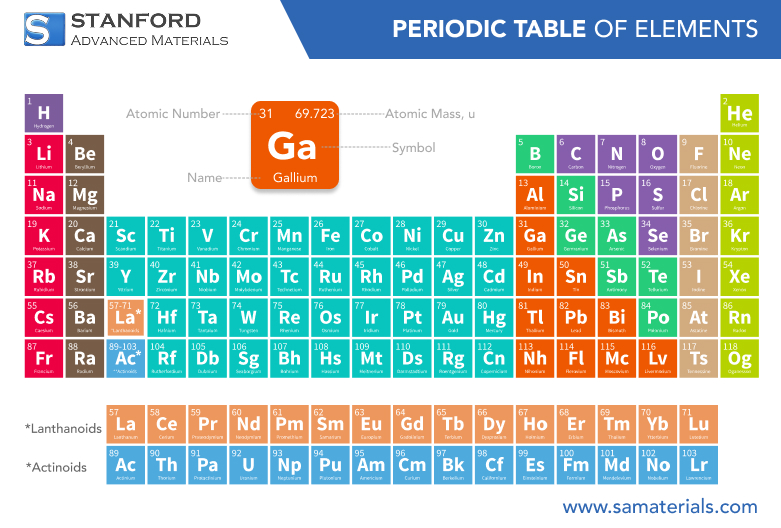
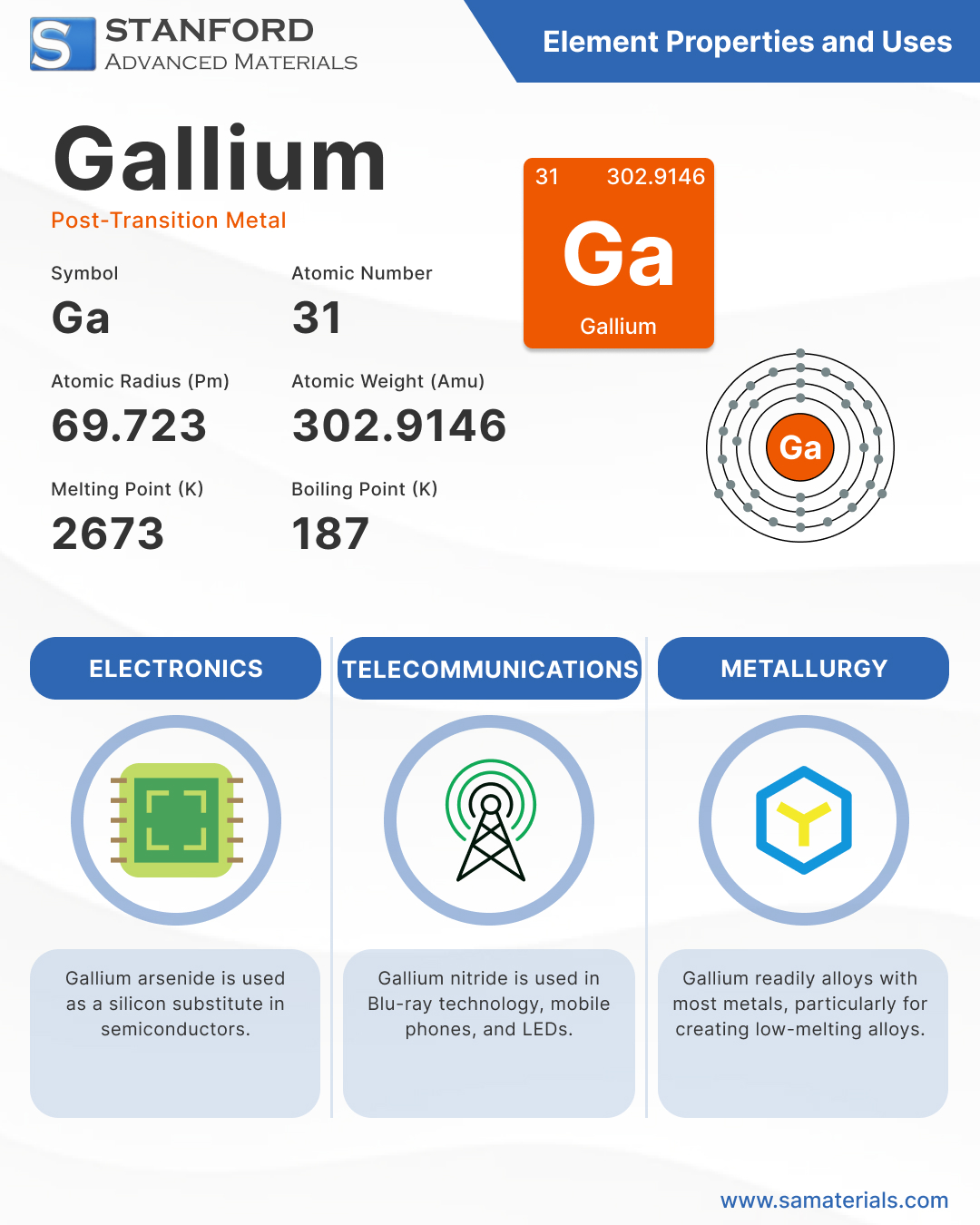
Without gallium, modern LEDs would be dimmer, 5G networks would be slower, and solar cells would be less efficient. This soft, silvery metal—with the symbol Ga and atomic number 31—is a critical enabler of high-performance electronics.
Introduction to the Element
Gallium is a post-transition metal that was discovered in 1875 by the French chemist Paul-Émile Lecoq de Boisbaudran. It is commonly found in trace amounts in minerals such as bauxite and sphalerite. Gallium does not occur in its elemental form in nature but is extracted from ores through refining processes. It is known for its low melting point and ability to remain in liquid form at temperatures just above room temperature.
Chemical Properties Description
Gallium is characterized by its ability to form compounds with a variety of elements. It exhibits a +3 oxidation state in most of its compounds, which is the most stable form of gallium. Some of its key chemical properties include:
- Reactivity: Gallium reacts with oxygen in the air to form gallium oxide (Ga2O3), a stable compound. It also reacts with halogens, acids, and alkalis.
- Alloy Formation: Gallium is known to form alloys with many metals, including aluminum, gold, and silver. These alloys often have unique properties, such as increased strength or improved conductivity.
- Non-corrosive: Despite its reactivity, gallium does not corrode easily, which makes it useful in specialized applications.
Physical Properties Data Table
|
Property |
Value |
|
Atomic Number |
31 |
|
Density |
5.91 g/cm³ |
|
Melting Point |
29.76°C (85.57°F) |
|
Boiling Point |
2204°C (3999°F) |
|
Electrical Conductivity |
Good |
|
Thermal Conductivity |
40.6 W/m·K |
|
Appearance |
Silvery-white metal |
|
Crystal Structure |
Orthorhombic |
For more information, please check Stanford Advanced Materials (SAM).
Common Uses
Gallium has a variety of applications in industries ranging from electronics to medical technology. Some of its common uses include:
- Semiconductors: Gallium is crucial in the production of semiconductors. Gallium arsenide (GaAs) is commonly used in the manufacturing of light-emitting diodes (LEDs), lasers, and solar cells due to its superior efficiency in these applications.
Example: GaN in 5G Infrastructure
Gallium Nitride (GaN) is increasingly used in 5G base stations due to its ability to operate at higher frequencies and temperatures than traditional silicon. A single GaN-based amplifier can replace multiple silicon components, reducing system complexity and power consumption. Major infrastructure providers like Nokia and Ericsson have adopted GaN in their latest 5G products.
- Aerospace: Gallium is used in aerospace technology, especially in high-temperature environments where its low melting point allows it to remain in a liquid state.
- Optical Devices: Gallium compounds are utilized in optical devices, including infrared detectors and thermometers.
- Medical Devices: Gallium-based compounds have been used in medical imaging, particularly in the form of radiopharmaceuticals for scanning and diagnostics.
Preparation Methods
Gallium is primarily obtained as a byproduct of refining bauxite, the main ore for aluminum production. It is usually extracted from the process by a series of chemical reactions. One of the most common methods for isolating gallium is through the Bayer process, where gallium is separated from aluminum by dissolving it in sodium hydroxide.
In the laboratory, gallium can be prepared by reducing gallium oxide (Ga2O3) with hydrogen or other reducing agents. Additionally, gallium is often extracted from zinc ores, and the process involves dissolving the gallium into a solution, then precipitating it by various methods.
Related Industrial Products
Gallium's unique properties contribute to the development of various industrial products, including:
- Gallium Arsenide (GaAs): Widely used in electronic circuits and optoelectronic devices such as solar cells, LEDs, and lasers.
- Gallium Nitride (GaN): A material used in high-power electronics and LEDs, due to its ability to operate at higher temperatures and voltages compared to other semiconductors.
- Gallium-based Alloys: Gallium is used in low-melting-point alloys that have applications in thermometers, electronics, and other specialized areas.
Frequently Asked Questions
What is gallium used for in electronics?
Gallium is used in the production of semiconductors, particularly in the form of gallium arsenide, which is important in the manufacturing of LEDs, solar cells, and lasers.
Can gallium be found naturally?
No, gallium is not found in its elemental form in nature. It is typically extracted from ores such as bauxite and sphalerite during the refining process of other metals.
What are the physical characteristics of gallium?
Gallium is a silvery-white metal with a low melting point of 29.76°C, allowing it to remain in a liquid state at temperatures just above room temperature.
Is gallium harmful to humans?
Gallium is generally not toxic, but exposure to gallium compounds in large amounts may cause irritation or other health issues. Proper handling and safety measures are important when working with gallium.
How is gallium prepared for use in industries?
Gallium is primarily obtained as a byproduct of aluminum and zinc refining. It is extracted from ores like bauxite using chemical processes such as the Bayer process.
 Chin Trento