Products
 Bars
Bars
 Beads & Spheres
 Bolts & Nuts
 Crucibles
 Discs
Discs
 Fibers & Fabrics
 Films
Films
 Flake
Flake
 Foams
Foams
 Foil
Foil
 Granules
 Honeycombs
 Ink
Ink
 Laminate
 Lumps
Lumps
 Meshes
 Metallised Film
 Plate
Plate
 Powders
 Rod
Rod
 Single Crystals
 Sputtering Target
 Tubes
Tubes
 Washer
 Wires
Wires
 Converters & Calculators
 Write for Us



Oganesson: Element Properties and Uses

Description
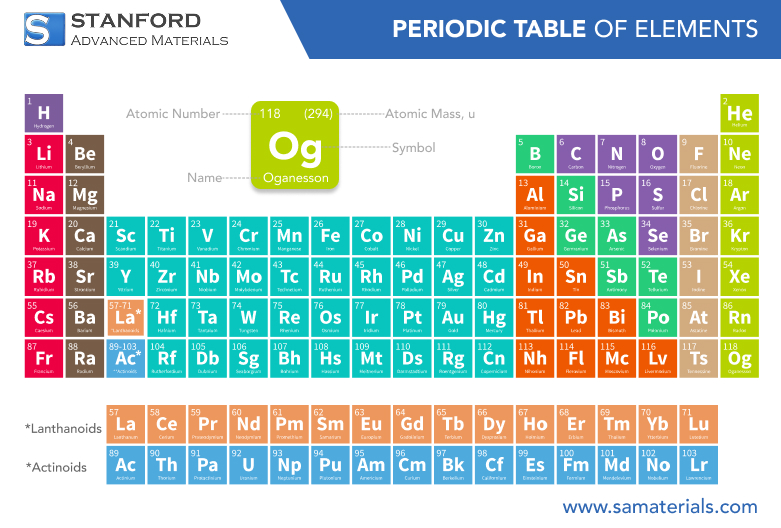
Oganesson (Og) is the name of a synthetic noble gas that was discovered with unique and basically theoretical chemical and physical properties. Being one of the heaviest elements and rather recently discovered, it has attracted much interest in nuclear chemistry and atomic physics. The current article intends to show its discovery, preparation, potential properties, and the few applications it has in scientific research.
History and Naming
First synthesized in 2002 at the Joint Institute for Nuclear Research in Dubna, Russia, by a team of Russian and American scientists, the discovery was a result of collaboration by Russian scientists and the Lawrence Livermore National Laboratory in California. The name honors Yuri Oganessian, a Russian physicist who made important contributions to the discovery of superheavy elements.
Oganesson was a great breakthrough in nuclear chemistry, as it added another element to the periodic table within the noble gas group. This was done by bombarding a target of californium-249 with calcium-48 ions in a particle accelerator, wherein the fusion of these nuclei resulted in Oganesson. Due to its extreme instability and very short half-life, only a few atoms have ever been produced, which makes it one of the rarest and most elusive elements in the world.
Noble Gas Group
Oganesson falls under the category of noble gases, that is, Group 18 of the Periodic Table. Normally, Group 18 includes elements like helium, neon, argon, krypton, xenon, and radon, which are inert because of their full valence electron shell. Oganesson was predicted to behave similarly: chemically inert.
However, with an atomic number this high and the relativistic effects that increasingly come into play with heavier atoms, it has been theorized that Oganesson may actually deviate somewhat from the typical noble gas characteristics. These are expected to change the behavior of the outer electrons, possibly giving it metallic character or other unexpected properties quite unlike those of the lighter noble gases.
Chemical Properties Description
Chemical properties are known mostly theoretically for oganesson because of the extreme limit of experimental data. It is expected to be chemically inert, like all noble gases, though its position within the periodic table and the relativistic effects on its electrons probably mean it will not behave exactly like the lighter noble gases.
But one of the most striking theories regards the fact that Oganesson, under specific circumstances, can show metallic properties due to its electrons moving at relativistic speeds; thus, dramatic changes in the way electrons interact among themselves or with other atoms would take place, making Oganesson so different from any other noble gas that makes some scientists think it cannot behave as an ideal gas.
Physical Properties
Similar to other noble gases, oganesson is predicted to be a gas at room temperature, though some theory indicates that its electron configuration could allow it to exhibit metallic properties under certain conditions. Its boiling and melting points, along with its density, are speculated based on the trends of the other noble gases, although these remain speculative due to the extreme instability and rarity of the element.
Direct measurement of the physical properties of Oganesson is impossible because of its extremely short half-life (on a timescale of milliseconds). Its properties are estimated based on advanced computational models; however, the actual behavior of the element under normal conditions remains uncertain.
Common Uses
Oganesson has no practical uses other than in scientific research because it is extremely rare and has a very short half-life. Its synthesis is of interest to academics in testing nuclear reaction models and refining theories related to electron behavior in superheavy elements. The study of Oganesson can also help in extending our knowledge regarding how heavy elements behave under extreme conditions of the periodic table and may offer some insights into the possible creation of even heavier elements.
Its small yield and short lifetime have so far precluded the investigation of chemical properties of this element; thus, no industrial or commercial use has as yet been developed. However, its discovery represents a milestone in the continued pursuit of expanding the periodic table and testing the limits of chemical bonding and nuclear stability.
Methods of Preparation
Oganesson is produced by advanced nuclear reactions in particle accelerators. High-energy collisions of calcium-48 ions and a californium-249 target are used to produce the element. The fusion reaction yields Oganesson, but only a few atoms of it have been produced so far.
The synthesis of Oganesson is a very complicated and low-probability process; this element has an extremely short half-life usually on the order of milliseconds. Therefore, to capture and study Oganesson, highly specialized equipment and careful planning is required.
Frequently Asked Questions
What is Oganesson?
Oganesson is a synthetic element, which has the atomic number 118, and it is one of the heaviest noble gases. It was first synthesized in 2002 and is named after Russian physicist Yuri Oganessian.
How is oganesson produced?
Oganesson is produced by bombarding a californium-249 target with calcium-48 ions in a particle accelerator. This nuclear fusion reaction produces a few atoms of Oganesson.
What are the chemical properties of Oganesson?
Oganesson is theoretically inert, like other noble gases; however, due to relativistic effects on its electrons, it might behave quite differently-possibly exhibiting a more metallic character or failing to conform to ideal gas laws.
What are the common uses of Oganesson?
Due to the extremely short half-life and rarity of this element, Oganesson is exclusively used in scientific research. The element assists scientists in refining models of nuclear reactions and electron behavior in superheavy elements.
Why is Oganesson important in scientific research?
Oganesson contributes to the testing of nuclear models and brings light to the behavior of electrons within superheavy elements. Its study is a stepping stone in expanding our understanding of chemistry and physics at the extremes of the periodic table.


 Chin Trento