Products
 Bars
Bars
 Beads & Spheres
 Bolts & Nuts
 Crucibles
 Discs
Discs
 Fibers & Fabrics
 Films
Films
 Flake
Flake
 Foams
Foams
 Foil
Foil
 Granules
 Honeycombs
 Ink
Ink
 Laminate
 Lumps
Lumps
 Meshes
 Metallised Film
 Plate
Plate
 Powders
 Rod
Rod
 Single Crystals
 Sputtering Target
 Tubes
Tubes
 Washer
 Wires
Wires
 Converters & Calculators
 Write for Us



Understanding the Triple Point in Thermodynamics

Introduction
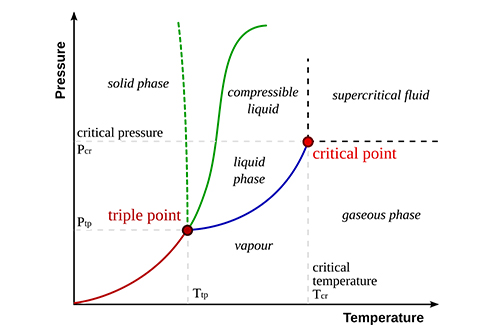
In thermodynamics, the triple point is a fascinating phenomenon where a substance can exist in all three phases—solid, liquid, and gas—at equilibrium. This precise condition is critical for defining standard temperature and pressure scales and has significant implications in various scientific fields.
Properties of Triple Point
The triple point is characterized by specific temperature and pressure values unique to each substance. At this point, the kinetic energy of the molecules allows the three phases to coexist without one phase dominating the others. Understanding the triple point helps in studying phase transitions and the behavior of materials under different environmental conditions.
Triple Point vs Critical Point
While both the triple point and the critical point involve phase transitions, they represent different conditions:
|
Feature |
Triple Point |
Critical Point |
|
Phases Coexisting |
Solid, Liquid, Gas |
Liquid and Gas only |
|
Temperature |
Specific to each substance |
Higher than the triple point temperature |
|
Pressure |
Specific to each substance |
Critical pressure, beyond which distinct liquid and gas phases do not exist |
|
Phase Transition |
Equilibrium among three phases |
Transition between liquid and gas phases |
Applications of Triple Point
The triple point has practical applications in calibration of thermometers, standardizing temperature scales, and in the study of material properties. It serves as a reference point in scientific experiments and industrial processes where precise control of phase states is essential.
Triple Point in Everyday Life
Although not commonly observed directly, the concept of the triple point underlies phenomena such as frost formation, sublimation, and the behavior of water in different states. Understanding the triple point aids in meteorology, environmental science, and engineering disciplines.
Table of Triple Points
Here's a table showing the triple point values for various substances. The triple point is the temperature and pressure at which all three phases (solid, liquid, and gas) of a substance coexist in equilibrium.
|
Substance |
Triple Point Temperature (°C) |
Triple Point Pressure (Pa) |
|
Water |
0.01 |
611.657 |
|
Carbon Dioxide |
-56.6 |
518.5 × 10³ |
|
Helium |
-268.93 |
2.29 |
|
Nitrogen |
-210.00 |
1.4 × 10³ |
|
Oxygen |
-218.79 |
1.5 × 10³ |
|
Sulfur |
115.21 |
1.3 × 10⁶ |
|
Mercury |
-38.83 |
2.0 × 10⁵ |
|
Ammonia |
-77.7 |
1.2 × 10⁶ |
|
Methane |
-182.5 |
1.0 × 10⁶ |
|
Argon |
-189.34 |
1.0 × 10³ |
Related Materials from Stanford Advanced Materials
Stanford Advanced Materials (SAM) supplies high-purity gases, liquids, and solids used in phase equilibrium studies and calibration applications:
- High-purity metals
- Specialty alloys
- Custom fabrication
All materials are supplied with certificates of analysis. [Browse our products] or [contact us] for specifications.
Frequently Asked Questions
What is the triple point of water?
The triple point of water occurs at 0.01°C and 611.657 pascals, where ice, liquid water, and water vapor coexist.
How is the triple point used in temperature calibration?
It serves as a fixed reference point for calibrating thermometers, ensuring accurate temperature measurements across scientific and industrial applications.
Can the triple point occur in all substances?
Yes, every pure substance has its own unique triple point, defined by specific temperature and pressure conditions.
What is the difference between the triple point and the melting point?
The melting point refers to the temperature at which a solid turns into a liquid at a specific pressure, whereas the triple point involves the coexistence of solid, liquid, and gas phases.
Why is the critical point important in thermodynamics?
The critical point marks the end of the liquid-gas phase boundary, beyond which the distinct liquid and gas phases cease to exist, allowing for the study of supercritical fluids.





 Chin Trento