
 Products
 Bars
Bars
 Beads & Spheres
 Bolts & Nuts
 Crucibles
 Discs
Discs
 Fibers & Fabrics
 Films
Films
 Flake
Flake
 Foams
Foams
 Foil
Foil
 Granules
 Honeycombs
 Ink
Ink
 Laminate
 Lumps
Lumps
 Meshes
 Metallised Film
 Plate
Plate
 Powders
 Rod
Rod
 Single Crystals
 Sputtering Target
 Tubes
Tubes
 Washer
 Wires
Wires
 Converters & Calculators
 Write for Us



Vapor Pressure: Basics and Examples

Introduction: What is Vapor Pressure?
Vapor pressure is a crucial thermodynamic and physical chemistry term that describes the equilibrium pressure of a vapor over its liquid or solid form at a given temperature. It just tells us how easily a substance will evaporate. An evaporation-quick liquid has high vapor pressure (e.g., acetone), while an evaporation-slow liquid has low vapor pressure (e.g., mercury).
How Vapor Pressure Works
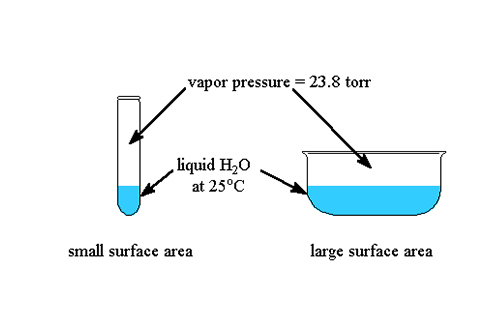
At any temperature, some molecules in a liquid have enough kinetic energy to evaporate into the vapor phase. More and more molecules evaporate, and some of them come back in the process of condensation. At the stage where the rate of evaporation equals the rate of condensation, the system is in equilibrium—the vapor pressure at the given temperature is described by this equilibrium. Exponential dependence of the vapor pressure on temperature follows from the Clausius–Clapeyron equation.
Factors Influencing Vapor Pressure
1. Temperature
Temperature has the most direct effect on vapor pressure. With increased temperature, molecular kinetic energy is increased, and more molecules can escape the liquid phase. For example, water vapor pressure increases from 17.5 mmHg at 20°C to 760 mmHg at 100°C, where it boils under standard atmospheric pressure.
2. Intermolecular Forces
Greater intermolecular forces—such as hydrogen bonding or van der Waals forces—lower vapor pressure. Hydrogen-bonding water possesses a much lower vapor pressure compared to weak dipole-dipole-interacting acetone.
3. Nature of the Substance
The molecule's shape also matters. Substances with lighter, less polar molecules (diethyl ether) have higher vapor pressures than heavier or more strongly bonded ones (glycerol or mercury).
Methods for Measuring Vapor Pressure
1. Manometric Method
This is the classical technique in which the liquid is contained in a sealed vessel and the equilibrium vapor pressure is measured directly with a manometer after equilibrium has been reached. It provides accurate readings at low to moderate pressures.
2. Dynamic Method
This method is quantifying vapor pressure from the variation in the liquid volume or weight with time as vapor is released. It's mostly applied to quickly evaporating substances or for elevated temperatures.
3. Effusion Method
The number of gas molecules leaving through a small pore (effusion) varies linearly with vapor pressure. It's suitable for minute samples and volatile substances.
4. Clausius–Clapeyron Calculations
For the majority of substances, measurement directly is not possible. Vapor pressure at various temperatures is then determined from the Clausius–Clapeyron equation on the basis of experimentally determined boiling points and enthalpy of vaporization.
Practical Significance of Vapor Pressure
1. Meteorology and Climatology
Vapor pressure directly relates to humidity—a vital parameter in weather forecasting and precipitation. For instance, relative humidity (RH) is the actual water vapor pressure to saturation vapor pressure ratio at any given temperature. Accurate measurement of vapor pressure helps predict dew points, fog, and rainfall.
2. Industrial and Chemical Engineering
In vapor pressure, evaporation, and chemical separation, vapor pressure dictates how things will act upon heating and cooling. Petroleum refining, for instance, depends upon vapor pressure differences to split hydrocarbons such as hexane and toluene apart by fractional distillation.
In refrigeration, the refrigerant such as R134a or ammonia is selected in part for their vapor pressure properties—they need to evaporate and condense nicely within a safe range of pressures.
3. Pharmaceutical Applications
Drug formulations containing volatile components must consider vapor pressure to ensure stability and shelf life. For instance, ethanol-based antiseptic gels use formulations with controlled vapor pressures to balance effectiveness and evaporation rate.
4. Environmental Science
Vapor pressure also determines how contaminants, like volatile organic compounds (VOCs), behave in the atmosphere. Highly vapor-pressure compounds, like benzene or acetone, contribute significantly to the formation of smog and are controlled heavily in the environment.
Examples and Data
|
Substance |
Vapor Pressure at 20°C (mmHg) |
Vapor Pressure at 100°C (mmHg) |
|
Water |
17.5 |
760 |
|
Ethanol |
44.6 |
400 |
|
Acetone |
180 |
760 |
|
Methanol |
95.3 |
1300 |
|
Benzene |
75.1 |
450 |
|
Diethyl Ether |
430 |
5800 |
|
Mercury |
0.0012 |
0.2 |
|
Hexane |
150 |
450 |
|
Toluene |
22.3 |
230 |
|
Chloroform |
160 |
500 |
These figures illustrate how molecular forces and temperature affect volatility. Diethyl ether, for instance, boils very quickly at room temperature due to its high vapor pressure, while mercury approaches nonvolatility even at high temperatures. For more information, please check Stanford Advanced Materials (SAM).
Frequently Asked Questions
What is vapor pressure?
Vapor pressure is the pressure of a vapor in equilibrium with its liquid or solid at a given temperature.
How does increasing temperature increase vapor pressure?
Because molecules gain kinetic energy and more easily overcome intermolecular forces, there is more evaporation.
Why is water not so volatile as acetone?
Water's high hydrogen bonds require more energy to break and are therefore less volatile.
Can vapor pressure predict volatility?
Yes. Greater vapor pressure indicates greater volatility and more rapid evaporation.
Why is vapor pressure so important to weather forecasting?
It is used to calculate humidity, dew point, and condensation—essential to forecast rain and cloud development.
 Chin Trento