

 Products
 Bars
Bars
 Beads & Spheres
 Bolts & Nuts
 Crucibles
 Discs
Discs
 Fibers & Fabrics
 Films
Films
 Flake
Flake
 Foams
Foams
 Foil
Foil
 Granules
 Honeycombs
 Ink
Ink
 Laminate
 Lumps
Lumps
 Meshes
 Metallised Film
 Plate
Plate
 Powders
 Rod
Rod
 Single Crystals
 Sputtering Target
 Tubes
Tubes
 Washer
 Wires
Wires
 Converters & Calculators
 Write for Us



5 Materials for Perfectly Glowing Skin

Everyone wants that healthy, radiant glow that looks like it's shining from within, but achieving it is easier said than done when you factor in stress, sleep deprivation, environmental pollutants, and hectic schedules. Fortunately, technology has also improved when it comes to skin care. By being better educated on some important ingredients and their functions, you'll be able to make better decisions when you go shopping for skin care products down at your local convenience store. Here are five materials that are proven by science to give you smooth skin.
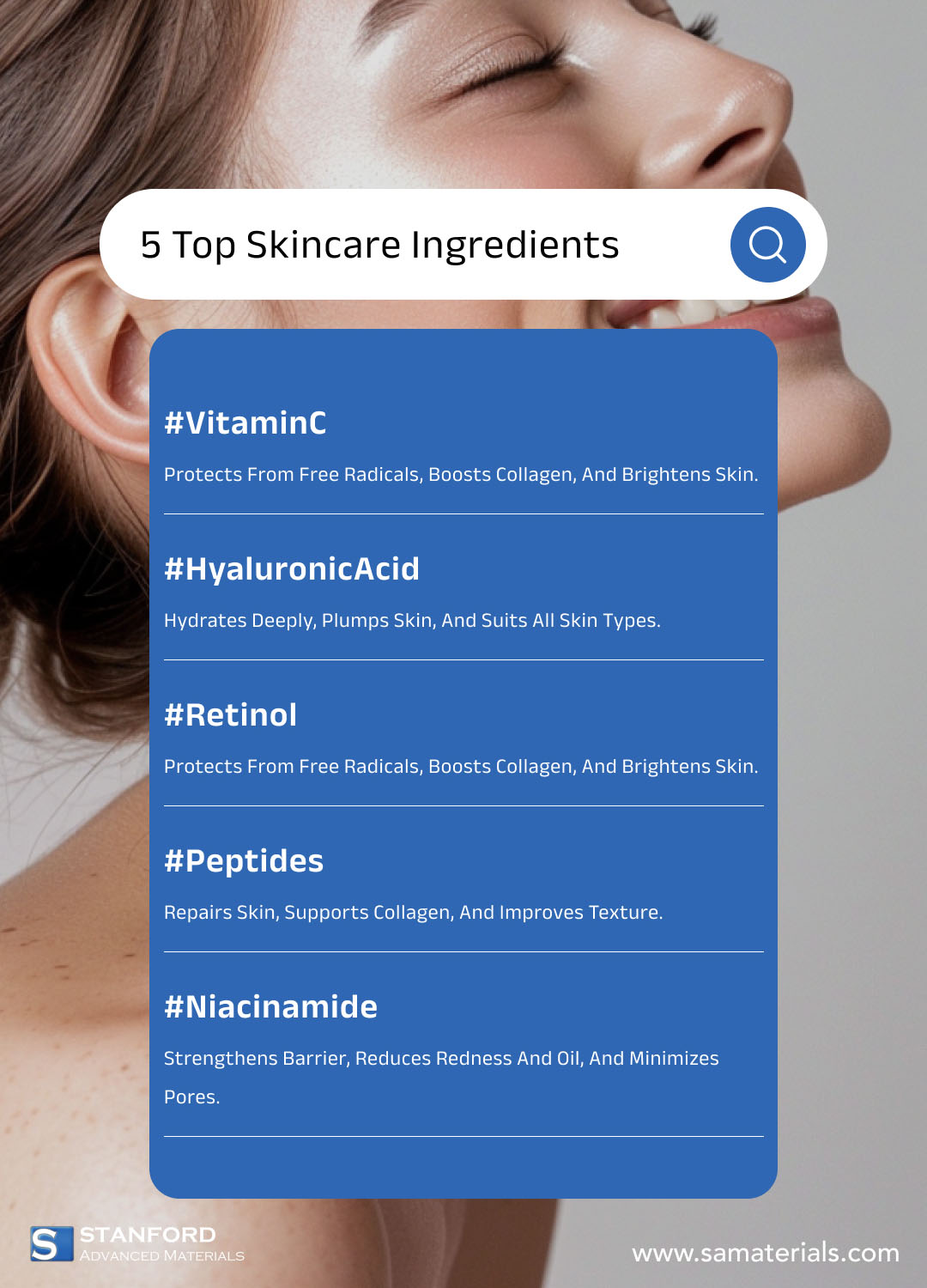
Vitamin C: The Brightening Agent
Vitamin C is one of the best-studied and best-recommended ingredients for skincare, for several reasons. Vitamin C is a powerful antioxidant, so it works by eliminating free radicals formed by UV exposure, pollution, and environmental factors. Free radicals are harmful molecules formed when UV exposure breaks down harmless molecules in our body, damaging cells and making us look older. Vitamin C works by preventing this damage, thereby protecting our skin and further triggering the production of collagen in our body, making it brighter and smoother by enhancing its elasticity and firmness over a period of time.
When using Vitamin C, one should consider the concentration at which the Vitamin C is used. It should be used in concentrations ranging from 10% to 20%. Vitamin C should be applied in the morning because it is more effective in increasing the skin's protection from environmental factors when used at this time. Vitamin C is sensitive to air and light; therefore, one should store the cream properly. At first, one may experience some stinging when using Vitamin C, but this effect diminishes as one gets accustomed to the reaction.
Hyaluronic Acid: The Hydration Magnet
Hyaluronic acid is a naturally occurring substance already found in the skin, where it is essential for maintaining hydration. The astounding aspect of its properties, however, is its capability of holding as much as 1,000 times its weight in water. As such, it is able to draw hydration not only from the environment, as mentioned, but also from within the skin, resulting in an instantly hydrated appearance. Hydrated skin appears fuller, smoother, and radiant, symbolizing the healthy glow.
In a skin care regimen, hyaluronic acid is known to work well on all skin types, including sensitive and acne skin. It is best used when the skin is slightly damp and coupled with a moisturizer to lock the moisture. Some hyaluronic acid creams use various molecular weights—high molecular weight to hydrate the surface and lower molecular weight to penetrate deeply into the skin. Hyaluronic acid lacks the ability to exfoliate or brighten the skin, but its skin-quality-improving properties are ideal for a glowing skin care routine.
Retinol: The Skin Revitalizing Specialist
Retinol, a vitamin A derivative, is known to be among the most efficacious skin renewal tools available in the market. This product works on the skin's mechanism of stimulating its natural renewal phase by encouraging the removal of old and damaged skin cells while inducing new ones to grow. This has been found to soften the skin's texture, reduce fine lines and spots of pigmentation, and even boost its clarity. Retinol has been proven to assist in collagen synthesis, and with it, skin becomes firm and youthful-looking.
Though effective, retinol is a product that needs to be used properly. It is best to start off slowly—beginning one to two times a week—and is best done at night since it makes the skin more sensitive to the sun. It is also crucial to use sun protection when applying retinol. When it comes to concentration, new users would benefit best by starting off low while those who are more experienced can start to use stronger products. It is best to view retinol as an investment since it is a product that gives visible results slowly.
Peptides: The Skin-Strengthen
Peptides are short chains of amino acids and represent the building block for some essential proteins found in the skin, like collagen and elastin. In cosmetic applications, peptides act like messengers that relay information to skin cells, telling them to repair damaged areas and restore support to the structure of the skin. The end result is a smoother, more defined complexion.
Peptide products tend to be gentle on the skin and can thus be used on a daily basis, especially on sensitive skin. Moreover, these products can layered atop most other skincare ingredients, such as hyaluronic acid and niacinamide, and thus can be used along with other skincare products. Peptides do not offer an immediate dramatic effect on the skin; however, their advantages can be enjoyed over time when used on a constant basis. They help in strengthening the support structure of the skin over time.
Niacinamide: the Balancing
Niacinamide, also recognized as vitamin B3, is extremely versatile and is valued for its ability to promote overall skin health. It increases the strength of the skin barrier by promoting the production of ceramides. It also has anti-inflammatory effects, making niacinamide useful in reducing inflammation caused by redness, combatting breakouts, as well as controlling excessive production of oil. It is also useful in reducing the dilation of pores as well as fine lines.
One of the biggest reasons why niacinamide is appreciated by many for its skincare applications is because it combines well with other skincare products. It can be used both in the day and at night and with vitamin C, retinols, peptides, and hyaluronic acid. The best ratio for niacinamide should always be between 2% and 5%. Those with sensitive skin will greatly benefit from niacinamide because it will give them visible improvements with minimal irritation compared to other skincare products with stronger formulas. For more information, please check Stanford Advanced Materials (SAM).
Frequently Asked Questions
Are the ingredients compatible with each other?
To answer, yes. Modern skincare routines tend to successfully incorporate all of them. But to avoid irritating your skin, it is best to incorporate new products one at a time. Also, a dermatologist can be consulted to allow for combinations specifically for one's skin type.
When will I see the results?
Results depend on the product, as well as the individual skin type. Hydrating qualities, such as hydration provided by Hyaluronic Acid, can be seen in a matter of days, while brightening, such as brightness offered by Vitamin C, Retinol, or Peptides, take a few weeks.
Do these ingredients work well on all skin types?
In general, yes. These ingredients have been commonly incorporated into skincare products. Still, for people who have very sensitive skin or other skin issues, doing a patch test or consulting with a professional before proceeding may be the best course of action.
 Chin Trento