
 Products
 Bars
Bars
 Beads & Spheres
 Bolts & Nuts
 Crucibles
 Discs
Discs
 Fibers & Fabrics
 Films
Films
 Flake
Flake
 Foams
Foams
 Foil
Foil
 Granules
 Honeycombs
 Ink
Ink
 Laminate
 Lumps
Lumps
 Meshes
 Metallised Film
 Plate
Plate
 Powders
 Rod
Rod
 Single Crystals
 Sputtering Target
 Tubes
Tubes
 Washer
 Wires
Wires
 Converters & Calculators
 Write for Us



Synthesis and Processing of Perovskite Powder

Introduction
Perovskite powder is an essential material in several industries. It is used in solar cells, sensors, and advanced electronics. Scientists have been attempting to streamline the processing methods for decades. The powder has unique characteristics, and ensuring its purity and homogeneity is of great importance for high-performance application. In this article, we will discuss the main synthesis processes and factors ensuring the purity and consistency of the product.
General Synthesis Methods (Sol Gel, Hydrothermal, Solid-State Reaction)
Sol gel method is employed for bulk production of perovskite powder. Metal alkoxides and salts are mixed with alcohol and water. The mixture is then water-treated and alcohol-treated to develop a gel, which is then heat-treated and dried to develop a powder. This gives a uniform texture to the powder. It is amply employed in research laboratories as control is easy.
The hydrothermal method employs hot and high pressure water. Sealed containers are used in the reaction. This process enhances crystal growth under controlled conditions. It generally yields high crystal quality. It is widely used by many researchers when single-phase perovskite production is required.
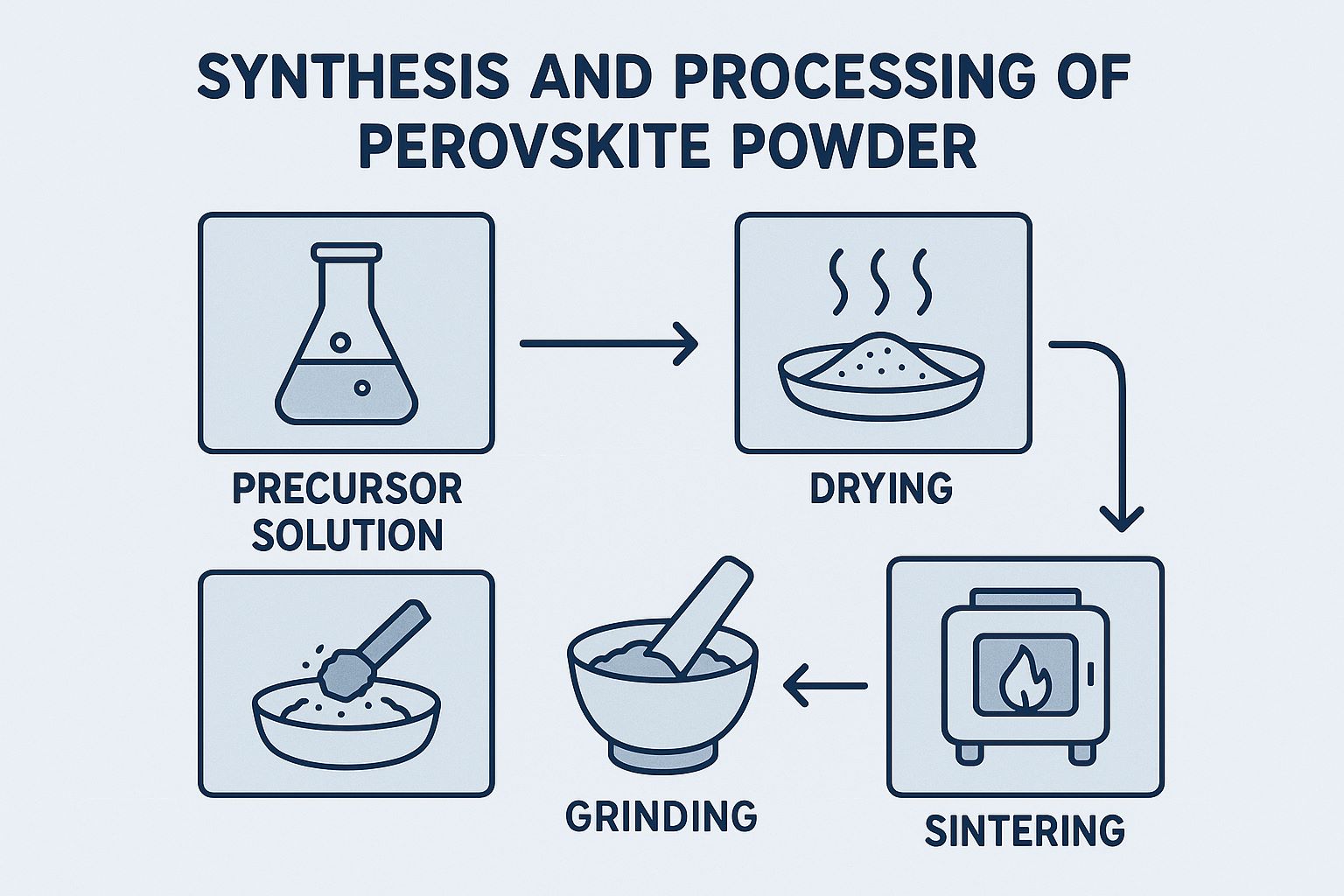
Solid-state reaction is an ancient method. It is a technique of mixing components in solid form before high-temperature sintering. The powders are ground with caution to ensure good intermixing. During heat treatment, the materials react to form the perovskite structure. This is quite commonly used in industry. This has been reported as facile for scaling up process.
There are advantages and limitations of each process. Better control over composition is achieved through the sol gel process. Fewer defects are present in the crystal formed through the hydrothermal route. Solid-state reaction can be used for large material bulk. Proper selection of the process with respect to the desired property and application in the industry.
Particle Size Control and Morphology
Particle size control is significant for perovskite powder. Achieving the right particle size can affect device performance. Larger particles can reduce energy conversion device efficiency. Small particles are typically preferred for homogeneous solar cell films.
Various techniques are utilized for particle size control. Factors during the sol gel process, such as the pH of the solution, help in regulating the growth. Temperature and pressure are the two in hydrothermal processes. Milling time and temperature are the decisive ones for the solid-state reaction. These need to be regulated carefully. Minute changes can make a big difference to the resulting powder.
Morphology is also important. The surface texture of perovskite can dictate application. Scientists look at factors like porosity and grain boundaries. Smooth, even morphology provides improved performance. In practical applications, well-controlled morphology has improved device stability in sensing devices and enhanced the absorption of light in solar systems.
Common examples in the peer-reviewed literature suggest that particle size and morphology control can be employed to bring about increases in device efficiency by ten to twenty percent. Such specific percentages are helpful when engaged on processes for batch production at the industrial scale.
Purity and Phase Characterization
Purity is a critical aspect of perovskite powder processing. Impurities may lower the efficiency in devices such as light emitters. The material's phase is also extremely crucial. A polluted phase may cause unwanted deterioration in stability and performance.
Researchers utilize a number of methods of determining purity. X-ray diffraction is one that has extensive use. This machine confirms the crystal structure and detects secondary phases. Scanning electron microscopy helps in measuring morphology and particle distribution. In some cases, energy dispersive X-ray spectroscopy is employed to confirm elemental impurities.
Quality control is not just research protocol but also industrial practice. Various industrial examples demonstrate the reality that small differences in the process of synthesis can lead to very pure and single-phase perovskite. The resulting powders show enhanced absorption of light, which is absolutely essential for solar energy conversion. They are also better for electrical conductivity in sensing devices. Some investigations point out that reducing impurities can increase performance parameters by more than fifteen percent.
The uniform processing method and characterization equipment guarantee quality production is sustained at a uniform level. For instance, in scaling up laboratory method to industrial production, the same characterization method is used. Such common method guarantees the product is of the same kind, ensuring devices such as photovoltaic cells work reliably over long operation.
Conclusion
Perovskite powder is going to have a very promising future in many applications related to technology. Synthesis may be done using different processes. Sol gel technique, hydrothermal process, and solid-state reaction are all different ways with advantages. Particle size and morphology must be controlled too. Purity and characterization of the phases help to ensure a high-quality product.
Frequently Asked Questions
F: What is the sol gel method?
Q: It mixes metal alkoxides with water and alcohol to form a uniform gel that is then dried and calcined to powder.
F: How is particle size controlled?
Q: Particle size during synthesis could be controlled by varying pH, temperature, pressure, and milling time.
F: Why must perovskite powder be of high purity?
Q: Purity avoids defects and improves device efficiency and stability.

 Chin Trento