
 Products
 Bars
Bars
 Beads & Spheres
 Bolts & Nuts
 Crucibles
 Discs
Discs
 Fibers & Fabrics
 Films
Films
 Flake
Flake
 Foams
Foams
 Foil
Foil
 Granules
 Honeycombs
 Ink
Ink
 Laminate
 Lumps
Lumps
 Meshes
 Metallised Film
 Plate
Plate
 Powders
 Rod
Rod
 Single Crystals
 Sputtering Target
 Tubes
Tubes
 Washer
 Wires
Wires
 Converters & Calculators
 Write for Us



What Are the Differences between Traditional Alloys and High-Entropy Alloys?

Introduction
Traditional alloys and high-entropy alloys (HEAs) are two types of materials used in various applications. Both of them are composed of metallic elements, yet there are several key differences between these alloys. In this article, we will explore the differences between traditional alloys and HEAs, including their composition, microstructures, properties, applications, and production methods.
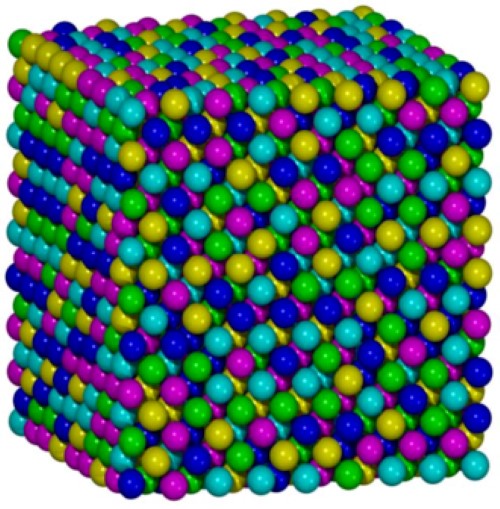 [1]
[1]
Figure 1. Automatic Model of HEAs
Introduction to Traditional Alloys & High-entropy Alloys
Traditional alloys combine one metal element with other metal or non-metal elements. These types of alloys reserve some properties of the original base metal while changing some features, such as enhanced strength or promoted ductility.
There are a wide variety of alloying elements that can be added to the base metals. Chromium is commonly added to enhance the corrosion resistant of the alloys; tungsten is a metal alloying element used to improve wear resistance at high temperatures; while carbon addition is frequently added in steel and cast iron alloys to improve strength.
High-entropy alloys refer to alloys containing 5 or more principal elements, each of which has an atomic percentage between 5% and 35%. The inclusion of multiple elements results in a complicated structure and high entropy effect, which bring about HEA’s unique physical and mechanical properties compared with conventional alloys.
Stanford Advanced Materials (SAM) has rich experience in the manufacture and sale of high-entropy alloy products. There is a broad range of quality HEA powders, spherical powders, and ingots on our website. Send us an inquiry if you are interested.
Traditional Alloys VS. High-entropy Alloys
--Composition
Traditional alloys and high-entropy alloys have different element compositions. For one thing, conventional alloys are typically composed of two or three metallic elements in varying proportions. Whereas, HEAs contain at least five elements in equal or approximately equal atomic proportions. For another, the base metal in traditional alloys accounts for the largest proportion, while the elements in high-entropy alloys take up equal or near-equal proportions.
--Microstructure
Different composition results in different structures. Traditional alloys typically exhibit a well-defined microstructure, such as a eutectic or dendritic structure, while HEAs exhibit a disordered, homogeneous microstructure. The disordered nature of HEAs leads to a random distribution of atoms, which reduces the occurrence of phase transformations, even at high temperatures.
--Properties
Traditional alloys exhibit a range of properties, depending on their composition and microstructure. For example, some traditional alloys may be strong but brittle, while others may be ductile but have low strength.
In contrast, HEAs show a superior combination of properties, including high strength, ductility, and thermal stability, due to their disordered microstructure. For instance, VNbMoTaW is a remarkable refractory alloy with a high yield strength of over 600 MPa (87 ksi)) even at a temperature of 1,400 °C, which could even outperform conventional superalloys.
--Applications
Traditional alloys are popular materials used in various applications, such as automotive, aerospace, and construction.
HEAs, on the other hand, are a relatively new class of materials that are still being explored for their potential applications. They have shown promise in various applications, including high-temperature thermoelectric applications, wear-resistant coatings, and structural materials.
For instance, HEAs are applied to the automobile industry to make engine parts, drivetrain components, and other structural equipment. These alloys also serve as promising materials for nuclear applications thanks to their high-temperature mechanical properties and radiation and corrosion resistance.
--Production
The preparation process of conventional alloys is relatively simple, while there are multiple approaches to producing high-entropy alloys.
Traditional alloys are typically produced using conventional methods, such as casting, extrusion, and forging. Generally, the process includes melting, mixing, solidifying, and cooling thereafter.
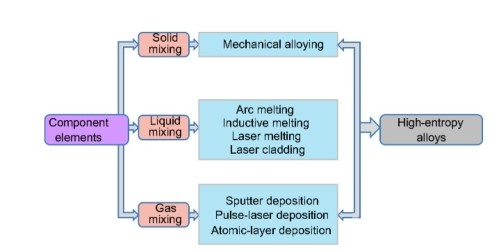
Yet, the production of HEAs requires specialized techniques (see Figure 2) due to their complex composition and microstructure. Most of them are made with arc melting and induction melting. Solid-state processing employs mechanical alloying. Gas-phase processing utilizes sputtering or molecular beam epitaxy (MBE).
 [2]
[2]
Figure 2. Fabrication of HEA
Conclusion
In a word, traditional alloys and high-entropy alloys differ in their composition, microstructure, properties, applications, and production methods. While traditional alloys have a well-defined microstructure and properties, HEAs offer a unique combination of properties due to their disordered, homogeneous microstructure. HEAs are a promising class of materials for various applications and are still being explored for their full potential. Stanford Advanced Materials (SAM) is a reliable supplier of high-entropy alloys. For more information, please visit our homepage.
Reference:
[1] High-entropy alloy. (2023, June 5). In Wikipedia. https://en.wikipedia.org/wiki/High-entropy_alloy#See_also
[2] Zhang, Wei & Zhang, Yong. (2018). Science and technology in high-entropy alloys. Science China Earth Science. 2-22.
lbjq.jpg)
 Chin Trento