Products
 Bars
Bars
 Beads & Spheres
 Bolts & Nuts
 Crucibles
 Discs
Discs
 Fibers & Fabrics
 Films
Films
 Flake
Flake
 Foams
Foams
 Foil
Foil
 Granules
 Honeycombs
 Ink
Ink
 Laminate
 Lumps
Lumps
 Meshes
 Metallised Film
 Plate
Plate
 Powders
 Rod
Rod
 Single Crystals
 Sputtering Target
 Tubes
Tubes
 Washer
 Wires
Wires
 Converters & Calculators
 Write for Us



An Overview of the Nitinol

Nickel-titanium alloy, also known as nitinol, is a binary alloy composed of nickel and titanium. The two elements are roughly equal in atomic percentage (Nitinol 55 and Nitinol 60 are common).
Austenitic phase and martensitic phase
Due to the changes in temperature and mechanical pressure, nitinol has two different crystal structure phases, namely the austenitic phase and the martensitic phase.
In nitinol, the austenite is called the mother phase, which is the crystal phase shown by alloy at high temperature. When the temperature decreases, austenite will gradually convert to martensite (subphase).
In the process of martensite and austenite transformation, there are four kinds of temperatures:
* As: the temperature at which martensite begins to convert to austenite during the process of temperature rise.
* Af: the temperature at which martensite finishes the conversion into austenite during the process of temperature rise.
* Ms: the temperature at which austenite begins to convert to martensite during the process of temperature drop.
* Mf: the temperature at which austenite finishes the conversion into martensite during the process of temperature drop.
The phase transformation of nitinol has a thermal hysteresis, so As is not equal to Mf, for the same reason, Af is not equal to Ms.
Two characteristics of nitinol
1. Shape memory
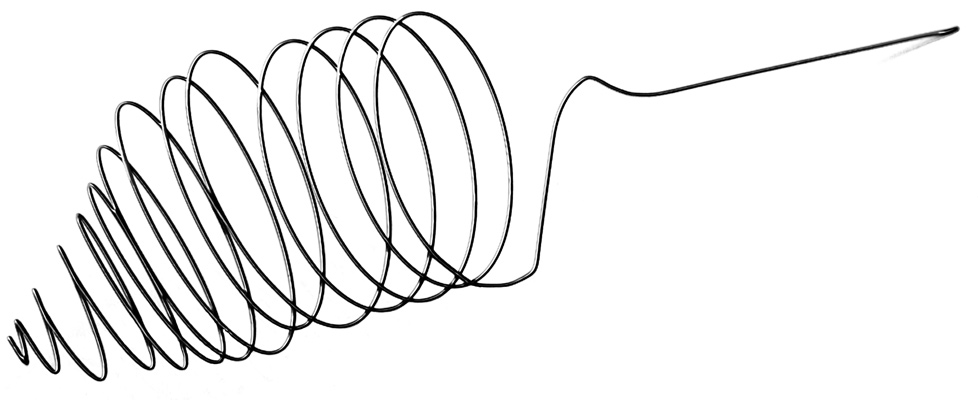
Shape memory happens when mother phase of a certain shape is cooled from above the Af temperature to below the Mf temperature and completely forms the martensite, deforming the martensite below Mf temperature. After being heated to below Af temperature, with reverse phase transformation, the material will automatically restore its shape in mother phase. In fact, the shape memory effect is a thermally induced phase transition process of nitinol. It refers to the ability of nitinol to deform at a certain temperature and then restore the original, non-deformed shape when the temperature is higher than its "transition temperature".
2. Superelasticity
The so-called superelasticity refers to the phenomenon in which the sample produces a strain that is far greater than the elastic limit strain under the effect of external forces and the strain can automatically restore during unloading. In the mother phase, due to the effect of external stress, the strain triggers martensitic phase transition so that the alloy exhibits mechanical behaviors that are different from those of ordinary materials. Its elastic limit is much larger than that of ordinary materials. And it no longer follows Hooke’s Law. Compared with the shape memory effect, superelasticity does not involve heat.
Applications of nitinol
1. Eyeglass frames
Though many nitinol applications are invisible to the general public, some are quite familiar. Eyeglass frames made from nitinol can be bent severely out of shape, but then return perfectly to normal. Also, some years ago, when cell phones had pull-out antennas, many of the antennas were made from Nitinol, allowing them to flex without breaking or permanently bending.
2. Orthodontistry
Another superelastic application, where you or your children may have experienced nitinol, is in archwires used for orthodontists. The orthodontist takes a nitinol wire and bends it, attaching it to the teeth. Because the wire is superelastic, it tries to return to its straight condition and continually exerts a force on the teeth. This allows less frequent visits to the orthodontist to have braces tightened.
3. Medical devices
Surgical instruments and components made from nitinol fill many needs, especially in minimally invasive or arthroscopic surgery. These may take advantage of the superelasticity and fatigue resistance of nitinol. A tool that has a bend in it can be straightened and introduced through a cannula, a rigid tube. When it emerges from the cannula, the tool returns to its original shape. The surgeon performs the procedure, and then the tool is retracted back into the cannula where it straightens out again for easy removal.
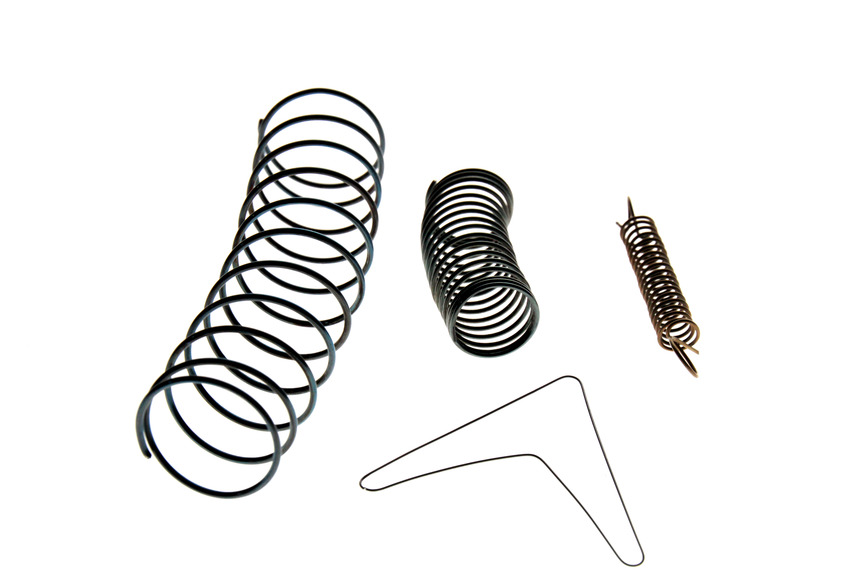
The superelastic quality of nitinol, along with its biocompatibility, makes it ideal for making many types of medical devices that are implanted in the body. An application familiar to many of us is the stent, a device that supports blood vessels and keeps them open. Nitinol’s superelasticity allows a medical device, such as a stent or a heart valve, to be compressed into a shape that fits inside a catheter. The catheter is positioned at the correct location in the body, the device is released, and it returns to its original shape.
This same superelasticity makes nitinol the only material suitable for stents used in the carotid artery in the neck, or blood vessels in the legs. In these vulnerable locations, a blow to the area of a stent will cause it to deflect, but a nitinol stent will return to its intended shape. Stents made of other materials would be subject to crushing or permanent bending by such an impact.
4. Other applications
A number of lesser-known applications use nitinol’s shape memory capability. A well-known computer manufacturer used a nitinol device to eject PCMCIA (Personal Computer Memory Card International Association) cards. Also, nitinol is used in couplings that join the ends of hydraulic tubing in aircraft. In a less serious application, nitinol enables spoons from the magic shop to bend when placed in hot water.
 Chin Trento