
 Products
 Bars
Bars
 Beads & Spheres
 Bolts & Nuts
 Crucibles
 Discs
Discs
 Fibers & Fabrics
 Films
Films
 Flake
Flake
 Foams
Foams
 Foil
Foil
 Granules
 Honeycombs
 Ink
Ink
 Laminate
 Lumps
Lumps
 Meshes
 Metallised Film
 Plate
Plate
 Powders
 Rod
Rod
 Single Crystals
 Sputtering Target
 Tubes
Tubes
 Washer
 Wires
Wires
 Converters & Calculators
 Write for Us



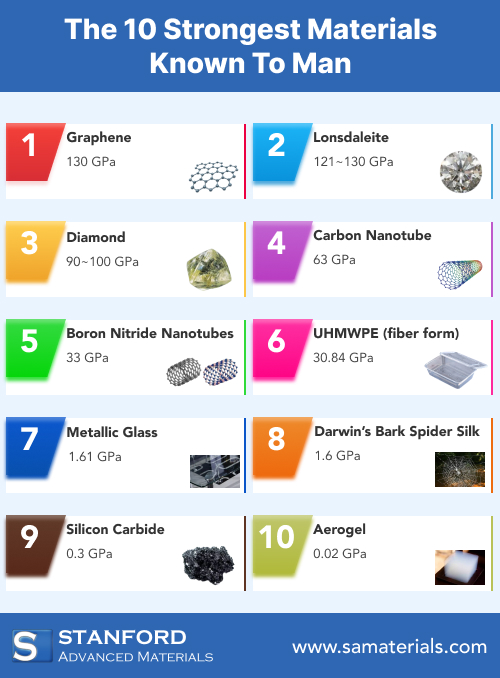
The 10 Strongest Materials Known To Man

This ranking is based on tensile strength (GPa) except where noted. Some materials (e.g., aerogel) are included for their unique properties, such as ultra-low density or thermal resistance.
Note: "Strongest" here refers to tensile strength (resistance to being pulled apart). For hardness (scratch resistance), diamond remains the hardest natural material (Mohs 10).
| Rank | Material | Tensile Strength (GPa) | Key Property | Typical Application |
|---|---|---|---|---|
| 1 | Graphene | 130 | Strongest known material, single-atom layer | Aerospace, composites, electronics |
| 2 | Lonsdaleite | 121–130 | Hexagonal diamond, 58% more pressure-resistant than diamond | Industrial cutting, meteoritic origin |
| 3 | Diamond | 90–100 | Hardest natural material, Mohs 10 | Cutting tools, jewelry, abrasives |
| 4 | Carbon Nanotube | 63 | 1D quantum material, 5× strength of steel | Nanotechnology, structural composites |
| 5 | Boron Nitride Nanotube | 33 | Thermal & chemical stability, binds well with polymers | Protective shields, electrical insulators |
| 6 | UHMWPE Fiber | 30.84 | 15× stronger than steel wire, lightweight | Armor, medical devices, ropes |
| 7 | Metallic Glass | 1.61 | Amorphous structure, high elasticity | Aerospace components, sports equipment |
| 8 | Darwin's Bark Spider Silk | 1.60 | Toughest biological material, 10× stronger than Kevlar | Biomimetic materials, medical sutures |
| 9 | Silicon Carbide | 0.30 | Mohs 9.5, thermal resistance | Ceramics, semiconductors, abrasives |
| 10 | Aerogel | 0.02 | World's lowest density, withstands 1200°C | Thermal insulation, aerospace |
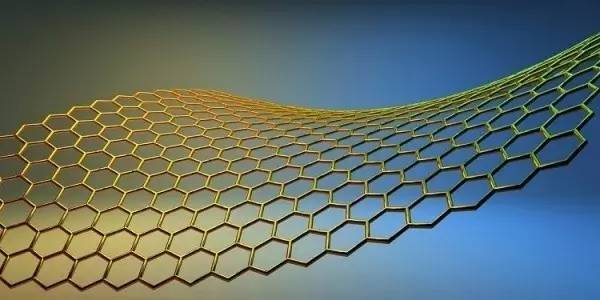
1. Graphene (130 GPa)
Graphene is the strongest known material, with unmatched tensile strength due to its single-atom-thick carbon lattice.
Graphene is a honeycomb two-dimensional film formed by carbon atoms with sp2 hybridization. It is a monolayer sheet structure separated from graphite and is also the thinnest known material. The tensile strength and elastic modulus of graphene are 130 GPa and 1.1 TPa, respectively, and its strength is 100 times that of ordinary steel. Bags made of graphene, which can hold about 2 tons of weight, are by far the strongest material known.
2. Lonsdaleite (121~130 GPa)
Lonsdaleite, a rare hexagonal form of diamond, is theoretically stronger than conventional diamond.
Lonsdaleite was first identified in a crater by American geologist Lonsdale and defined as a hexagonal meteorite diamond. Like diamonds, they are made of carbon atoms, but their carbon atoms are arranged in different shapes. The results of the simulation show that lonsdaleite is 58% more resistant to pressure than the diamond.
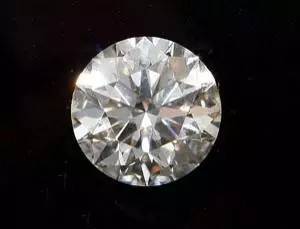
3. Diamond (90~100 GPa)
Diamond features exceptional tensile strength and hardness thanks to its compact tetrahedral crystal structure.
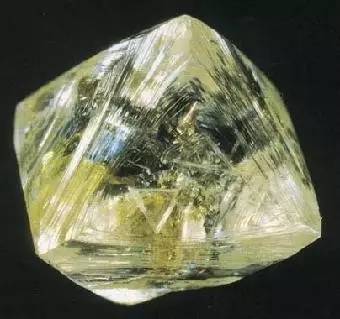
Diamond is the hardest naturally occurring substance on earth, and it is an allotrope of carbon. The hardness of diamond is the highest level of Mohs hardness - grade 10. Its microhardness is 10000kg/mm2, which is 1,000 times higher than quartz and 150 times higher than corundum.
4. Carbon Nanotube (63 GPa)
Carbon nanotubes combine extreme strength and light weight, making them ideal for structural nanomaterials.
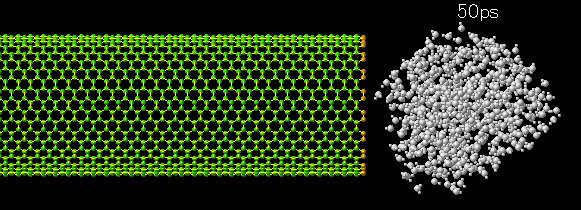
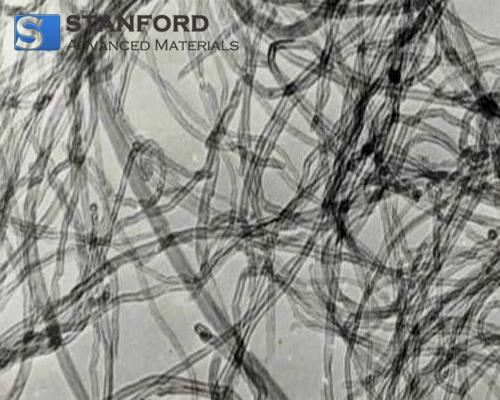
Carbon nanotubes (CNTs) are one-dimensional quantum materials consisting of hexagonal carbon atom arrangements formed into coaxial tubes. They can be classified as single-walled carbon nanotubes (SWCNTs) or multi-walled carbon nanotubes (MWCNTs) depending on the number of graphene layers. Carbon nanotubes have excellent mechanical properties, with a tensile strength of 63 GPa. Their elastic modulus can reach up to 1 TPa, which is equivalent to that of diamond and about 5 times that of steel.
5. Boron Nitride Nanotubes (33 GPa)
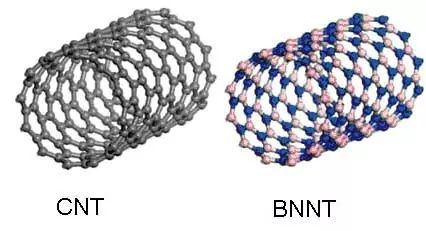
Like carbon, boron nitride can form single-atom sheets that can be curled up to form nanotubes. Boron nitride nanotubes (BNNTs) are structurally similar to carbon nanotubes and offer comparable tensile strength, with values around 33 GPa. Their real advantage comes from exceptional thermal and chemical stability, as well as strong interfacial bonding with polymers—BNNTs show about 30% higher interfacial strength with PMMA and about 20% higher with epoxy resin compared to carbon nanotubes.
Boron nitride nanotubes have optical properties, excellent mechanical and thermal conductivity properties, as well as withstand high temperatures and absorb neutron radiation, thus becoming effective additives for mechanical or thermal enhancement of polymer, ceramic and metal composites. Additional applications of boron nitride nanotubes include protective shields, electrical insulators, and sensors.
6. UHMWPE Fiber (30.84 GPa)
Ultra-high molecular weight polyethylene fiber is used in armor and medical devices due to its high strength-to-weight ratio.
UHMWPE is a kind of fiber made from polyethylene with a relative molecular weight of 1 million to 5 million, which is currently one of the strongest and lightest fibers in the world. It is 15 times stronger than steel wire but very light in weight, and it is 40 percent lighter at most than materials such as aramid.
7. Metallic Glass (1.61 GPa)
Metallic glass features high strength and elasticity due to its disordered atomic structure.
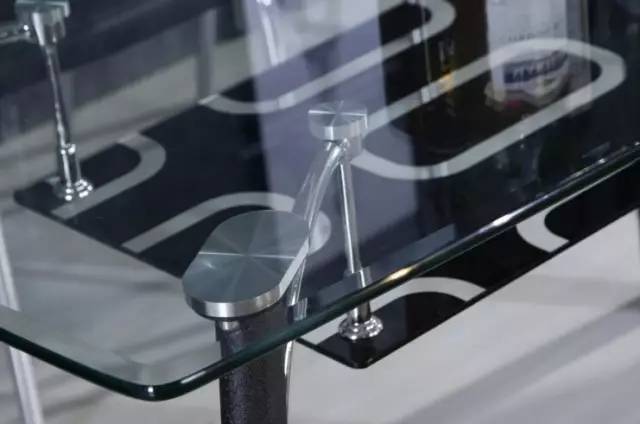
Metallic glass is also called amorphous metal, which is usually an alloy, with an amorphous structure and glass structure. This double structure determines that it has many properties superior to those of crystalline metal and glass, such as good electrical conductivity, high strength, high elasticity, more wear-resistant and corrosion-resistant. Metallic glass is stronger than steel and harder than hard tool steel.
8. Darwin's Bark Spider Silk (1.6 GPa)
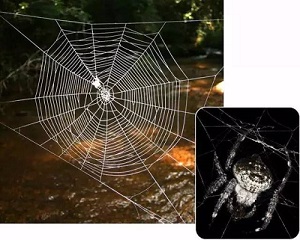
This spider silk stands out as one of the toughest biological materials, outperforming most synthetic fibers.
A new species of spider, Darwin's bark spider, has been found on Madagascar to create the world's largest and most solid web. At 25 meters wide, the spider's web is the strongest biological material ever studied and 10 times stronger than kevlar of the same size.
9. Silicon Carbide (0.3 GPa)
Silicon carbide is a durable ceramic known for thermal resistance and moderate tensile strength.
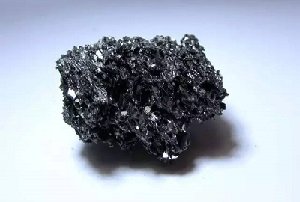
Silicon carbide is a natural mineral in nature, or it is made from quartz sand, petroleum coke (or coal coke), wood chips and other raw materials by smelting at high temperature in a resistive furnace. Silicon carbide is hard with a Mohs hardness of 9.5, which is second only to the world's hardest diamond. In addition, silicon carbide has excellent thermal conductivity. It is a kind of semiconductor and can resist oxidation at high temperatures.
10. Aerogel (0.02 GPa)
Aerogel is an ultralight material with minimal tensile strength, but valuable for thermal insulation.
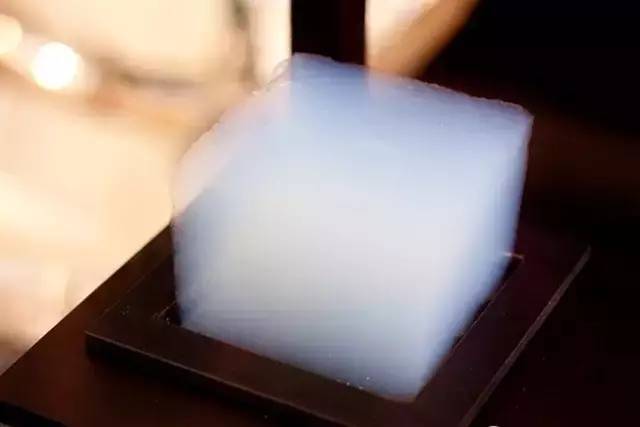
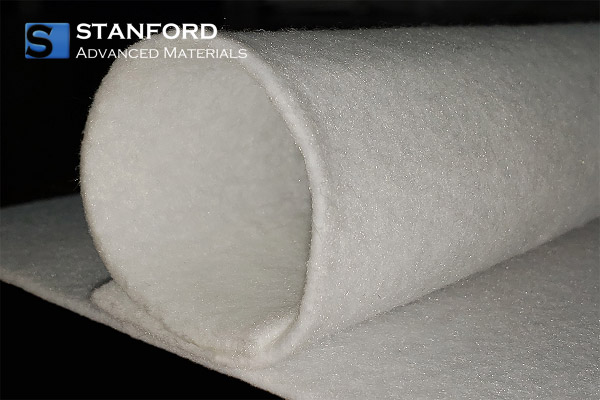
Aerogel is a form of solid material that has the smallest density in the world. Aerogels have a remarkable strength-to-weight ratio due to their extremely low density and can withstand compressive forces thousands of times their mass, and they remain thermally stable up to 1200°C.
Interested in sourcing high-performance materials for research or industrial applications? Stanford Advanced Materials (SAM) offers a wide range of advanced materials, including graphene, carbon nanotubes, and UHMWPE fibers. Learn more on our website.
References
- Banerjee, A., et al. (2018). Ultralarge elastic deformation of nanoscale diamond. Science, 360(6386), 300–302.
- Chen, X., Dmuchowski, C., Park, C., Fay, C., & Ke, C. (2017). Quantitative Characterization of Structural and Mechanical Properties of Boron Nitride Nanotubes in High Temperature Environments. Scientific Reports, 7.
- Class for Physics of the Royal Swedish Academy of Sciences. (2010, October 5). Scientific Background on the Nobel Prize in Physics 2010: Graphene [PDF]. Nobel Prize. Archived
- Ding, J., Chen, G., Huang, W., Cheng, J., Li, T., Cheng, C., & Xu, J. (2024). Tensile Strength Statistics and Fracture Mechanism of Ultrahigh Molecular Weight Polyethylene Fibers: On the Weibull Distribution. ACS Omega, 9.
- Kazuki Takashima, Akira Ishida. (2008). Metals and Alloys. In Y.B. Gianchandani, O. Tabata, & H. Zappe (Eds.), Comprehensive Microsystems (pp. 53–73). Elsevier.
- Kono, N., Ohtoshi, R., Malay, A. D., Mori, M., Masunaga, H., Yoshida, Y., Nakamura, H., Numata, K., & Arakawa, K. (2021). Darwin's bark spider shares a spidroin repertoire with Caerostris extrusa but achieves extraordinary silk toughness through gene expression. Open Biology, 11(12).
- Li, Q., Yi, S., Li, Z., & Yu, Z. (2011). Lonsdaleite – A material stronger and stiffer than diamond. Scripta Materialia, 65, 229–232.
- Magagnosc, D. J., & Schuster, B. E. (2019). Fracture strength of hot-pressed silicon carbide at the microscale. Materials Science and Engineering: A, 765, 138297.
- Ünal, H., Sert Çok, S., Koç, F., Gizli, N., & Pekbey, Y. (2019). Investigating the effect of silica aerogel content on the mechanical properties of epoxy resin system. Research on Engineering Structures and Materials.
- Yu, M. F., Lourie, O., Dyer, M. J., Moloni, K., Kelly, T. F., & Ruoff, R. S. (2000). Strength and breaking mechanism of multiwalled carbon nanotubes under tensile load. Science, 287(5453), 637–640.
 Chin Trento