Products
 Bars
Bars
 Beads & Spheres
 Bolts & Nuts
 Crucibles
 Discs
Discs
 Fibers & Fabrics
 Films
Films
 Flake
Flake
 Foams
Foams
 Foil
Foil
 Granules
 Honeycombs
 Ink
Ink
 Laminate
 Lumps
Lumps
 Meshes
 Metallised Film
 Plate
Plate
 Powders
 Rod
Rod
 Single Crystals
 Sputtering Target
 Tubes
Tubes
 Washer
 Wires
Wires
 Converters & Calculators
 Write for Us



Preparation and Properties of Porous Alumina Ceramics

What Are Porous Alumina Ceramics and Their Significance
Porous alumina ceramics are a class of alumina (Al2O3) materials with a controlled pore distribution, ranging from very fine micropores (<2 nm) to considerably larger macropores (>50 nm). The pore volume ratio, from around 10% to over 90% in a carefully controlled manner using techniques such as sintering, anodizing, or sacrificial templating, can be greatly varied from pure, solid alumina.
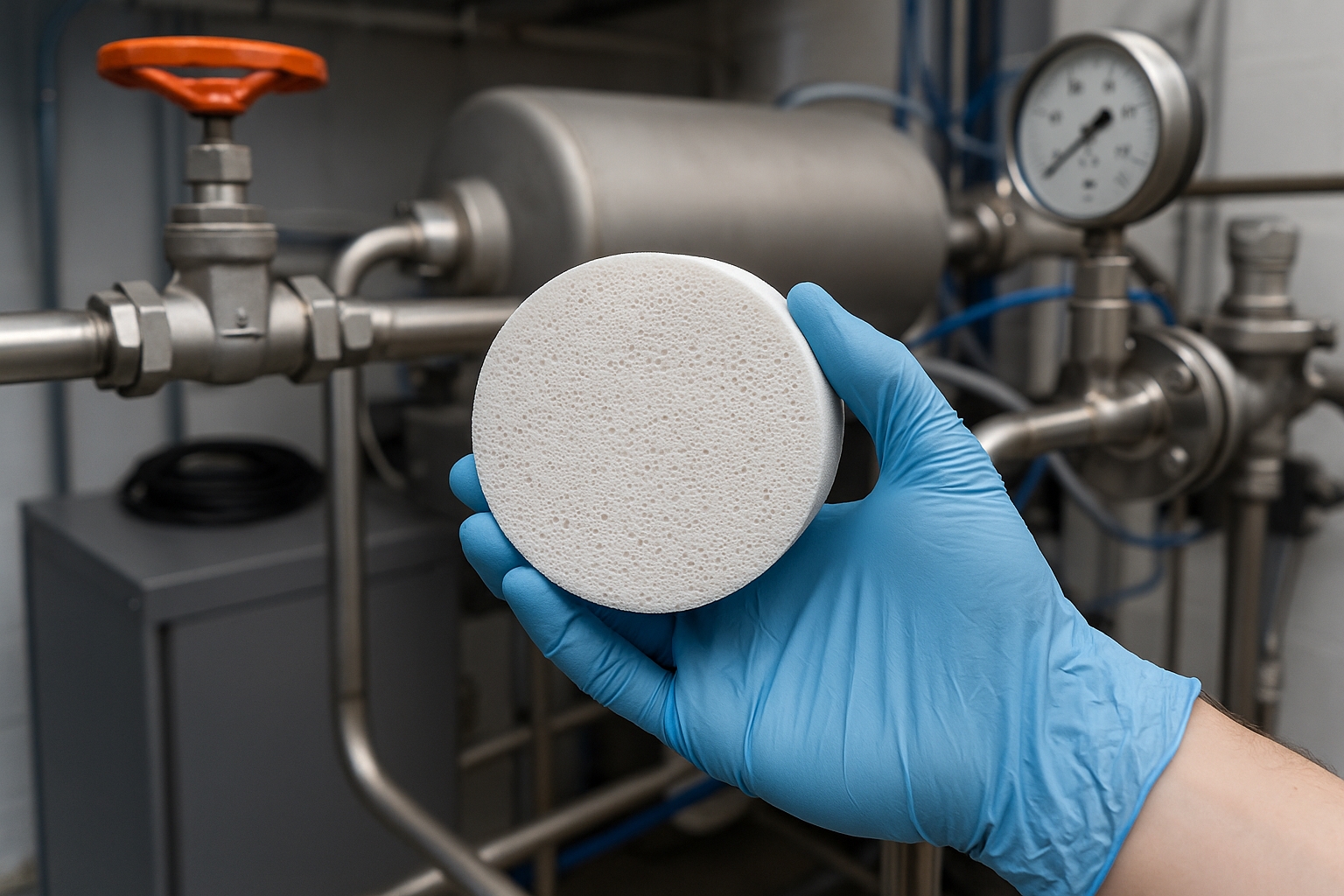
The uniqueness of these ceramics lies in their thermal stability; they can withstand temperatures of up to 1700°C without degradation. In their chemical properties, they are inert and resistant to corrosion from both acidic and alkaline surroundings, as well as organic ones. The pore size and distribution are controllable, generally from 5 nm to hundreds of micrometers. They also retain strong mechanical strength despite their porous structures, which often result in compressive strength values over 50 MPa, depending on their porosity. They also exhibit excellent thermal insulation, having thermal conductivity of 0.1 to 0.5 W/mK. They also exhibit excellent electrical insulation, having resistivity above 10^12 Ωcm.
Applications Requiring Porous Structures
Porous materials have numerous applications. In the filtration of fluids, the minute holes trap the particles. In catalysis, the large surface area facilitates chemical reactions. In the medical field, the application of ceramics as a scaffold on which cells grow is a suitable example of porous materials. In the insulation of buildings, the presence of pores in the materials is preferred as they reduce the flow of heat. Practical examples indicate improvements in the performance of materials incorporating pores.
Importance of Porosity and Microstructure
The arrangement of the pores is directly related to performance. Small variations in pore dimensions influence strength and robustness. The well-organized pore distribution ensures that the structure is strong and consistent while offering the intended function. Seasoned engineers understand that it is essential to strike the right chord concerning microstructure performance to generate superior reliability, and the process is the tool that helps achieve this. Varied results can come from minute differences.
Manufacturing of Porous Alumina Ceramics
There exist a number of promising manufacturing paths. One of the most widely used alumina ceramics manufacturing processes involves the use of a pore former that can either burn out or be dissolved. Freeze-casting involves the sublimation of the frozen alumina particles from the alumina suspension. Even direct foaming exists. Alumina paste can be mixed with air to produce bubbles that turn into pores. Each technique has an impact on pore size distribution and overall strength.
Control of Porosity and Microstructure
Making it nice and consistent is quite complex. Some important factors here involve the extent to which the powder is concentrated in the first place, the proportion of the substance known as the pore former that is added to it, and the temperatures involved in the stages of sintering. Increasing the proportion of powder will produce less porous ceramics, while increasing the proportion of the pore former will increase their porosity. Sintering times are then varied to encourage good grain growth.
Physical, Mechanical, and Functional Properties
Physically, porous alumina ceramics have excellent properties. They demonstrate a hardness of about 15 gigapascals and show good resistance to abrasion. The thermal stability of these ceramics is a high value in excess of 1500°C. In terms of density, these ceramics are lighter than most. They have a large surface area, which greatly assists in catalysis. Despite being porous, they show good mechanical strength. They are non-reactive, a property useful in extreme conditions.
Applications of Porous Alumina Ceramics
Such ceramics find applications in many different areas. In water and air filters, they act as a capturing material for undesired particles. For chemical processing, the high surface area is conducive for the creation of catalysts that speed up the reaction. For medical applications, they are employed as bone inserts and tissue engineering because cells can readily grow on these materials. For high-temperature insulation, the pores contribute effectively toward reducing the flow of heat. High-performance heat shields and furnance linings utilize the porous properties of alumina.
Conclusion
The porosity alumina ceramics are strong and efficient materials as well. Their specifically designed pore structures offer many uses in both industries as well as in health care. The preparation methods as well as processing conditions are highly effective in forming their microstructure properties. Filtrations, catalyst supports, insulators, and implant materials are just a few examples where porosity alumina has many effects in a vast variety of uses.
Frequently Asked Questions
What is the application of porous alumina ceramic?
Filtration, catalysis, biomedical implants, and insulation
How is the porosity adjusted?
Through the change of processing variables as well as the addition of pore formers.
What are some important physical characteristics?
High thermal stability, a hardness of about 15GPa, and lower density.
 Chin Trento