Products
 Bars
Bars
 Beads & Spheres
 Bolts & Nuts
 Crucibles
 Discs
Discs
 Fibers & Fabrics
 Films
Films
 Flake
Flake
 Foams
Foams
 Foil
Foil
 Granules
 Honeycombs
 Ink
Ink
 Laminate
 Lumps
Lumps
 Meshes
 Metallised Film
 Plate
Plate
 Powders
 Rod
Rod
 Single Crystals
 Sputtering Target
 Tubes
Tubes
 Washer
 Wires
Wires
 Converters & Calculators
 Write for Us



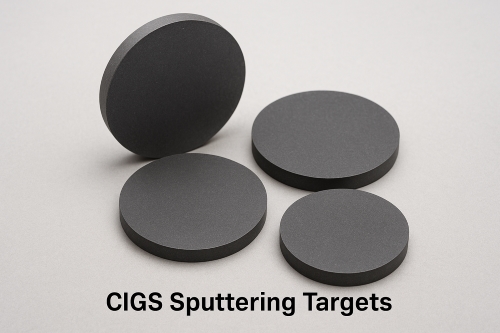
CIGS Sputtering Targets: Materials for High-Efficiency Thin-Film Solar Cells

Introduction
Copper indium gallium diselenide is well known in the world of thin-film solar cells. Researchers and engineers use sputtering targets on this compound for high-efficiency energy conversion. This article gives a clear view of the materials and methods used with these sputtering targets. It explains the basic material make-up and simple processes used.
Material Composition of Copper Indium Gallium Diselenide Targets
Copper indium gallium diselenide, often known as CIGS, is a compound made of copper, indium, gallium, and selenium. The ratio of these elements is important. A balanced mix ensures uniform and high-quality films on solar cells. For example, a target with 24% copper, 21% indium, 12% gallium, and 43% selenium has been used widely. Different compositions can change how well the film performs. Many engineers rely on precise measurements such as these to achieve a good balance for energy conversion. These materials are chosen for their robustness and ability to work together well.
Fabrication Methods of Copper Indium Gallium Diselenide Sputtering Targets
There are several ways to fabricate CIGS sputtering targets. One common method is pressing powders into a dense form and then sintering them at high temperatures. This process binds the elements with strong bonds. A pressing step ensures that the powder has a good base. Sintering then turns this into a solid material. This method has been used for decades in thin-film production labs. Another approach uses chemical solution processing. Here, chemicals combine and react on a substrate to form the target. Other methods include vacuum processing and co-evaporation. Many of these methods allow for control over the microstructure and improve the completeness of the film when sputtered.
Deposition Techniques Using Copper Indium Gallium Diselenide Targets
Sputtering plays a major role in depositing thin films of CIGS. In sputtering, particles leave the target and arrive on the substrate. Direct current sputtering is used mainly for conductive materials. Radio frequency sputtering serves well with less conductive targets. The vacuum in the deposition chamber aids in forming pure films. Careful control of pressure and power ensures that the film is even. A good example of this is the radio frequency sputtering method. It has been shown to create films with fewer flaws. These controlled conditions help to manage the quality and efficiency of the solar cells produced.
Advantages of Copper Indium Gallium Diselenide-Based Solar Cells
Solar cells based on CIGS have many strengths. They work well under different lighting conditions. They are flexible and light when made properly. Many solar farms and even roof installations use these cells. Their high conversion efficiency means that more energy is produced from the same sunlight area. Additionally, CIGS cells tolerate partial shading better than many other types. Their reliability makes them a favorite in both large and small systems. The use of sputtering targets helps to keep production costs low while delivering good performance. This makes CIGS an attractive option for many energy projects.
Performance Factors Linked to Target Quality
The quality of the sputtering target affects the final film. Uniformity in the target leads to consistent film thickness and composition. When the film is even, solar cells work better and last longer. Impurities or defects in the target can cause weak spots in the film. These weak spots may reduce the cell's overall efficiency. In my many years of work, I have seen that even small changes in the target quality can greatly affect performance. Advanced control techniques in a production environment help ensure that each target meets strict standards.
Conclusion
Copper indium gallium diselenide sputtering targets offer a simple path to high-efficiency thin-film solar cells. The materials used are chosen for balance and durability. Various fabrication techniques provide options to suit different production needs. Deposition through sputtering results in films that perform well. The overall success of CIGS-based solar cells depends on the quality of the sputtering targets. These targets are central to producing reliable, efficient solar cells. A careful approach in material selection and preparation leads to better energy solutions. For more information, please check Stanford Advanced Materials (SAM).
Frequently Asked Questions
F: What is copper indium gallium diselenide used for in
solar cells?
Q: It is used as the active layer in thin-film solar cells due to its high
light absorption.
F: How is the sputtering target made?
Q: Powder is pressed into shape and sintered at high temperatures to form a
dense target.
F: Why is target quality important?
Q: High quality targets ensure uniform thin films, which improve solar cell
efficiency.
 Chin Trento