Products
 Bars
Bars
 Beads & Spheres
 Bolts & Nuts
 Crucibles
 Discs
Discs
 Fibers & Fabrics
 Films
Films
 Flake
Flake
 Foams
Foams
 Foil
Foil
 Granules
 Honeycombs
 Ink
Ink
 Laminate
 Lumps
Lumps
 Meshes
 Metallised Film
 Plate
Plate
 Powders
 Rod
Rod
 Single Crystals
 Sputtering Target
 Tubes
Tubes
 Washer
 Wires
Wires
 Converters & Calculators
 Write for Us



Three Uses of Gold Single Crystal Substrates

Introduction
Gold single crystal substrates have existed for centuries in engineering and research. They have been used by senior engineers and researchers in various experiments. The substrates allow for surface property control in a precise manner. The substrates allow engineers to study reactions and control the device construction.
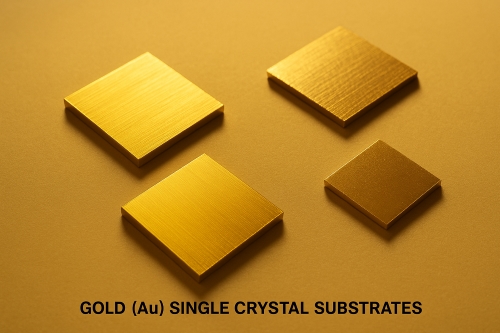
Material Properties of Gold Single Crystals
Gold single crystals are characterized by their purity and uniformity, high in fact. Their atoms are arranged in a neat order. They have very good electrical conductivity. Their surface is stable in the air and resistant to corrosion. The plane surface of a single crystal is precious. Some experiments rely on such a surface to analyze minor changes on a molecular scale. For example, precise electric properties contribute to sensor technology. Scientists may use single crystals of gold to measure reaction rates. They have a work function and surface energy that is well known and can be easily determined.
Fabrication and Preparation Techniques
Preparation of single crystal gold substrates is a careful process. First, gold of high purity is grown with special procedures. Large areas of single crystal surfaces are created with crystal growth methods. The substrate is then cut and polished. Mechanical polishing is utilized to obtain an atomically flat surface. Chemical etching, at times, helps further refine the surface. Scientists use techniques like thermal annealing with a view to reducing defect density. These procedures ensure that the gold single crystal has a very smooth and level surface for experiments.
A: Applications of Surface Science and Catalysis
Gold single crystal substrates are utilized in surface science. Their atomically flat surfaces allow chemical reactions to be observed. Scientists set up experiments based on these substrates to investigate reaction kinetics. Gold is inert but can be employed to support catalytic reactions when a minute quantity of another metal is mixed with it. Therefore, gold crystals have been used to research oxidation and reduction. Single crystal surfaces, for example, have been combined with platinum or palladium in an effort to improve catalytic effects. Engineers find these substrates useful as they allow one to observe clearly where reactions begin and how fast they propagate.
B: Uses in Nanotechnology and Plasmonics
Gold single crystal substrates have a key position in nanotechnology. They provide an ideal support for the growth of nanomaterials. Thin films or nanoparticles can be deposited on the surface with no interference from grain boundaries. High conductivity of gold supports the creation of sensitive nano devices. Surface plasmon effect is also improved with the substrate. In plasmonics, free metal electrons are involved in interaction with waves of light to create strong fields. Researchers make use of the effect to improve sensors and optical devices. Ordered gold surface ensures uniform plasmonic responses. Uniformity is helpful while creating devices at extremely small scales.
C: Applications in Quantum and Electronic Devices
Gold single crystal substrates find application in quantum experiments and electronic devices. Their uniform electric properties render them beneficial in this area. Researchers use them as electrodes in quantum transport experiments. The reduction of noise in electronic measurements is made possible due to the clean and uniform surface. In device fabrication, the substrates guide thin film and nanowire growth. The high conductivity renders it suitable to carry signals within small circuits. In the majority of cases, a gold single crystal electrode will show more stable performance than a polycrystalline material electrode if precise control is in demand.
Comparison with Polycrystalline and Other Metal Substrates
Polycrystalline substrates have also various properties compared to gold single crystal substrates. Polycrystalline gold, for instance, comprises many small grains. Grains also create boundaries that can disrupt electron flow. An irregular surface can also affect the outcome of a chemical reaction. But a gold single crystal has no grain boundaries. Its homogeneous nature leads to more reproducible measurements.
The other metal substrates may also have similar crystal defects. Silver and copper, for example, are viable options but are often afflicted with oxidation or compromised stability. Gold single crystals are preferred by engineers in situations where accuracy and durability are essential. Gold also enjoys a further benefit from the simplicity of chemical treatment.
Conclusion
Gold single crystal substrates enjoy multiple benefits for both scientific research and daily use. Their clear-cut atomic structure gives unambiguous information about surface science and catalysis. They enable the formation of nanostructures and increase plasmonic effects in optical devices. Their smooth electrical characteristics also have use in quantum and electronic devices. Gold single crystals, unlike their polycrystalline counterparts, possess a clean and well-behaved surface. The reproducibility of the surface is vital for reproducible outcomes from experiments. These substrates continue to be a favorite tool in the hands of researchers, engineers, and technologists.
Frequently Asked Questions
F: Why are gold single crystal substrates used for surface science?
Q: They are used to examine surface reactions and determine chemical and physical changes with high accuracy.
F: In what ways are gold single crystal substrates different from polycrystal substrates and why are they used?
Q: Single crystals have a smooth boundary-grain-free surface, providing more consistent experimental outcomes.
F: Can gold single crystal substrates increase electronic device performance?
Q: Yes, their consistent electrical characteristics reduce noise and improve stability in electronic measurements.
 Chin Trento