Products
 Bars
Bars
 Beads & Spheres
 Bolts & Nuts
 Crucibles
 Discs
Discs
 Fibers & Fabrics
 Films
Films
 Flake
Flake
 Foams
Foams
 Foil
Foil
 Granules
 Honeycombs
 Ink
Ink
 Laminate
 Lumps
Lumps
 Meshes
 Metallised Film
 Plate
Plate
 Powders
 Rod
Rod
 Single Crystals
 Sputtering Target
 Tubes
Tubes
 Washer
 Wires
Wires
 Converters & Calculators
 Write for Us



Advantages and Disadvantages of Aluminum Nitride Single Crystal Substrates

Introduction
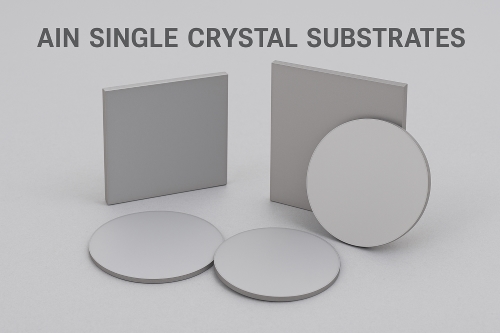
Aluminum nitride single crystal substrates have gained attention in advanced electronics and engineering fields. I have worked with these materials for many years. They have unique properties. They are not used by everyone. Today we will discuss their structure, advantages, disadvantages, and how they compare with other substrates.
Structure and Properties
Aluminum nitride (AlN) single crystal substrates feature a well-ordered hexagonal lattice. They offer outstanding thermal conductivity—typically between 200 and 300 W/m·K—making them ideal for heat management in high-power electronics. AlN also boasts high dielectric strength (often exceeding 10 kV/mm) and excellent dimensional stability. With a low thermal expansion coefficient (~4.5–5.0 ppm°C), these substrates perform reliably across temperature variations, supporting precision in advanced electronic applications. For more specific data, please check the table below.
|
Property |
Typical Value |
|
Crystal Structure |
Wurtzite (Hexagonal) |
|
Lattice Constant (a) |
3.112 Å |
|
Lattice Constant (c) |
4.982 Å |
|
Thermal Conductivity |
~285 W/m·K (RT, single crystal) |
|
Thermal Expansion Coefficient |
4.2–5.3 ×10⁻⁶ /K |
|
Dielectric Constant (εᵣ) |
~8.5–9.0 (at 1 MHz) |
|
Dielectric Loss (tan δ) |
< 10⁻³ |
|
Bandgap |
~6.2 eV |
|
Refractive Index (n) |
~2.1–2.2 |
|
Hardness |
~11 GPa |
|
Density |
3.26 g/cm³ |
|
Electrical Resistivity |
>10¹⁴ Ω·cm |
|
Melting Point |
~2,800 °C (sublimes) |
|
Orientation Available |
c-plane (0001), a-plane (11-20), m-plane (10-10) |
Advantages of Aluminum Nitride Single Crystal Substrates
There are several advantages of using this material.
First, its excellent thermal conductivity helps keep components cool. This property is essential in devices with high power demand.
Second, the substrate has a high dielectric constant and a low loss tangent. This means that signals pass with minimal interference.
Third, its high breakdown voltage makes it suitable for high-frequency and high-voltage applications.
Fourth, the stable thermal expansion and crystalline uniformity prevent structural issues in layered devices. These factors reduce the risk of device failure. Their properties are a great help in industries such as telecommunications and microwave engineering.
Limits of Aluminum Nitride Single Crystal Substrates
However, there are some drawbacks. Production is costly. The method of producing single crystal substrates is delicate and requires accurate control. Additionally, the growth rate is low and can have the possibility of producing defects if everything is not ideal. Some batches may differ slightly in quality. Another drawback is mechanical brittleness. While aluminum nitride is robust in thermal and dielectric contexts, it is brittle when subjected to mechanical stress. This renders processing more difficult when it is produced. Furthermore, the small substrate sizes now available make mass applications less frequent. These aspects can hamper mass application despite the material's technical attractiveness.
Comparison with Other Substrates
In contrast to other substrates, aluminum nitride single crystal substrates both possess strengths and weaknesses. Silicon carbide substrates also possess high thermal conductivity. They are likely to be less expensive but more prone to signal passage loss. Sapphire substrates are mechanically robust and optically transparent; however, their dielectric properties may be less competitive. Aluminum nitride substrates play a niche in which high thermal performance and dielectric strength are both needed at the same time. While each type of substrate has its limitations, the aluminum nitride single crystal substrate is utilized when heat dissipation and reliable electrical performance are paramount.
Applications of Aluminum Nitride Single Crystal Substrates
These substrates have been used in many real-world applications.
High-power transistors and radio frequency components use aluminum nitride to manage heat effectively. Many companies in the power electronics field choose them for their robust dielectric performance.
They are also applied in LED devices where thermal management is critical to prolong device life. In microwave circuits, the low dielectric loss ensures that high-frequency signals retain their strength. In one case, a power amplifier was built using an aluminum nitride substrate, and it showed superb signal stability and heat dispersion.
Each of these applications benefits from the material's superior thermal and electrical properties.
Conclusion
Aluminum nitride single crystal substrates come with many benefits. Their high thermal conductivity, excellent dielectric properties, and stable performance under temperature stress make them a favorite for high-power applications. At the same time, high production costs and mechanical fragility present challenges. For more information, please check Stanford Advanced Materials (SAM).
Frequently Asked Questions
F: What is the strongest benefit of aluminum nitride single crystal substrates?
Q: High thermal conductivity and excellent dielectric performance.
F: How does aluminum nitride compare with silicon carbide substrates?
Q: It has lower dielectric losses but is more expensive and brittle.
F: Are aluminum nitride substrates used in high-power electronics?
Q: Yes, they are widely used in high-power and radio frequency devices.
 Chin Trento